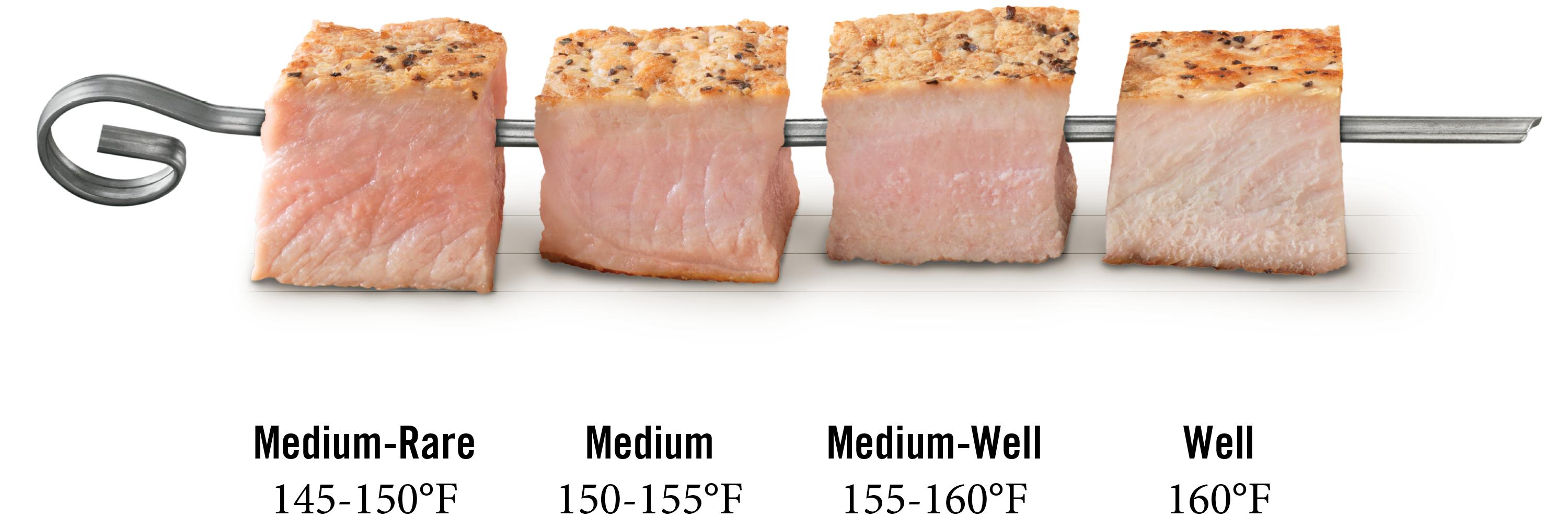
Stop killing your pork chops. Seriously. Most people grew up in households where a pork loin wasn't considered "safe" unless it had the texture of a recycled radial tire and the moisture content of the Sahara. We can thank our grandparents for this, or rather, the very real fear of Trichinella spiralis that loomed over mid-century kitchens. But things changed. In 2011, the USDA fundamentally shifted the goalposts for the correct temperature for pork, lowering the recommended internal temp for whole cuts from 160°F to 145°F. That 15-degree difference is the gap between a succulent, blushing piece of meat and a dry, flavorless tragedy.
If you’re still aimlessly poking at a roast with your finger or, worse, cutting into it to "see if the juices run clear," you’re doing it wrong. Clear juices are a myth. Color is a liar. The only thing that matters in the modern kitchen is a calibrated digital thermometer.
The 145 Degree Revolution
For decades, the "magic number" was 160°F ($71°C$). This was a safety blanket. The logic was simple: kill everything. The problem is that at 160°F, the protein fibers in pork contract so tightly they squeeze out every drop of intracellular moisture. You’re left with "The Other White Meat" marketing from the 80s—lean, mean, and incredibly boring.
When the USDA revised its guidelines, it wasn't just being trendy. Modern farming practices have virtually eliminated trichinosis in commercial pork. Nowadays, the risk is almost non-existent in the US food supply. By hitting 145°F ($63°C$) and allowing for a mandatory three-minute rest, you achieve the same level of pathogen lethality as the old, higher temperature.
Wait. The rest period is non-negotiable.
During those three minutes, the temperature actually continues to rise—a phenomenon called carryover cooking—and the heat levels out across the meat. More importantly, the muscle fibers relax, allowing those precious juices to redistribute. If you cut it the second it hits 145°F, all that flavor ends up on your cutting board. Nobody wants a soggy cutting board and dry meat.
Not All Pork is Created Equal
Here is where it gets kinda tricky. While a pork chop or a tenderloin thrives at 145°F, try cooking a pork shoulder (Boston butt) to that temperature and you’ll be chewing until 2027. It’s about collagen.
Whole muscle cuts like chops, roasts, and loins are lean. They don't have much connective tissue. These are the ones you want at that medium-rare to medium range. A little pink in the middle is not just okay; it's actually preferred by chefs.
Ground pork, however, is a different beast entirely. Because the grinding process spreads surface bacteria throughout the meat, you absolutely must hit 160°F for sausages and burgers. No exceptions. No "medium-rare" pork burgers unless you really enjoy gambling with foodborne illness.
Then you have the "low and slow" cuts. These are the workhorses of BBQ. Pork shoulder and ribs are packed with tough connective tissue and fat. To melt that collagen into silky gelatin, you need to push way past "done." We’re talking 195°F to 205°F ($90°C$ to $96°C$). That’s the "pull apart" zone. At 145°F, a shoulder is technically safe to eat, but it will be tough as a boot.
Why Your Thermometer Might Be Lying
You bought a cheap analog thermometer at the grocery store. It has a big round face and a red needle. Throw it away.
Honestly, those dial thermometers are notoriously inaccurate and take forever to register a reading. By the time the needle stops moving, your pork loin has jumped five degrees. You need a digital instant-read thermometer. Brands like Thermoworks (specifically the Thermapen) are the industry standard for a reason. They give you a reading in two seconds.
Accuracy matters because the window for the correct temperature for pork is surprisingly small. At 145°F, it's perfect. At 155°F, it's starting to get tough. At 165°F, you might as well be eating cardboard.
Pro Tip: The Carryover Calculation
If you want your pork to finish at 145°F, you should actually pull it off the heat when the thermometer reads 140°F.
- Large roasts: Pull 5-7 degrees early.
- Standard chops: Pull 2-3 degrees early.
- Small medallions: Pull right at the finish line.
The thermal mass of a large roast means it holds a lot of energy. Even after you take it out of the oven, the exterior—which is much hotter than the center—will continue to push heat inward. If you wait until the center hits 145°F while it’s still in the oven, it’ll likely coast up to 152°F or higher while resting. You’ve just overcooked your dinner by accident.
Regional Nuances and Expert Opinions
J. Kenji López-Alt, author of The Food Lab, has spent more time than most humans thinking about the cellular structure of meat. He notes that the 145°F recommendation is actually quite conservative. In a controlled environment, pork held at 140°F for a specific amount of time is just as safe as pork flashed to 145°F. However, for the home cook, sticking to 145°F provides a necessary margin of error.
Interestingly, different cultures have different tolerances for pink pork. In many parts of Europe, particularly France and Germany, pork is frequently served à point—just at the point of being cooked, which often looks quite pink. In the US, we are still shaking off the "gray meat" era.
If you're cooking for guests who are squeamish about pink meat, don't argue with them. Just cook theirs to 150°F. It’ll be slightly drier, but they’ll be happier. But for yourself? Trust the science. Trust the 145.
Common Mistakes to Avoid
- Checking the temperature near the bone: Bone conducts heat differently than muscle. If your probe touches the bone, you’ll get a false high reading. Aim for the thickest part of the meat, away from fat or bone.
- Ignoring the thickness: A thin 1/2-inch grocery store chop will overcook in a heartbeat. You can't even really use a thermometer on those effectively. Buy thick-cut chops (at least 1 to 1.5 inches) if you want to hit that perfect temperature.
- Cold Meat: Taking pork straight from the fridge to a hot pan causes the outside to char before the inside even thinks about getting warm. Let it sit out for 20-30 minutes. It makes a difference.
The Science of Tenderness
Why does the temperature matter so much? It's all about myosin and actin, the primary proteins in meat. Myosin begins to denature around 104°F, which is when the meat starts to firm up. Actin denatures at higher temperatures, around 150°F. When actin denatures, it forcefully squeezes out moisture. This is why 145°F is the "sweet spot"—you've denatured the myosin for a pleasant chew, but you haven't yet nuked the actin, so the water stays inside the cells.
If you go to 160°F, you are essentially wringing out the meat like a wet sponge. No amount of sauce can fix that.
Putting It Into Practice
Next time you're at the store, grab a thick-cut, bone-in pork chop. Season it heavily with salt and pepper. Sear it in a cast-iron skillet with a bit of oil until it’s got a deep, golden-brown crust. Flip it.
Start probing.
When that digital display hits 140°F, pull it. Set it on a warm plate. Walk away. Go make a salad. Set the table. Talk to your family. Do anything except touch that meat for five minutes. When you finally cut into it, you’ll see a faint, rosy hue. It’ll be juicy. It’ll actually taste like something. You'll realize that the correct temperature for pork isn't just a safety guideline; it's a culinary revelation.
Your Pork Temperature Cheat Sheet
- Loin, Tenderloin, Chops: 145°F ($63°C$) + 3-minute rest.
- Ground Pork (Sausage, Burgers): 160°F ($71°C$). No rest required for safety, but good for juice.
- Fresh Ham (Raw): 145°F ($63°C$).
- Pre-cooked Ham (Reheating): 140°F ($60°C$).
- Shoulder / Ribs (BBQ): 195°F-205°F ($90°C$-$96°C$) for collagen breakdown.
Actionable Next Steps
- Verify your equipment: Perform an ice-water test on your current thermometer. Fill a glass with crushed ice and a little water; it should read exactly 32°F ($0°C$). If it’s off by more than two degrees, replace it with a high-quality digital instant-read model.
- Buy thick: The next time you cook pork chops, ask the butcher for a "double-cut" chop (at least 1.5 inches thick). This thickness provides a larger thermal window, making it much easier to pull the meat at exactly 140°F-142°F for a perfect 145°F finish.
- Practice the rest: Commit to a timer. Don't eyeball the resting period. Physically set a timer for 5 minutes for chops and 15 minutes for larger roasts to ensure the fibers relax and the carryover cooking completes its cycle.