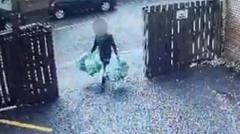
You wake up, walk outside your property, and there it is. Seven massive bags of household garbage, leaking slime onto the pavement. Someone decided your wall was their local dump. It's frustrating, it's disgusting, and if you live in the UK, it's probably a regular Tuesday.
Most people call the local council. You wait on hold, file a report online, and weeks later, nothing happens. Or worse, if you manage a private property, the council tells you it's your financial problem to clean it up.
That's exactly what Dean Gauci faced while maintaining a block of flats in Cardiff. Instead of paying a private waste removal service or begging the local authorities to look at it, he took matters into his own hands. He hunted down the culprit using closed-circuit television (CCTV) footage, walked the trash straight back to the offender's front door, and dumped it on his porch.
It's the ultimate revenge story. But it also highlights a massive, broken system that turns regular citizens into garbage detectives.
The Cardiff Confrontation That Went Viral
Gauci runs Stay Care Operations Ltd, a maintenance company managing short-term rentals and flats. Finding garbage illegally dumped on his managed properties wasn't a novelty. He notes this was easily the 30th or 40th time people had used the spot as a personal landfill.
Instead of swallowing the disposal cost or charging the landlord, Gauci went to work.
First, he went through the bags by hand. The fly-tipper had peeled the address labels off Amazon boxes inside the sacks, proving the act was completely premeditated. He knew he was breaking the law and tried to cover his tracks.
Next, Gauci pulled the building's security camera footage. He spent hours sifting through video until he found the exact moment. At 9:00 AM on a Friday, a man was caught on camera hauling the seven heavy bags across the street and dropping them by the flats.
Armed with a clear image of the guy's face, Gauci didn't call the police. He showed the footage to three different neighbours on the street. Within minutes, someone recognized the culprit. He lived just ten houses up on the exact same road.
Gauci loaded the seven leaking bags of waste, marched up the street, and piled them high against the culprit's front door. Then he rang the bell.
When the man opened the door to face a wall of his own garbage and a camera phone, his excuse was painfully weak. "I was going to move this, sorry mate," he muttered.
Why the Official System Invites Vigilante Justice
You might wonder why Gauci didn't just hand over the video footage to Cardiff Council. To understand that, you have to look at the sheer scale of the fly-tipping crisis across the UK and the abysmal prosecution rates.
According to data from the Department for Environment, Food and Rural Affairs (DEFRA), local authorities in England alone deal with over one million fly-tipping incidents every single year. Clearing this waste costs taxpayers tens of millions of pounds annually. Yet, the chances of a fly-tipper actually facing a court conviction are less than 1%.
Most councils rely on fixed penalty notices (FPNs), which are essentially small fines. But tracking down the offenders takes time and resources that local councils simply don't have. If a camera captures a license plate, there's a chance. If it just captures a person walking down the street with a bag, the council file is closed immediately.
Property managers and landowners face a brutal double standard under current UK environmental laws:
- If someone dumps waste on public land, the council pays to clear it using taxpayer money.
- If someone throws that exact same pile of waste over your private fence, it becomes your legal responsibility.
- Failing to clear waste from your own private land can actually result in the council prosecuting you for keeping a messy property.
When the law treats the victim like the criminal, citizen retaliation like Gauci's becomes inevitable.
The Fine Line Between Karma and Criminal Charges
While the internet cheered Gauci's "taste of his own medicine" approach, taking matters into your own hands carries severe legal risks. If you plan to pull a similar stunt, you need to understand where the law stands.
Technically, when Gauci moved the garbage from his property back to the offender's doorstep, he committed an act of fly-tipping himself under section 33 of the Environmental Protection Act 1990. The law doesn't care who originally bought the items inside the bag. It only looks at who deposited the waste on land without a proper environmental permit.
If the culprit had been spiteful enough to call the police or report Gauci to Cardiff Council, Gauci could have faced a fixed penalty notice or a criminal charge.
Then there is the issue of filming. Recording someone on a public street is generally legal in the UK. However, marching onto private property, filming through an open door, and publishing the footage online can trigger civil lawsuits regarding harassment or data protection violations under UK GDPR guidelines.
Gauci got away with it because the culprit knew he was dead to rights and felt too stupid to argue. But confronting an unknown criminal at their home can easily escalate into physical violence.
How to Protect Your Property Without Breaking the Law
If your property is a constant target for illegal waste dumping, you don't have to sit back and take the financial hit. You can fight back using legal frameworks that actually stick.
Upgrade Your Security Placement
Standard security cameras often sit too high, capturing only the tops of baseball caps or blurry heads. Position at least one camera at eye level, secured inside a vandal-proof casing. Ensure the camera resolution is high enough to read car registration plates at night, as most commercial fly-tippers operate under the cover of darkness.
Use Warning Signage Correctly
A simple "CCTV in Operation" sign isn't just a deterrent; it is a legal requirement if your cameras capture public pathways. Under Information Commissioner's Office (ICO) rules, clear signage makes your video footage admissible as evidence if you hand it over to the local authorities or environmental agencies for prosecution.
Report with Bulletproof Evidence
If you catch someone in the act on camera, do not just send a vague email to your local council. Build a proper evidence log. Include the exact time, date, vehicle registration, and high-definition stills of the person's face. File the report through official government portals or specialized apps like ClearWaste, which track council response times and push for investigations.
Secure the Perimeter
Fly-tippers look for easy targets—dark alleys, low walls, and recessed doorways. Installing bright, motion-activated LED lighting is often enough to make a criminal drive past your property to find an easier target. Defensive landscaping, like planting thick, thorny bushes along a vulnerable boundary wall, cuts off access entirely.
The reality is that municipal enforcement isn't keeping pace with the scale of the problem. While dumping seven bags of garbage back on a neighbor's porch makes for a satisfying viral video, building an ironclad electronic trail is the safest way to force local authorities to issue the heavy fines these offenders deserve.
Man catches fly-tipper in the act and gets instant revenge
This video captures a remarkably similar confrontation where a resident catches a local litter lout on camera and drops the waste right back to their front door.