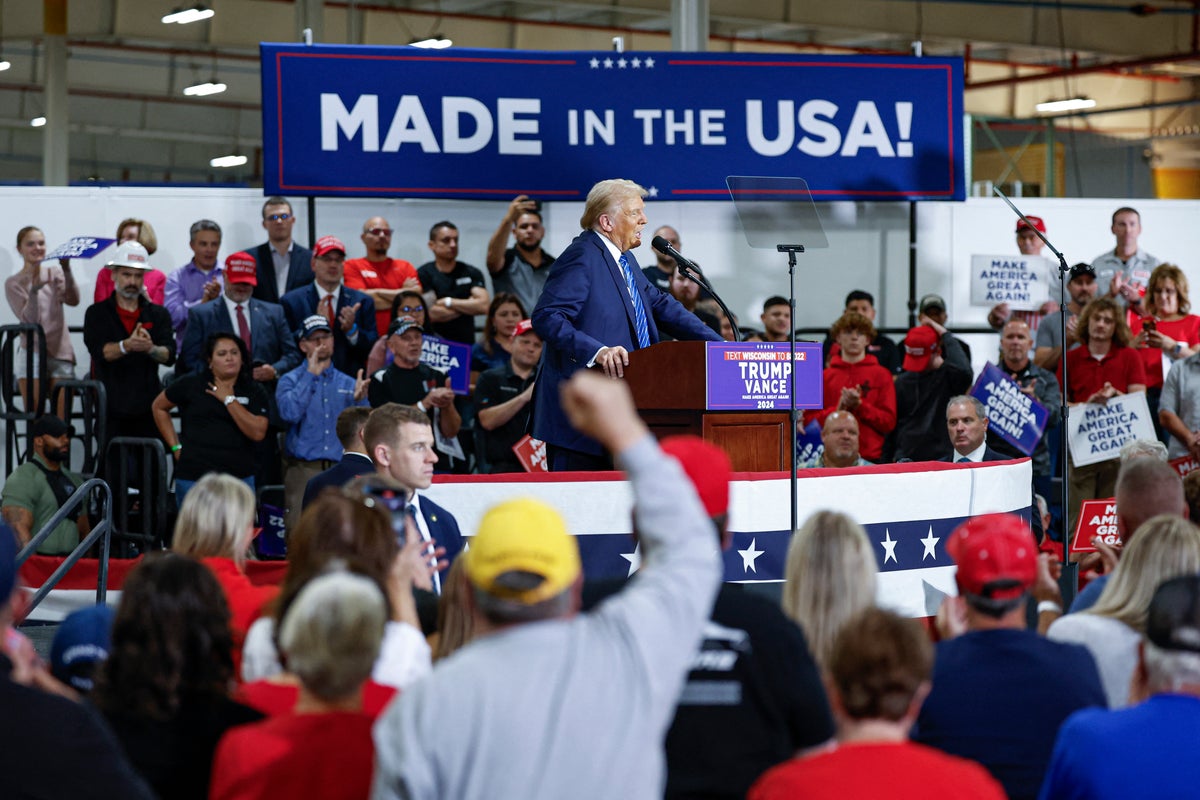
The traditional political press corps has descended on Pennsylvania once again, dragging out the exact same tired script they have used for decades. The boilerplate narrative is entirely predictable: a candidate visits a diner in Scranton or a factory floor near Erie, and reporters declare that voters are weighing macro-level inflation metrics against historical political baggage.
It is lazy journalism. It misses the fundamental mechanism of how the modern working-class economy operates.
The mainstream consensus insists that swing-state voters act like amateur econometricians, obsessing over federal interest rates and annualized consumer price index fluctuations. They do not. Having spent fifteen years analyzing regional capital flows and supply chain data, I can tell you that the national economic conversation is completely disconnected from regional realities. The working class does not care about federal rate cuts; they care about local credit availability and the fact that their regional employers are getting squeezed by structural shifts that no standard political speech can fix.
The Myth of the Flatline Inflation Metric
Pundits love to scream about national inflation percentages because a single, sweeping number fits neatly on a cable news graphic. But treating inflation as a uniform, nationwide blanket is a fundamental mistake.
Price pressures are localized and asymmetrical. In Pennsylvania, the cost of living crisis isn't driven by a generalized macroeconomic calculation. It is driven by the hyper-concentration of specific regional monopolies.
Consider logistics and energy. When national analysts talk about rising costs, they point to global oil benchmarks. But if you look at the actual operational balance sheets of mid-sized manufacturers in the Lehigh Valley, their pain point isn't the price of crude. It is the skyrocketing cost of regional warehousing, local utility distribution fees, and localized commercial real estate speculation.
The national press reports on the economy as if a voter in Pittsburgh experiences the same financial pressures as a tech worker in Austin or a real estate agent in Miami. By averaging these realities together, the media creates a fictional data point that represents absolutely no one.
The Political Amnesia of Factory Floor Photo-Ops
Politicians from both major parties love the optics of heavy industry. They put on hard hats, stand in front of pristine steel beams, and promise a resurgence of blue-collar manufacturing. It is pure theater.
The hard truth nobody admits is that the nature of industrial employment has structurally decoupled from local headcount. The automated facilities driving current output require advanced technicians, not massive assembly lines of manual laborers. When a politician promises to "bring back the jobs," they are promising a nostalgia that directly contradicts modern industrial efficiency.
I have watched mid-market manufacturing companies invest millions into automation to survive rising domestic input costs. The output goes up, but the local payroll shrinks. A candidate standing on a warehouse floor promising a 1970s-style employment boom is either deeply ignorant or intentionally misleading. The media plays along because a crowded factory floor makes for a better photograph than a silent, automated cleanroom managed by three engineers.
Stop Asking if the Economy Is Good or Bad
If you want to understand the electorate, you have to stop asking the fundamentally flawed question: "Is the economy working?"
The premise itself is broken. The economy is not a single engine that works or fails; it is a system of wealth extraction that works perfectly for specific asset classes while leaving others behind.
People Also Ask: When will prices return to normal?
The brutal reality is that they will not. Prices do not go backward without a catastrophic economic depression. Deflation is a nightmare scenario for capital markets, meaning federal fiscal policy is expressly designed to prevent prices from dropping. The real issue isn't the nominal price of goods; it is the stagnating velocity of local wages relative to corporate profit margins.
Instead of waiting for a statistical reset that is never coming, businesses and workers have to adapt to a permanently higher cost floor. For a mid-sized business owner in Pennsylvania, this means stopping the wait-and-see game on interest rates. Relying on short-term debt to bridge operational inefficiencies under the assumption that capital will become cheap again next year is a fast track to insolvency.
The Real Crisis Is Regional Credit Contraction
While the media obsesses over federal interest rates, the true threat to the Rust Belt economy is happening behind closed doors at regional and community banks.
When national interest rates remain high, smaller financial institutions face a severe liquidity squeeze. They are forced to tighten their underwriting standards aggressively. This does not merely make loans more expensive—it cuts off credit lines entirely for the very businesses that form the backbone of swing-state economies.
- The Micro-Enterprise Squeeze: Small machining shops, regional distributors, and local construction firms cannot access capital to modernize or expand.
- The Consolidation Trap: As local businesses lose access to credit, they become easy targets for private equity firms that buy them out, strip their assets, and centralize operations elsewhere.
- The Downside of My Approach: Acknowledging this reality means admitting that a simple change in the White House or a minor adjustment by the Federal Reserve will not fix the structural decline of local banking ecosystems. It requires painful, long-term regulatory restructuring, not a quick-fix executive order.
The national political narrative completely ignores this credit crunch because explaining fractional reserve lending and regional bank capital requirements does not generate easy clicks. It is much easier to write a story about a voter who is angry about the price of eggs.
Dismantling the Myth of the Swing-State Economic Savior
Both political platforms rely on the illusion of executive control. One side promises that targeted tariffs and protectionism will magically revitalize dead industrial corridors. The other side claims that federal subsidies for green infrastructure will create an overnight economic renaissance.
Both claims are false.
Global supply chains are far too complex and rigid to be re-engineered by a handful of tariffs. When you slap a tariff on foreign inputs, you don't instantly create a domestic supplier; you simply increase the material costs for the domestic manufacturers who rely on those components to build their final products.
Similarly, federal infrastructure spending moves at a glacial pace, frequently trapped in years of bureaucratic red tape and litigation before a single shovel hits the dirt. The idea that a massive federal bill passed in Washington translates into immediate, sustainable local prosperity is a fiction designed for campaign ads.
The economic trajectory of states like Pennsylvania is driven by demographic shifts, global energy markets, and the pace of technological automation—forces that are largely immune to whoever happens to be sitting in the Oval Office.
Stop looking at the campaign trail for economic salvation. Stop treating the national financial press as an accurate reflection of your local reality. The corporate media will continue to cover the election as a shallow horse race fueled by oversimplified statistics, entirely blind to the actual mechanics of regional survival.
Examine the credit lines of your local banks. Look at the capital expenditures of your regional employers. Track the automation of your local industries. That is where the real story lies, and no politician visiting a diner is going to tell it to you.


