The introduction of a dedicated sensory room at Hong Kong International Airport (HKIA) represents more than a localized amenity update; it is a calculated response to the rising friction in global transit hubs caused by increasing neurodivergent passenger volumes. Modern aviation infrastructure is traditionally designed for high-efficiency throughput, utilizing harsh lighting, high-decibel acoustic environments, and complex spatial navigation—factors that function as stressors for individuals with invisible disabilities, including autism, ADHD, and sensory processing disorders. By formalizing a "sensory space," HKIA is attempting to re-engineer the passenger journey through a lens of physiological regulation, acknowledging that traditional terminal design creates a structural bottleneck for a significant portion of the traveling public.
The Tri-Modal Stress Response in Aviation Hubs
The efficacy of any sensory intervention must be measured against its ability to mitigate three specific environmental stressors inherent to airport design.
- Acoustic Saturation: Modern terminals rely on constant auditory signaling, from flight announcements to the mechanical hum of baggage carousels. For passengers with auditory processing sensitivities, this creates a state of chronic hyperarousal, leading to cognitive fatigue and decision-making degradation.
- Visual Hyper-Stimulation: The proliferation of digital signage and high-contrast retail environments creates an environment of visual clutter. This forces the brain into a continuous state of scanning and filtering, which is metabolically expensive for neurodivergent individuals.
- Proprioceptive Disorientation: Massive open-plan terminals often lack clear tactile or spatial boundaries. This lack of defined personal space can trigger anxiety in individuals who require predictable physical environments to maintain self-regulation.
HKIA’s new facility addresses these stressors by decoupling the passenger from the main terminal flow, providing a controlled environment where these inputs are artificially dampened or curated.
Structural Design and the Sensory Regulation Framework
The sensory room at HKIA is built upon a framework of environmental control, utilizing specific hardware and layout choices to provide "sensory escape hatches." The facility is categorized by its functional zones, each targeting a different neurological need.
The Low-Stimulus Zone
This area is designed for total sensory deprivation. By utilizing sound-dampening materials on walls and ceilings, the space achieves a lower decibel floor than the open terminal. The lighting is typically tunable, allowing users to shift from standard fluorescent temperatures to warmer, lower-lumen outputs. This serves as a "reset" mechanism for the nervous system, allowing the passenger to return to a baseline state before attempting the high-stress tasks of boarding and security screening.
The Interactive Feedback Zone
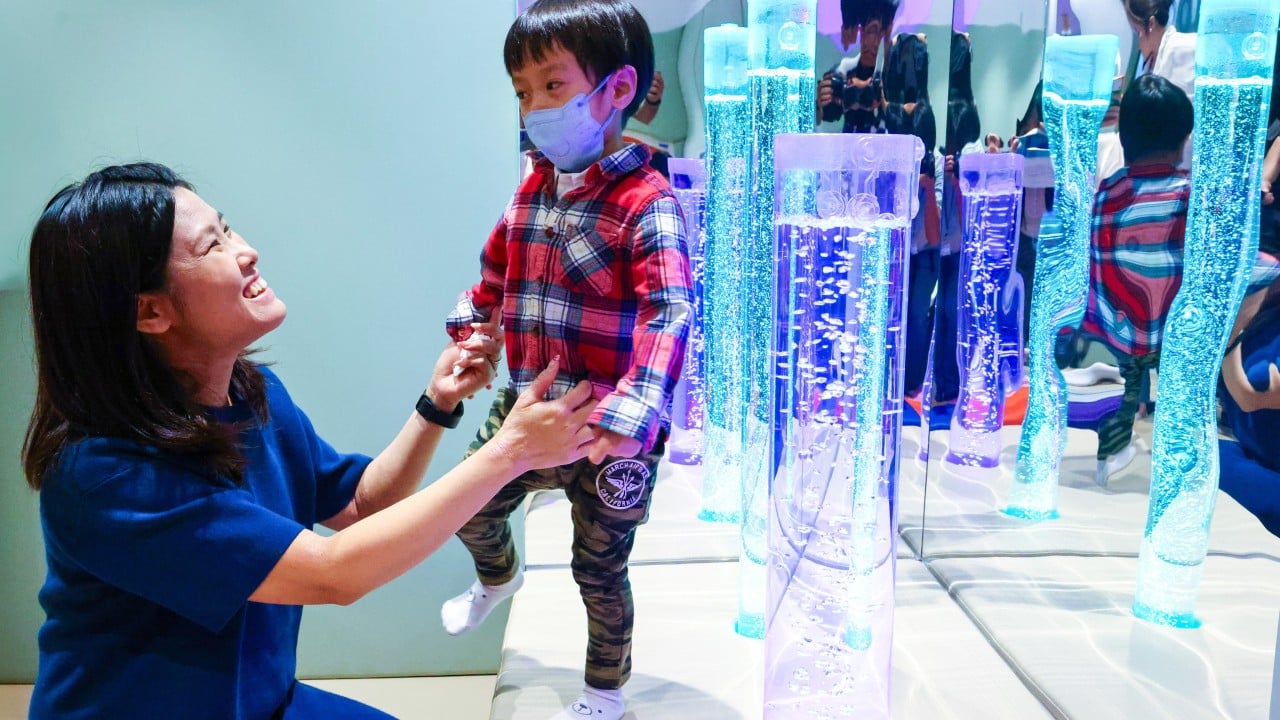
While some require deprivation, others require specific types of stimulation to self-regulate. HKIA integrates tactile elements and visual focal points, such as bubble tubes or fiber-optic installations. These tools provide predictable, rhythmic visual and tactile input. From a physiological standpoint, this encourages "grounding"—a process where the individual focuses on a singular, controlled stimulus to ignore the chaotic, uncontrolled stimuli of the broader airport.
The Transitional Buffer
The room acts as a physical buffer between the high-intensity airside environment and the enclosed, pressurized environment of the aircraft cabin. This transition is often where "meltdowns" or significant distress occur. By providing a mid-point for regulation, the airport reduces the likelihood of medical emergencies or passenger disturbances at the gate, which carries a direct operational cost in terms of flight delays and staff resource allocation.
The Economic and Operational Rationale
The development of such spaces is not merely an exercise in corporate social responsibility; it is a strategy to optimize operational flow. Invisible disabilities represent a growing segment of the travel market. When these passengers experience high levels of distress, the resulting operational friction manifests in several ways:
- Gate Delays: Passengers who are overstimulated may struggle with complex boarding instructions, leading to boarding queue stagnation.
- Customer Service Load: Frontline staff spend a disproportionate amount of time managing high-distress situations that could be prevented through environmental design.
- Security Throughput: Sensory overload often leads to non-compliance or slow responses during security screenings, reducing the overall efficiency of the checkpoint.
By providing a self-service regulation space, HKIA offloads the "regulation burden" from the airport staff to the infrastructure itself. This creates a more predictable passenger flow and reduces the volatility of the boarding process.
Identifying the Hidden Demographic: The Data Gap
A primary challenge in quantifying the success of these spaces is the "invisible" nature of the disabilities they serve. Unlike physical mobility aids, which are easily tracked via wheelchair assistance requests, neurodivergent needs are often self-managed and under-reported.
The mechanism for identifying these passengers at HKIA involves the "Sunflower Lanyard" scheme, a global standard that allows individuals to discreetly signal a need for additional support. However, reliance on this system creates a data bottleneck. The actual number of passengers who could benefit from a sensory room likely exceeds the number of lanyard wearers. For the airport to truly optimize this space, it must move toward a model of "Universal Design," where sensory-friendly principles are integrated into the main terminal rather than siloed in a single room.
Technical Limitations and Scalability Constraints
Despite the benefits, sensory rooms face several systemic limitations:
- Capacity vs. Demand: A single room in a hub as large as HKIA is a drop in the ocean. If demand exceeds capacity, the room itself becomes a source of stress as passengers queue for access.
- Proximity Friction: If a passenger is at a distant gate, the effort required to navigate back to the sensory room may outweigh the benefit of the room itself. The "cost of travel" within the airport becomes too high.
- Maintenance and Hygiene: Interactive sensory tools (tactile walls, bean bags) require high-frequency cleaning and maintenance to remain functional and sanitary, posing a recurring operational expense.
To overcome these, HKIA would need to move toward a decentralized model—implementing "Sensory Pods" or quiet zones at every gate cluster rather than a singular flagship facility.
Future Engineering of the Passenger Journey
The next phase of sensory inclusion will likely shift from physical rooms to digital and acoustic layering. We can hypothesize the integration of "Acoustic Wayfinding," where specific sound frequencies are used to guide passengers through the terminal, or the use of Augmented Reality (AR) to simplify complex signage for those with cognitive processing challenges.
The current sensory room is a necessary "V1" (Version 1.0) of a neuro-inclusive terminal. It validates the need but also highlights the limitations of treating inclusion as an add-on rather than a core design principle. For HKIA to maintain its status as a premier global hub, the logic of the sensory room—predictability, control, and sensory moderation—must eventually bleed out into the design of security checkpoints, immigration halls, and retail corridors.
The strategic play for airport operators is to move beyond the "amenity" mindset. The focus must shift toward a "Neuro-Inclusive Infrastructure" audit. This involves mapping the terminal’s decibel map, light-intensity map, and "decision-point density" to identify areas where the environment itself is failing the passenger. The sensory room at HKIA is the diagnostic tool proving that the rest of the terminal is currently too loud, too bright, and too complex for the modern demographic reality. Priority should be shifted toward decentralized sensory relief stations and the integration of dimmable, zonable lighting at every gate to ensure regulation is available at the point of need.