In 1661, Catherine of Braganza packed her silks and her expectations and sailed from Lisbon to London to marry King Charles II. She brought with her a dowry that changed the map of the world. Tucked among the chests of sugar and bags of gold was a deed to a cluster of seven swampy, fever-ridden islands on the western coast of India. The British Crown, at the time, was unimpressed. They saw a collection of mudflats and coconut groves plagued by the smell of rotting fish and the relentless humidity of the Arabian Sea. They saw a liability.
The King eventually leased the whole archipelago to the East India Company for a measly ten pounds of gold a year. It was a bargain for a wasteland.
But maps lie. They show static lines on paper, ignoring the violent, restless energy of the water and the people who refuse to be drowned by it. Bombay—now Mumbai—was never meant to be a city. It was a geographical accident forced into existence by sheer, stubborn human will.
The Wall Against the Tide
By the 1700s, the British realized they weren’t just fighting the Marathas or the Portuguese; they were fighting the moon. Every high tide, the sea surged through the narrow creeks between the islands, turning the roads into rivers and the homes into sodden ruins.
Imagine a merchant named Govind. He is a fictional composite, but his struggle was the reality for thousands. Govind moves his family from the mainland, lured by the promise of trade. He builds a small house near the fort. He wakes up at 3:00 AM to find his feet submerged in salt water. His grain is ruined. His children are coughing from the damp. He looks at the "city" and sees a fragmented jigsaw puzzle that doesn't fit together.
The British governor, William Hornby, looked at the same water and decided to defy his bosses in London. Without official permission, he began the Great Breach wall. He wanted to plug the gaps between the islands. He wanted to stop the ocean.
It was a project of insane proportions. Laborers spent decades hauling basalt rocks and pouring earth into the hungry mouth of the sea. The Hornby Vellard was more than a dam; it was the first heartbeat of a metropolis. By closing the breach between Worli and Malabar Hill, the British drained the central swamps. Suddenly, there was land where there had been only silt.
This wasn't a "strategic development plan." It was a war. Every inch of Mumbai is stolen property, taken back from the Arabian Sea one basket of dirt at a time.
The White City and the Black Town
As the mud dried, the walls went up. The Bombay Fort wasn't just a defensive structure; it was a psychological border. Inside the stone ramparts lay the "White Town"—orderly, paved, and echoing the architecture of London. Outside lay the "Black Town," a chaotic, vibrant, and suffocatingly crowded sprawl where the real work happened.
The stakes were invisible but lethal. If you lived inside the fort, you had the protection of the guns and the breeze. If you lived outside, you lived in the shadow of the cotton mills.
In the mid-19th century, the American Civil War broke out half a world away. It seems like a disconnected fact until you realize it was the catalyst that turned Bombay into a global titan. When American cotton exports stopped, the textile mills of Lancashire turned their desperate eyes toward India.
The city exploded. Money flooded in like the monsoon rains. The merchant princes—men like Jamsetjee Jeejeebhoy and David Sassoon—didn't just build businesses; they built the city’s bones. They funded hospitals, libraries, and the very ground people walked on. But for every palace built on Malabar Hill, ten thousand mill workers lived in "chawls"—cramped, single-room tenements where a dozen men shared a few square feet of floor.
The air smelled of raw cotton and sweat. The sky was permanently bruised by the smoke from the chimneys. This was the era of the "Cotton Mania," a speculative bubble that eventually burst, leaving many in ruin. But the infrastructure remained. The railways were laid. The telegraph lines hummed. The islands were no longer seven; they were becoming one.
The Great Erasure
The most ambitious transformation happened between 1817 and 1845 under the Colaba Reclamation Project. This wasn't just building a wall; it was a wholesale reshaping of the Earth.
Consider the sheer physical toll. Thousands of men and women carrying heavy stones on their heads in 40-degree heat. There were no hydraulic excavators. There was only the hammer, the chisel, and the human spine. They filled the "City of Seven Islands" until the water retreated, defeated. By the time the Causeway connected Colaba to the rest of the landmass, the geography of the archipelago had been erased.
The seven islands had vanished, replaced by a long, thin peninsula that reached out into the sea like a grasping hand.
The city became a pressure cooker. Because it was a peninsula, it couldn't grow outward; it could only grow upward or jam tighter together. This physical constraint birthed the unique character of the Mumbaikar. When you live in a city that is constantly trying to push you back into the ocean, you develop a certain grit. You learn to move faster. You learn to claim your two square feet of space on a local train with the ferocity of a soldier defending a trench.
The Ghost of the Fort
By the 1860s, the fort walls were a nuisance. They choked the growing city, preventing the flow of air and people. Governor Bartle Frere did something radical: he tore them down.
He didn't just remove the stones; he used them to build a new vision of the city. This was the birth of the Victorian Gothic skyline that defines Mumbai today. The High Court, the University, and the sprawling masterpiece of Victoria Terminus (now Chhatrapati Shivaji Maharaj Terminus) rose from the dust of the old fortifications.
Walking through South Mumbai today feels like walking through a dream of London viewed through a tropical lens. Gargoyles look down over palm trees. Stained glass filters the harsh Indian sun into soft blues and reds. It is a grand, theatrical mask worn by a city that, just a century earlier, was a fever dream of mud and malaria.
The Invisible Stakes of the Modern Sprawl
Today, the transformation continues, but the enemy has changed. The sea is rising again, reclaiming the edges. The modern "reclamations"—the Bandra-Worli Sea Link, the Coastal Road—are the descendants of Hornby’s wall. We are still throwing rocks at the ocean, hoping it stays quiet.
We often talk about Mumbai as a "city of dreams." It’s a cliché that hides the terrifying reality of its existence. Every person who steps off a train at Dadar station with a suitcase and a prayer is part of the ongoing reclamation. They are the human "fill" that keeps the city from collapsing.
The invisible stake is the cost of staying afloat. The cost is the commute—three hours a day in a metal box, breathing the exhaled air of four million other people. The cost is the constant, low-thrumming anxiety of the monsoon, wondering if the water will finally win this year.
Yet, no one leaves.
Why?
Because Mumbai is the only place where the geography of your birth matters less than the speed of your hustle. On the reclaimed land of Nariman Point, the billionaire and the chai-wallah breathe the same salt air. They are both standing on ground that wasn't there 200 years ago.
The city is a miracle of engineering, but it is a tragedy of space. It is a masterpiece of colonial ambition and an epic of indigenous endurance. We tend to think of cities as permanent fixtures of the landscape, like mountains or rivers. But Mumbai is a performance. It is a daily act of defiance against the Arabian Sea.
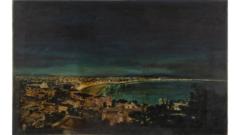
If you stand at Marine Drive at dusk, you can see the "Queen’s Necklace" glowing against the dark curve of the bay. It looks serene. It looks like it has always been there. But beneath the asphalt and the luxury hotels lies the ghost of a swamp. Beneath the roar of the traffic is the sound of the tide, waiting for a crack in the wall.
The seven islands are gone, but the water remembers. The city doesn't sleep because it can't afford to; if it stops moving, even for a moment, the sea might notice that the land it lost is still rightfully its own.
The lights of the skyline flicker, reflected in a sea that is forever reaching for the shore.