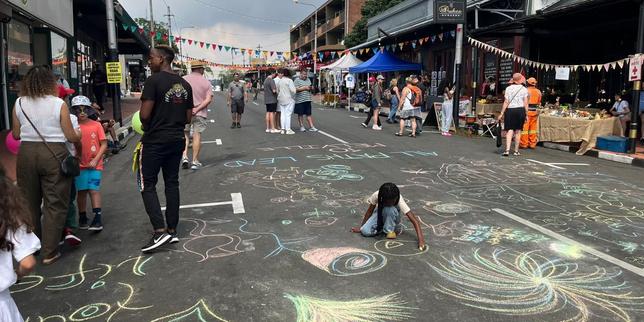
The narrative is always the same. A group of well-meaning activists paints a mural on a crumbling wall in Maboneng or Braamfontein. They put out some colorful chairs, organize a weekend "artisanal market," and claim they are "taking back the streets." The media swoons. They call it a grassroots revolution. They call it the "reappropriation of urban space."
They are wrong.
What they are actually doing is performing a slow-motion autopsy on a living city. By treating Johannesburg’s streets like a boutique social experiment rather than a brutal, high-velocity engine of commerce, these "urban pioneers" are suffocating the very energy they claim to protect. The romanticized version of Johannesburg—where streets belong to "the people" for leisure—is a middle-class fantasy that ignores the economic reality of the most unequal city on earth.
The Aesthetic Trap of Urbanism
The "citizen-led" movement in Johannesburg is obsessed with aesthetics. They want the city to look like a Pinterest board of a European capital. They talk about "walkability" and "pedestrianization" as if a few planters and a bike lane can solve the deep-seated structural rot of a city designed for segregation.
Here is the truth: Johannesburg was never meant to be pretty. It is a mining camp that got out of hand. It exists for one reason: to generate wealth. When you prioritize "vibrancy" and "community spaces" over the hard-nosed infrastructure of trade and transit, you aren't fixing the city. You are building a stage set for people who want to feel "edgy" without actually dealing with the friction of a real African metropolis.
I have spent a decade watching developers and neighborhood associations try to "curate" the street life of Jozi. They treat the informal economy—the hawkers, the taxi drivers, the "scavengers"—as a problem to be solved or a background texture to be photographed. In reality, those people are the street. The moment you "reappropriate" a street for a craft beer festival, you are displacing the actual economic lifeblood of the precinct.
The High Cost of Safe Spaces
The "citizen reclamation" crowd loves to talk about safety. They argue that by reclaiming the streets, they make them safer. This is a half-truth that hides a darker reality.
When a private residents' association or a Business Improvement District (BID) "takes back" a street, they aren't making the city safer. They are shifting the danger. They create bubbles of high-security luxury that push "undesirables" into the shadows of the next block over. This isn't urban renewal; it’s defensive architecture disguised as community building.
Security in Johannesburg has become a commodity. If you can afford to live in a "reclaimed" precinct, you buy the illusion of a functional state. But that illusion is fragile. It depends on private guards and surveillance tech that mimics the very apartheid-era spatial controls we claim to have moved past. By focusing on these tiny, hyper-local victories, we are giving the government a free pass. We are saying, "Don't worry about fixing the police or the power grid; we'll just hire our own guards and buy our own solar panels for this one specific street corner."
Why Walkability is a Luxury Good
Everyone loves a walkable neighborhood until they have to actually live in one that isn't subsidized by a massive security budget. The obsession with "pedestrian-friendly" zones in Johannesburg is fundamentally elitist.
In a city where the average commute for the working class involves two taxis and a two-hour journey from the periphery, "walkability" is a hobby for the wealthy. The people who actually need the streets to work are the ones moving goods, driving commuters, and running businesses. When we close roads for "people-friendly" zones, we increase the friction of commerce. We make it harder for the delivery guy, the taxi driver, and the small-scale trader to do their jobs.
We are importing urban planning theories from Copenhagen and applying them to a city with the DNA of a gold mine. It doesn't work. It creates "islands of excellence" surrounded by a sea of neglected infrastructure.
The Myth of the Creative Class
The competitor’s article likely mentions the "Creative Class" as the savior of the inner city. This is the ultimate urbanist delusion. Richard Florida, the man who popularized the term, has spent the last five years walking back his own theories because he realized they lead to hyper-gentrification and the destruction of the middle class.
In Johannesburg, the arrival of the "creatives" is the first sign of a neighborhood's impending death. They bring the coffee shops, then the galleries, then the property price spikes. Suddenly, the person who has lived in that neighborhood for forty years can’t afford the property taxes. The small workshop that actually made things—furniture, car parts, clothing—is replaced by a co-working space for people who "build brands."
We don't need more "concepts." We need more concrete. We need a city that functions for the person at the bottom of the ladder, not just the person at the top of the gallery list.
Stop Trying to Save the CBD
The most controversial truth that no one wants to admit is that the Johannesburg CBD might not be worth "saving" in its current form.
For thirty years, we have poured billions into "revitalizing" the city center. We have tried every trick in the book: tax incentives, city improvement districts, cultural precincts, and "citizen-led" clean-ups. And yet, the moment the private security guards go home, the "reclaimed" streets revert to chaos.
Why? Because the market has already moved on. The real Johannesburg—the one that actually generates the country’s GDP—is now in Sandton, Midrand, and the decentralized hubs of the north. Trying to force the CBD to become a trendy urban playground is like trying to turn a decommissioned battleship into a luxury yacht. It’s expensive, it’s inefficient, and it ignores the fundamental nature of the vessel.
The "citizens" who are "reappropriating" the streets are often just the last ones left who care about the old architecture. They are fighting a rear-guard action against entropy.
The Actionable Pivot: Embrace the Friction
If we actually want a functional Johannesburg, we need to stop trying to make it "nice." We need to start making it work. That means:
- Prioritize Logistics Over Aesthetics: Stop worrying about murals. Start worrying about loading zones, taxi ranks, and high-speed transit. A street that moves goods and people efficiently is a successful street, even if it’s ugly.
- Legalize the Informal: Instead of "reclaiming" streets for markets, we should be deregulating the streets for the people who are already there. Give the hawkers permanent stalls. Give the "waste pickers" a formal role in the city’s economy. Stop trying to polish them away.
- End the Security Bubbles: We need to stop allowing private associations to wall off public roads. If a street is public, it must be public for everyone—not just those who look like they belong in a craft gin bar.
- Tax the Vacancy: The biggest threat to Johannesburg isn't "crime and grime." It's speculative landlords who leave buildings to rot while waiting for the next "gentrification wave" to hit. We should be taxing empty buildings into oblivion until they are converted into high-density, low-cost housing.
The Harsh Reality
Johannesburg is a city of collision. It is loud, dirty, dangerous, and incredibly productive. When you try to "reclaim" its streets to make them peaceful and "livable," you are trying to kill the very thing that makes the city vital.
The people who live in the inner city don't need a "pocket park." They need a job. They need a functional bus system. They need a police force that isn't corrupt. They don't need "curated urban experiences."
Stop trying to fix the city by painting it. The streets of Johannesburg don't need to be "reclaimed" by citizens; they need to be unleashed by the government. Until we stop pretending that a weekend market is a substitute for a functioning state, we are just rearranging the deck chairs on the Titanic.
The "vibrant" street you see in the photos is a ghost. The real city is somewhere else, working, sweating, and ignoring your bike lanes entirely.
Stop romanticizing the struggle. Start demanding a city that actually works for the people who didn't choose to be "edgy," but were born into the friction.