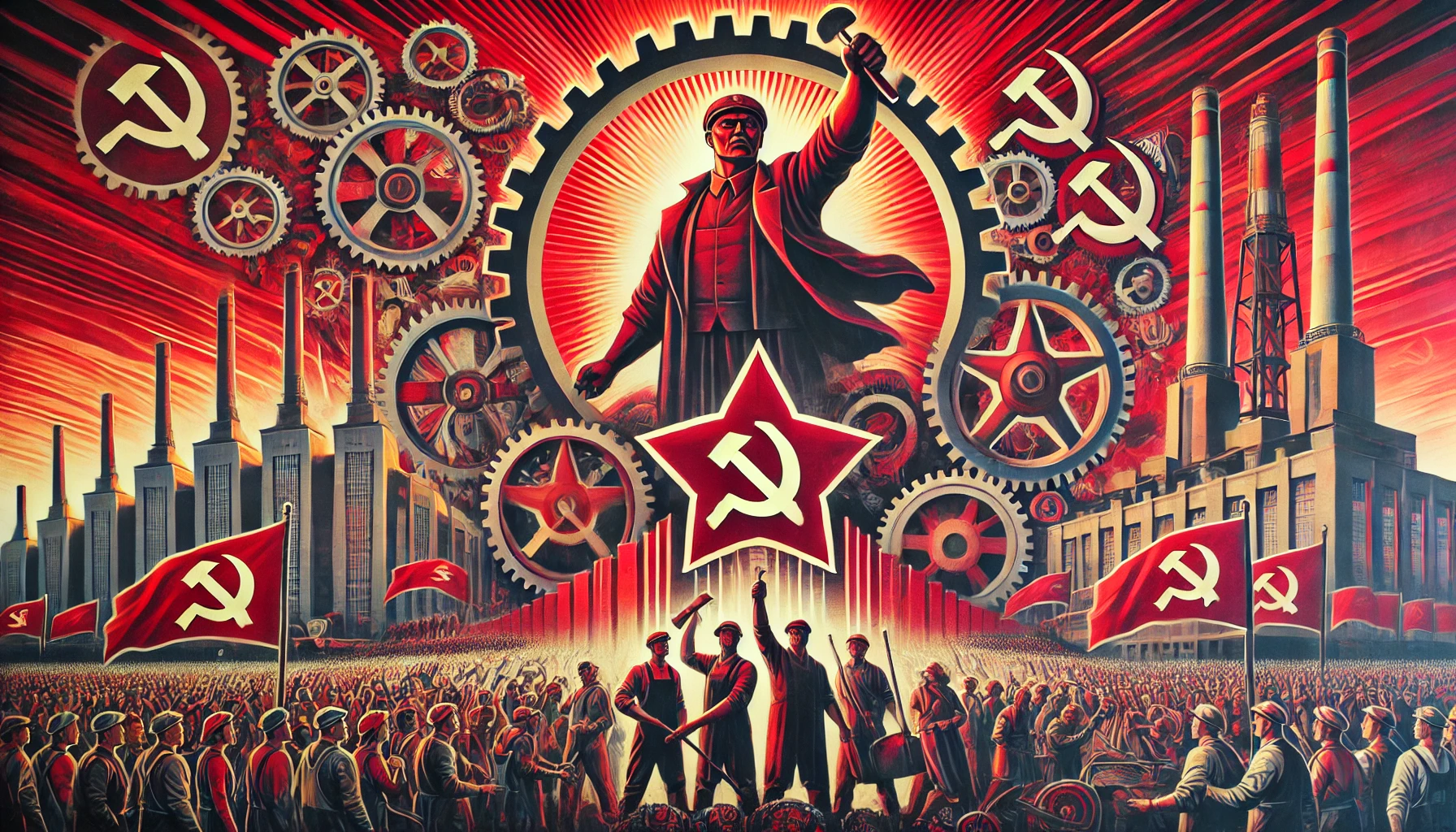
If you ask ten different people on the street to explain the meaning of communism, you’ll likely get ten wildly different answers. One person might talk about a gray, Soviet-style dystopia with bread lines and secret police. Another might describe a utopian dream where nobody has a boss and everyone gets a free house. A third person—probably a history buff—will start rambling about the spinning jenny and the Industrial Revolution in 19th-century Manchester. Honestly, it’s a mess. The word has been used as a slur, a rally cry, a governing philosophy, and a boogeyman for over 150 years.
At its core, communism is both an economic theory and a political project. It’s the idea of a classless society. No private property. No state. No money. Basically, a world where the community owns the "means of production"—the factories, the land, the software—and everyone contributes what they can and takes what they need. It sounds simple, but the gap between Karl Marx’s scribbled notes in a London library and the reality of the 20th century is a massive, often violent chasm.
The Bearded Ghost: Where the Idea Came From
We have to talk about Karl Marx. You can't avoid him. Along with Friedrich Engels, Marx wrote The Communist Manifesto in 1848, but he didn't just wake up one day and decide to ruin everyone's brunch. He was watching the world change. He saw kids working in coal mines. He saw factory owners getting rich while the people actually doing the work lived in filth.
Marx saw history as a series of fights. Class struggles.
He believed capitalism was just a phase. In his view, the "bourgeoisie" (the owners) were naturally exploiters of the "proletariat" (the workers). He argued that workers create value, but the owners keep the profit, which he called "surplus value." To Marx, the meaning of communism was the inevitable endgame. He thought capitalism would eventually eat itself, leading to a revolution where workers would seize control. It wasn't just a "nice idea" to him; he thought it was a scientific certainty, like gravity.
The Great Misunderstanding: Socialism vs. Communism
People use these terms interchangeably. They shouldn't.
In Marxist theory, socialism is the "middle man." It’s the transitional phase where the state takes over the economy to ensure fairness before eventually "withering away." Communism is the final destination—the stateless society. When you look at countries like the former USSR, China, or Cuba, they were (or are) technically "Socialist Republics" run by "Communist Parties." They never actually reached the "stateless, moneylender-free" paradise Marx described. They got stuck in the transition.
That's a huge distinction. If you tell a political scientist that the Soviet Union was "communist" in the literal sense of the word, they’ll probably push their glasses up and correct you. It was a command economy under a totalitarian party. There was still a state. There was still a hierarchy. There was definitely still "power."
The 20th Century Reality Check
When theory met the real world, things got complicated and, frequently, horrific. Vladimir Lenin took Marx’s ideas and added a "vanguard party"—a small group of elite revolutionaries to lead the masses. This shifted communism from a grassroots worker movement into a top-down bureaucratic machine.
Then came Stalin. Mao. Pol Pot.
In the Soviet Union, the state took control of all farms (collectivization), which led to the Holodomor in Ukraine, a man-made famine that killed millions. In China, the "Great Leap Forward" was intended to turn the country into an industrial powerhouse overnight but resulted in the largest famine in human history. Experts like historian Frank Dikötter have documented how these attempts to force the meaning of communism onto a population resulted in staggering loss of life. It’s a dark reality that anyone discussing the theory has to face head-on. It wasn't just about "sharing." It was about absolute control.
Why Do People Still Talk About It?
You’d think after the Berlin Wall fell in 1989, the conversation would be over. It isn't.
Why? Because the problems Marx pointed out haven't gone away. Inequality is still massive. The gap between a CEO's paycheck and a warehouse worker's salary is wider than it was in the 1800s. In some ways, modern "platform capitalism"—where apps own the tools and workers are just "partners"—feels a lot like what Marx was complaining about 170 years ago.
We see "Lite" versions of these ideas in modern discourse. Universal Basic Income (UBI), the "Right to Repair," and worker-owned cooperatives all borrow a little bit of the DNA from the original critique of private property. Even in Silicon Valley, you have "Fully Automated Luxury Communism" enthusiasts who think AI and robots will eventually make labor obsolete, forcing us into a society where everything is free and shared. It's a tech-heavy reboot of an old dream.
The "Communist" Label Today
Today, "communist" is often used as a political weapon in the United States to describe anything the government does. A new tax? Communism. A healthcare mandate? Communism. A bike lane? Believe it or not, some people call that communism too.
But if you look at actual communist states today, like China or Vietnam, the reality is a strange hybrid. China has a "Communist Party," but it also has billionaires, stock markets, and more high-end malls than the US. They call it "Socialism with Chinese Characteristics." It’s basically a massive state-managed capitalist engine. They’ve kept the political control of the party but ditched the "no private property" part of the original meaning of communism because, frankly, the original version didn't work for economic growth.
Common Myths and Quick Debunks
- "Everyone gets paid the same." Not exactly. In the theory, you contribute according to ability. If you’re a surgeon, you work as a surgeon. If you’re a poet, you write poems. The goal was to meet everyone's needs, not necessarily make everyone's bank account (which wouldn't exist) identical.
- "You can't own anything." Marx made a distinction between "private property" (stuff that makes money, like a factory) and "personal property" (your toothbrush, your clothes, your favorite book). Nobody was coming for your toothbrush. Usually.
- "It’s just about being nice." Nope. Original Marxism is quite cold and analytical. It’s about power dynamics and material resources. It’s "Materialism," not "Idealism."
Actionable Insights: How to Navigate the Conversation
If you’re trying to understand or debate the meaning of communism in a modern context, you need to be precise. Generalities are where the logic falls apart.
- Check the Definition: Always ask if the person is talking about "Philosophical Communism" (the stateless dream), "State Socialism" (the Soviet model), or "Social Democracy" (the Nordic model with high taxes and social safety nets). They are three very different things.
- Read the Source: Don’t just take a YouTuber's word for it. Skim The Communist Manifesto. It’s actually pretty short. You’ll see that Marx spent more time praising how fast capitalism grows than he did describing how the future would actually work.
- Look at the "Means of Production": If you want to see where these ideas live today, look at "Open Source" software. Linux or Wikipedia are, in a weird way, digital communism. Everyone contributes, no one "owns" it for profit, and it's free for everyone. It's a rare example of the theory working in a specific, non-violent niche.
- Acknowledge the Human Cost: You can't talk about the theory without acknowledging the 20th-century practice. Any serious discussion must account for why the attempt to eliminate class often led to the creation of a new, even more oppressive class of party officials.
Understanding the meaning of communism isn't about picking a side; it's about understanding the internal combustion engine of modern politics. Whether you view it as a failed experiment or a misunderstood goal, it remains the most significant critique of the world we live in today. The tension between individual ownership and collective good isn't going anywhere. We're just finding new ways to argue about it.