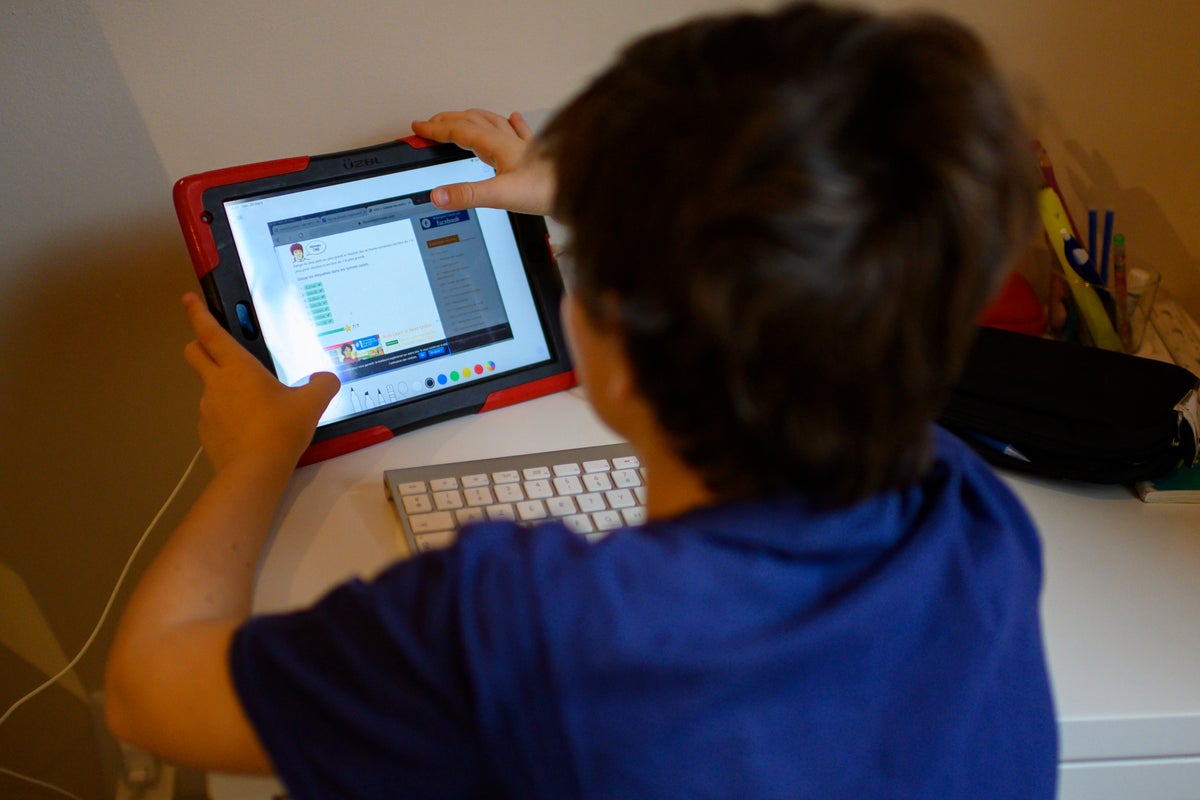
The experiment failed. For the past six years, public school classrooms looked more like tech startups than spaces for learning. We flooded five-year-olds with tablets, handed first-graders personal Chromebooks, and hoped software would somehow teach them how to read. It didn't.
Now, the second-largest school district in the United States is pulling the plug.
The Los Angeles Unified School District (LAUSD) school board just voted unanimously to completely ban classroom screen time for its youngest learners. Starting August 2026, students in preschool, kindergarten, and first grade will face a strict zero-screen policy. No tablets, no educational apps, no video-aided lesson plans. For older kids, tight caps will limit device usage to a handful of minutes per day or week.
This isn't a minor tweak to the student handbook. It's a massive, system-wide retreat from the digital-first education model that took over during the pandemic. LAUSD is drawing a hard line in the sand, betting that real learning happens with paper, pencils, and human interaction.
The Crushing Numbers Behind the Classroom Tech Retreat
To understand why this is happening, you have to look at the massive surge in classroom tech over the last few years. According to federal data, by 2025, a staggering 88% of public schools across the country had implemented one-to-one device programs. That means almost every single kid was handed a school-issued laptop or tablet.
We were told these devices would close equity gaps and offer personalized learning. What did we actually get?
National assessment data shows 9- and 13-year-olds are worse off in math and reading than they were a decade ago. Teachers have spent the last few years screaming into the void about shattered attention spans, classroom management nightmares, and kids who don't know how to hold a pencil but can bypass web filters in thirty seconds.
The American Academy of Pediatrics dropped a brutal policy statement warning that heavy non-educational and solo screen use in young children correlates directly with developmental delays. We're talking about real setbacks in language, fine motor skills, social-emotional growth, and executive functioning. When five-year-olds spend their school days clicking through gamified math apps instead of building with blocks, their brains miss out on critical spatial and physical development.
The New Los Angeles Rules Explained Simply
LAUSD isn't just suggesting that teachers tone it down. They've built a highly prescriptive, minute-by-minute framework that leaves very little room for interpretation.
Here's how the new daily and weekly screen caps break down across the grade levels starting this school year:
- Preschool through 1st Grade: 0 minutes. Full ban.
- 2nd and 3rd Grade: Maximum of 20 minutes per day.
- 4th and 5th Grade: Maximum of 30 minutes per day.
- 6th through 8th Grade: Maximum of 60 minutes per subject each week (capped at 6 hours total).
- 9th through 12th Grade: Maximum of 90 minutes per subject each week (capped at 10 hours total).
These strict limits include the time students spend on digital homework. To make sure teachers actually follow these rules, the district will use tracking software to audit device usage across all school-issued hardware.
The district is also completely blocking access to YouTube, social media platforms, streaming services, and non-approved gaming sites for all students. Furthermore, the old rule requiring kids to haul their school laptops home every single night is dead. The new default is that devices stay at school in centralized laptop carts unless a parent explicitly requests otherwise.
The Hard Reality of the Digital Divide
It's easy to celebrate this as a massive win for childhood, and for most kids, it is. Parent groups like Schools Beyond Screens lobbied hard for these changes, wanting a return to an education free from corporate tech influence.
But as someone who has tracked education policy for years, I know that no sweeping mandate comes without collateral damage. The pushback from civil rights and advocacy groups in Los Angeles highlights a massive equity problem that the district hasn't fully solved yet.
In LAUSD, roughly 20% of the student body consists of English language learners. For these kids, specialized translation software and digital audio tools on school devices aren't distractions; they're literal lifelines to understanding the lesson. The same goes for students with disabilities who rely on assistive technology to communicate or read.
Then there's the harsh economic reality. For many low-income families in Los Angeles, that school-issued Chromebook was the only computer in the house. Stripping those devices away or discouraging their use threatens to widen the gap between kids who have high-speed internet and personal MacBooks at home and those who don't.
While the board clarified that families can still opt-in to check out devices for home use, adding that extra layer of bureaucracy often means the families who need the tech most are the ones who slip through the cracks.
What School Districts Need to Do Right Now
The Los Angeles policy is going to ripple across the country. Other states are already moving in this direction; Iowa, for instance, passed legislation capping elementary screen time starting in 2027. If you're a parent, teacher, or school board member looking at the LAUSD model, you can't just wait around for a mandate to hit your local district.
First, look at your local classroom environment. Take an honest inventory of how much time your kids are spending on passive digital worksheets disguised as "educational apps." Push your local school boards to shift funding away from constant software license renewals and back toward physical textbooks, art supplies, and hands-on science equipment.
Second, demand clear distinctions between assistive technology and general instructional technology. Any local policy must explicitly protect access for students with individualized education programs (IEPs) and language learning needs so that a screen ban doesn't become an equity barrier.
LAUSD just proved that the tech-at-all-costs model is officially cracking. The era of treating our youngest children as guinea pigs for tech companies is coming to an end, and it's time to get back to the basics of human-led teaching.