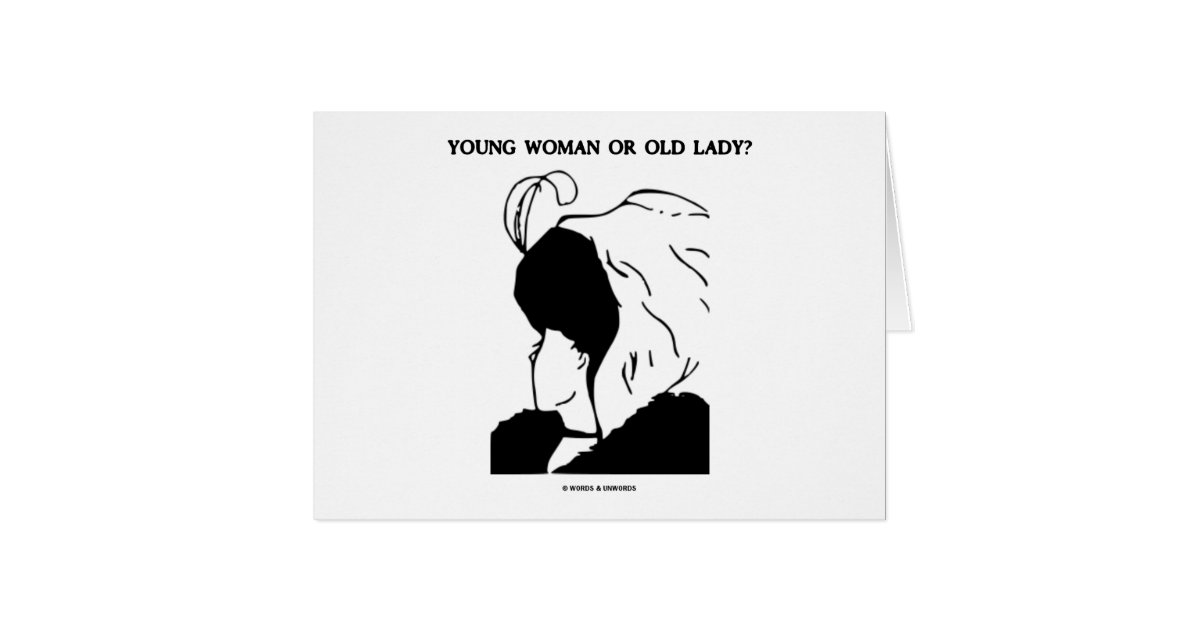
You’ve seen it. Everyone has. It’s that grainy, black-and-white sketch where one second you’re looking at a glamorous young woman with her head turned away, and the next, you’re staring at the prominent nose and sagging chin of an elderly woman. It’s called the old lady young lady optical illusion, and honestly, it’s probably the most famous piece of perceptual trickery in history.
It’s weird. Your brain can’t see both at the same time. It’s physically impossible. You’re either in the "young lady" camp or the "old lady" camp, and then—snap—the image flips. This isn't just a fun party trick or a viral meme from the pre-internet era. It’s a profound look into how our brains construct reality from messy data.
The sketch, formally known as "My Wife and My Mother-in-Law," has been studied by psychologists for decades. It tells us more about our biases, our age, and our neural pathways than almost any other visual test.
The secret history of a viral vintage sketch
Most people think this drawing started with a British cartoonist named William Ely Hill, who published it in Puck magazine back in 1915. He titled it "My Wife and My Mother-in-Law," with a snarky caption about both being in the picture. But Hill didn't actually invent it. The concept had been floating around on German postcards and advertisements for years before he put his spin on it.
It’s what psychologists call an ambiguous figure.
There’s no "correct" way to see it. The lines are static. They don’t move. The change happens entirely inside your primary visual cortex. When you look at the young woman’s ear, your brain might interpret it as the old woman’s eye. The young woman’s necklace? That’s the old woman’s mouth. The velvet choker becomes a thin lip. It’s a masterclass in how context dictates perception.
Interestingly, a 2018 study published in the journal Scientific Reports suggested that your age actually influences which version you see first. Researchers at Flinders University and the University of South Australia found that younger people were significantly more likely to see the young lady first, while older participants defaulted to the elderly woman. It’s called own-age bias. Basically, your brain is wired to recognize people who look like you or belong to your social peer group more quickly than those who don't.
Why your brain refuses to see both ladies at once
Perceptual switching is a wild phenomenon. When you look at the old lady young lady optical illusion, your brain is dealing with what’s known as "bistable perception."
Think of it like a light switch that can only be up or down. There is no middle ground.
When the visual input is ambiguous, the brain enters a state of competition. One neural interpretation suppresses the other. You can't see the "nose" and the "ear" simultaneously because they occupy the exact same spatial coordinates in your field of vision, but they require different "labels" in your mind.
- Top-down processing: This is when your expectations and memories influence what you see. If I tell you "look for the old lady," you'll find her because your brain is priming your visual system to hunt for specific features like a hooked nose or a headscarf.
- Bottom-up processing: This is the raw data—the lines, the shadows, the contrast.
The struggle between these two processes is why the image "flips." Your neurons eventually get tired of holding one interpretation, a process called neural adaptation, and the rival image grabs the spotlight.
It's more than just a drawing
This illusion is a staple in introductory psychology classes for a reason. It proves that what we "see" isn't a direct video feed of the world. It's a guess.
Psychologist Edwin Boring popularized the image in the 1930s, which is why it's sometimes called the "Boring Figure" (a bit of an unfair name for something so interesting). He used it to demonstrate how our mental sets—the frames of mind we bring to a situation—dictate our reality.
If you've been looking at pictures of jewelry all day, you might see the young woman's necklace first. If you've been thinking about your grandmother, the old lady might pop out immediately. Our brains are essentially prediction machines. We don't see with our eyes; we see with our expectations.
There are hundreds of variations of this now. Some use different ethnicities, others use more modern art styles, but the core mechanic remains the same. It taps into a fundamental flaw (or feature) of human consciousness: we cannot handle ambiguity. We crave a single, unified story for what we are looking at.
How to flip the image if you’re stuck
Some people genuinely struggle to see the "other" woman. If you've been staring at the old lady young lady optical illusion for five minutes and you’re convinced everyone else is lying to you, try these specific focal shifts:
To see the young woman: Focus on the "ear" of the woman. Realize that the "nose" of the old lady is actually the "jawline" and "chin" of the young girl. The old lady's "eye" is the young girl's "ear." The young lady is looking away from you, over her right shoulder.
To see the old woman: Look at the "necklace" of the young girl. That is the old woman’s mouth. The young girl’s "jawline" is the old woman’s massive nose. The "ear" is the "eye." The old lady is looking down and to the left, buried in her fur coat.
Actionable insights for the curious mind
Understanding this illusion isn't just about winning a visual game. It’s a tool for better thinking.
- Practice cognitive flexibility. When you find yourself in a heated argument, remember the lady. Just because you see a "nose" doesn't mean the other person isn't looking at a "jawline." Two people can look at the exact same set of facts and have completely different, yet valid, perceptions.
- Challenge your first impression. Since we know "own-age bias" is real, realize that your brain is lazy. It takes the path of least resistance. Force yourself to look for the "other lady" in complex situations.
- Use it as a brain break. Staring at ambiguous figures can actually be a form of "neural calisthenics." It forces the brain to break out of rigid patterns.
The old lady young lady optical illusion remains relevant because it’s a humble reminder that our perspective is always limited. We never see the whole picture at once. We only see the version our brain is currently equipped to handle. Next time you're sure about something, take a second look. There might be a whole other person hiding in the lines you haven't noticed yet.
To get the most out of this, try showing the image to someone from a different generation. Don't prompt them. Just ask what they see. Comparing the results is a quick, fascinating way to see own-age bias in action right in your own living room. For a deeper challenge, look up the "Husband and Father-in-Law" version, which applies the same principle to masculine features, often proving much harder for people to flip because of the different shadow weights used in the illustration.