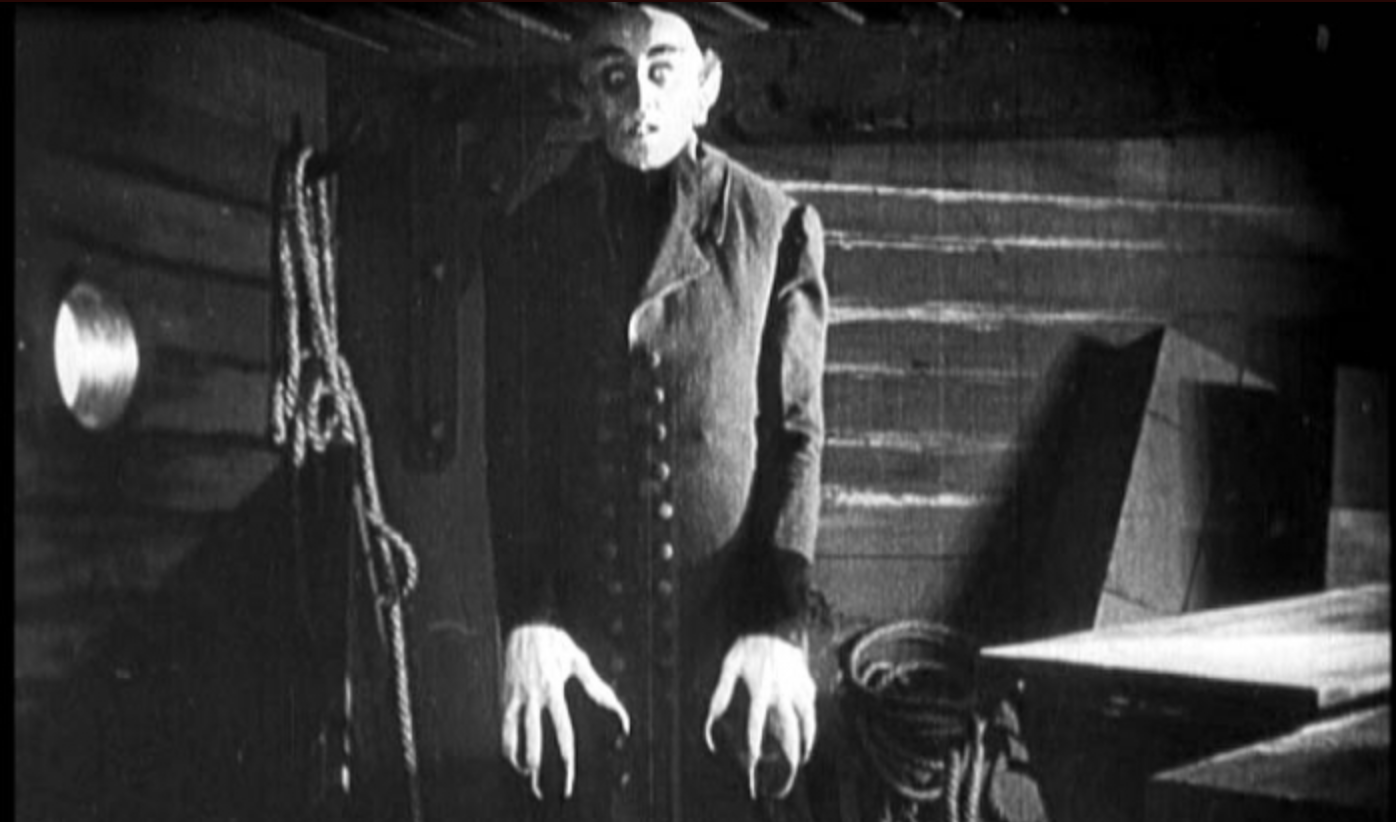
Look at Count Orlok. No, really look at him. He doesn't look like a "gentleman" vampire. He isn't suave, he isn't wearing a cape with a red silk lining, and he definitely isn't sparkly. He looks like a humanoid rat that’s been living in a damp basement for three centuries. That’s the magic—or the nightmare—of Nosferatu: A Symphony of Horror. Released in 1922, this film wasn't just a movie; it was a legal disaster, a masterpiece of German Expressionism, and honestly, the reason we’re still obsessed with vampires today.
It’s weird to think that a movie over a hundred years old can still be effective. Most silent films feel like museum pieces. They’re slow, the acting is "big" and theatrical, and the makeup is often goofy. But Max Schreck’s performance? It’s something else. When he rises stiffly from his coffin on the ship, he isn't just an actor in a costume. He feels like a literal plague.
The Lawsuit That Almost Erased History
Here’s a crazy bit of trivia: Nosferatu: A Symphony of Horror almost didn't survive. We shouldn't even be able to watch it right now. Prana Film, the studio behind it, basically tried to pull a fast one. They wanted to adapt Bram Stoker’s Dracula, but they didn't want to pay the estate for the rights. So, they changed the names. Dracula became Count Orlok. London became Wisborg. Vampires became "Bird of Death" or "Nosferatu."
Florence Stoker, Bram’s widow, wasn't having it. She sued for copyright infringement and she won. Big time. A judge ordered every single copy of the film to be burned.
Think about that. One of the most influential pieces of art in history was supposed to be ash. But, thanks to a few pirated copies that had already made it overseas to the United States and other parts of Europe, the film survived. It’s kinda poetic, right? A movie about an undead monster that refuses to stay dead actually survived its own execution.
Why German Expressionism Makes It So Weird
If you’ve ever felt "off" while watching this movie, it’s intentional. The director, F.W. Murnau, used a style called German Expressionism. Unlike the stuff coming out of Hollywood at the time, which tried to look realistic, Expressionism was all about mood. It’s about jagged edges, impossible shadows, and sets that look like they were pulled out of a fever dream.
In Nosferatu: A Symphony of Horror, the shadows are practically characters. There’s that famous shot of Orlok’s shadow creeping up the stairs, his elongated fingers reaching for the bedroom door. That’s not a jump scare. It’s something worse. It’s "unheimlich"—the uncanny. It taps into that primal fear of something being just slightly wrong with the world.
Murnau didn't just stay in a studio, though. Most Expressionist films were shot on built sets to control the look. Murnau took his cameras to the mountains of Slovakia and the streets of Lübeck and Wismar. Mixing real-world locations with a supernatural monster makes the whole thing feel more grounded and, frankly, more terrifying. You feel like this thing could actually be lurking in a real alleyway.
Max Schreck: Man or Monster?
There was actually a rumor for years—later turned into the movie Shadow of the Vampire—that Max Schreck was a real vampire. He wasn't, obviously. He was a dedicated character actor. But you can see why people thought that. His makeup was revolutionary for the time. The pointed ears, the two fangs in the middle of his mouth rather than the sides, and those fingernails.
Schreck’s movement is what does it. He doesn't blink much. He moves with a rigid, insect-like precision. While the other actors in the film, like Gustav von Wangenheim (who played Hutter), are doing that over-the-top silent movie acting, Schreck is incredibly still. That contrast is jarring. It makes him feel alien.
The Symphony of Themes
The title isn't just a fancy name. It’s a "symphony." The film is structured in five acts, much like a musical composition. It builds tension, hits a crescendo of horror, and then fades into a tragic, haunting end.
But what is it actually about? If you look at the historical context, Germany was reeling from World War I. The country was broken, impoverished, and dealing with the Spanish Flu. Nosferatu: A Symphony of Horror captures that collective trauma. Orlok brings a literal plague with him. He travels in a coffin filled with "cursed" earth and rats. To the audiences in 1922, this wasn't just a monster movie; it was a reflection of the invisible death that had been sweeping across Europe.
It’s also surprisingly erotic in a messed-up way. The vampire doesn't just want blood; he’s obsessed with Ellen, the pure-hearted wife. The way she has to sacrifice herself to destroy him is dark. It’s not a hero with a wooden stake who saves the day. It’s a woman who chooses to let a monster feed on her until the sun rises. It’s self-sacrifice, but it’s also deeply disturbing.
Common Misconceptions and Forgotten Facts
A lot of people think Nosferatu invented the idea that sunlight kills vampires. Believe it or not, in Bram Stoker's original Dracula, the Count could walk around in the sun. He was just weaker. Murnau and his screenwriter, Henrik Galeen, were the ones who decided that sunlight should turn a vampire into a puff of smoke. That one creative choice changed the entire genre forever.
Another thing people miss is the occult connection. Albin Grau, the producer and production designer, was a huge into the occult. He was a member of the Fraternitas Saturni. He filled the movie with hermetic symbols and cryptic documents that actually mean something in Western magical traditions. If you pause the movie on the letter Hutter reads from the Count, the symbols aren't just gibberish. They’re astrological and alchemical signs.
Comparing Versions: 1922 vs. 1979 vs. 2024
We can't talk about the original without mentioning Werner Herzog’s 1979 remake, Nosferatu the Vampyre. Herzog loved the original so much he basically recreated specific shots, but he added sound and color. Klaus Kinski played the Count, and he brought a pathetic, lonely quality to the character that Schreck didn't have. Schreck was a predator; Kinski was a predator who was tired of living.
And then there's the 2024 Robert Eggers version. Eggers is a stickler for historical accuracy, which is funny when you’re making a movie about a vampire. But he understands the "symphony" aspect. He knows that Nosferatu: A Symphony of Horror is about atmosphere more than plot.
How to Actually Watch It Today
Since the film is in the public domain, there are a million versions of it on YouTube and cheap DVDs. Most of them are terrible. They use grainy, third-generation prints and generic, "spooky" organ music that doesn't fit the timing of the scenes.
If you want the real experience, you have to look for the restored versions. The Friedrich Wilhelm Murnau Foundation did a massive restoration years ago that returned the film to its original tinting. See, silent movies weren't just black and white. They used color tints to show the time of day: blue for night, sepia for indoors, pink or yellow for dawn.
Watching a high-quality restoration with the original Hans Erdmann score (or a well-done modern one) is like seeing a different movie entirely. The details in the shadows pop. You can see the texture of the dirt on Orlok’s skin. It stops being a "classic you should watch" and becomes a movie you actually want to watch.
Actionable Steps for Horror Fans
If you're ready to dive into the world of Count Orlok, don't just put it on in the background while you scroll on your phone. You'll get bored. This movie requires a different kind of attention.
- Find the right version. Look for the "Kino Classics" or "Masters of Cinema" Blu-ray or streaming versions. These use the 2005-2006 restoration which is considered the gold standard.
- Turn off the lights. It sounds cliché, but this film relies on "chiaroscuro"—the contrast between light and dark. Any glare on your screen will ruin the effect of the shadows.
- Pay attention to the nature shots. Murnau was obsessed with the idea that nature itself was turning evil. Look at the shots of the Venus flytrap and the polyp. He was trying to show that the vampire is a natural, albeit perverted, part of the biological world.
- Compare it to the book. If you’ve read Dracula, note the differences. Notice how the ending of the film is much more atmospheric and tragic than the "action-movie" ending of the novel.
- Listen to the score. If you find a version with a live orchestra recording, choose that. The music is meant to guide your emotions in the absence of dialogue.
Nosferatu: A Symphony of Horror isn't just an old movie. It’s the DNA of the horror genre. Every time you see a monster creeping in the shadows or a vampire crumbling in the sun, you’re seeing the ghost of F.W. Murnau’s 1922 masterpiece. It’s survived lawsuits, fires, and a century of time. That’s because some nightmares are too vivid to stay buried.