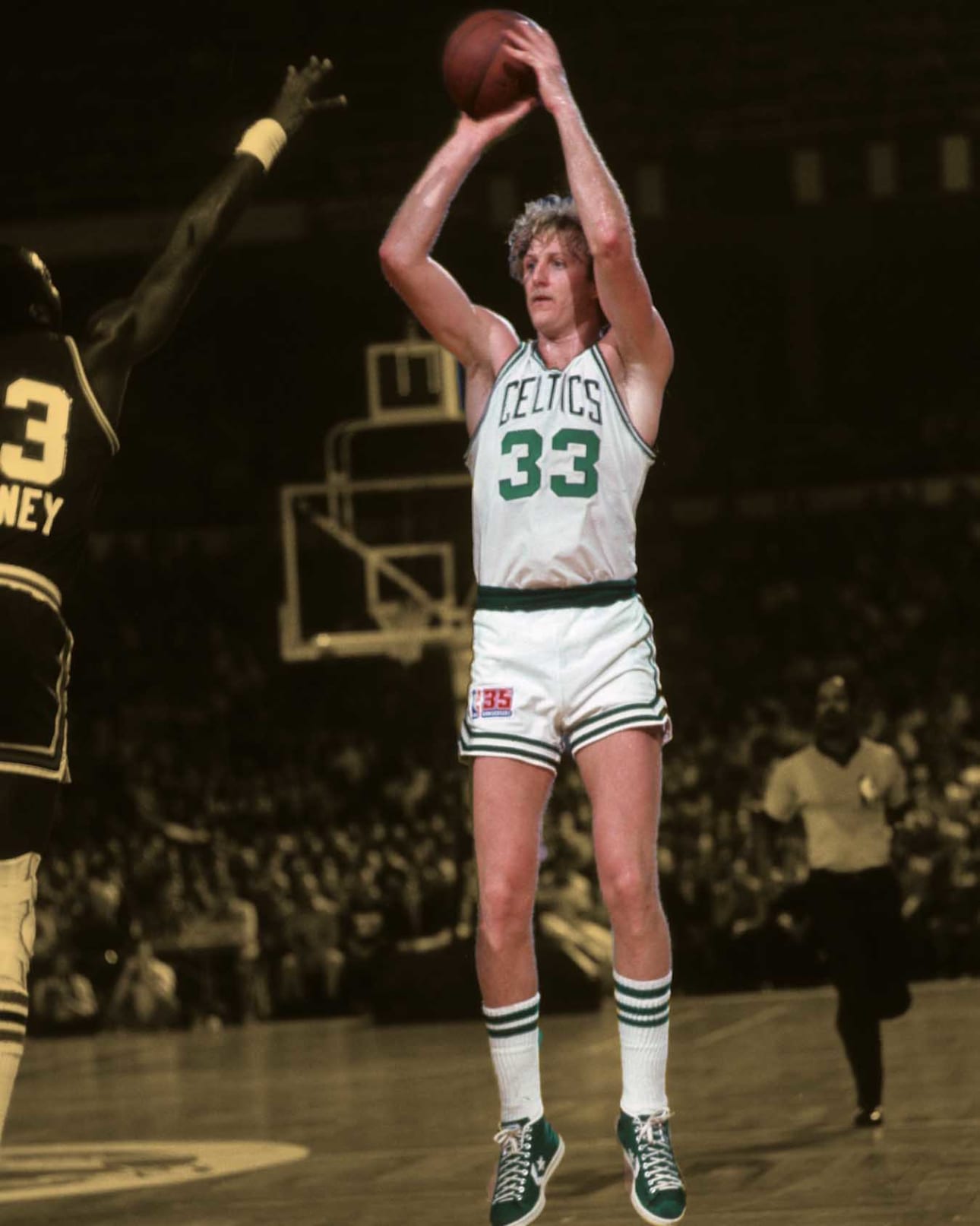
If you walked into a gym today and saw a 6-foot-9 guy with a blonde mullet, a wispy mustache, and a slight limp, you probably wouldn't think: There goes the most terrifying player in basketball history. You'd probably think he was there to fix the plumbing. Honestly, that was the magic of Larry Bird. He didn't look like a Greek god. He didn't jump over cars. But for a solid decade, he owned the NBA in a way that made grown men—superstars, mind you—question their own existence.
He was "The Hick from French Lick," a nickname that leaned into his small-town Indiana roots, but don't let the "shucks" routine fool you. The man was a cold-blooded assassin on the hardwood. He wasn't just "good for a white guy" or "a great shooter." He was a psychological nightmare who would tell you exactly how he was going to score, then do it, then ask you why you were still standing there.
The Myth of the "Unathletic" Legend
People love to say Larry Bird wasn't athletic. It's a lazy take. Sure, if your definition of athleticism is just a 40-inch vertical, then yeah, Larry was "ground-bound." But watch the old tape from 1980 to 1986. Before the back injuries turned his spine into a stick of dry kindling, Bird was everywhere. He was diving into the front row for loose balls. He was snatching 10 rebounds a game against guys built like tanks.
He had "functional athleticism." His hand-eye coordination was basically a superpower. He could tip a pass to a teammate without ever gripping the ball, a sort of volleyball-style touch that looked like luck but was actually pure geometry. His vision was 360 degrees. He didn't need to outrun you because he already knew where you were going to be three seconds before you did.
How Larry Bird Actually Played the Game
If you're trying to understand his style, basically think of a computer playing chess while everyone else is playing checkers. Larry Bird wasn't just a shooter. In fact, he didn't even shoot that many threes by today's standards. He was a master of the mid-range and a passing genius.
- The Passing: He averaged 6.3 assists for his career. That’s a lot for a forward. He’d throw no-looks from his hip or over-the-head rockets that would hit a cutting Kevin McHale right in the numbers.
- The Rebounding: 10.0 rebounds per game. He wasn't out-jumping Patrick Ewing; he was out-positioning him. He knew exactly where the ball would bounce off the rim based on the trajectory of the shot.
- The Efficiency: He was the founding member of the 50-40-90 club (shooting 50% from the field, 40% from three, and 90% from the free-throw line).
He played with a relentless motor. Michael Cooper, arguably the best perimeter defender of that era, once said Bird was the hardest player to guard—harder than Michael Jordan. Why? Because Jordan would beat you with speed and flight. Bird would beat you with constant movement, screens, and a mental grind that never stopped.
The Trash Talk That Broke Spirits
The stories are legendary. Most players talk trash to get themselves hyped up. Bird did it to humiliate you.
There was the time in 1988 at the Three-Point Contest. He walked into the locker room, looked at the other contestants—guys like Craig Hodges and Dale Ellis—and just asked, "So, who's coming in second?" He won the contest without even taking off his warm-up jacket.
Or the game against the Phoenix bench. He told them he was tired of playing against them and was going to hit a shot "in the trainer's lap." He proceeded to hit a rainbow three, got fouled, and literally landed in the trainer's lap. He just smiled.
He once told Xavier McDaniel exactly where he was going to stand, how many dribbles he was going to take, and that he was going to shoot it right in his face. He did it. Then he told Xavier, "I didn't mean to leave two seconds on the clock." It’s almost mean, right? But that was the edge. He needed that friction to stay sharp.
The Tragedy of the Driveway
You've probably heard about the back issues. But do you know how it started? It wasn't a hard foul or a bad fall in a game. In the summer of 1985, Larry Bird decided to build a gravel driveway for his mother back in Indiana. Instead of hiring a crew, he did it himself. Shoveling tons of gravel for days.
He messed up his back so badly that he was never the same.
Think about that. One of the greatest athletes in history cut his prime short because he was too stubborn to hire a contractor. By the late '80s, he couldn't sit on the bench. If you see old footage, he’s lying flat on the floor next to the Celtics' bench just to keep his spine from locking up. He was still averaging 20/10/7 while living in a state of constant, agonizing pain.
He retired in 1992 after the "Dream Team" run in Barcelona. He could barely walk, but he still helped get that Gold Medal.
Why His Legacy Is Bulletproof
Some people try to compare him to modern players. "Would he survive in today's NBA?" Honestly, he'd thrive. Imagine Larry Bird with modern spacing and the green light to shoot 10 threes a game. He’d be Luka Doncic with a meaner streak and three championship rings.
He didn't just play for stats. He played to win. He and Magic Johnson basically saved the NBA from bankruptcy in the '80s. Before they showed up, the Finals were being shown on tape delay. Their rivalry turned the league into a global powerhouse.
Bird is also the only person in NBA history to win MVP, Coach of the Year, and Executive of the Year. He took the Indiana Pacers to the Finals as a coach in 2000 and nearly took down Shaq and Kobe's Lakers. He’s just a winner. Period.
How to Apply the "Bird Mentality" to Your Own Life
You don't have to be 6-foot-9 to take something from Larry Legend's career. It's about preparation and psychological leverage.
- Master the Fundamentals: Bird was a great shooter because he practiced more than anyone else. He famously made hundreds of shots every morning before his teammates even woke up. High-level skill beats raw talent when talent doesn't work.
- Know the Room: Bird’s "scouting" was his memory. He knew every opponent's weakness. Whether you're in a boardroom or a classroom, knowing the people across from you is your biggest advantage.
- Confidence is a Weapon: He didn't just believe he was the best; he made sure everyone else believed it too. If you project absolute certainty, people tend to get out of your way.
If you want to see what peak basketball looks like, go find the 1986 Celtics highlights. It wasn't just a team; it was a symphony led by a guy who looked like he belonged on a tractor but played like he owned the moon. Larry Bird was a one-of-one. We won't see another like him.
Next Steps for the Larry Bird Fan:
- Watch the 1984 NBA Finals (Celtics vs. Lakers) to see the rivalry at its absolute peak.
- Read his autobiography, Drive, for a deeper look into that infamous driveway story.
- Study his passing highlights specifically—it's a masterclass in seeing things before they happen.