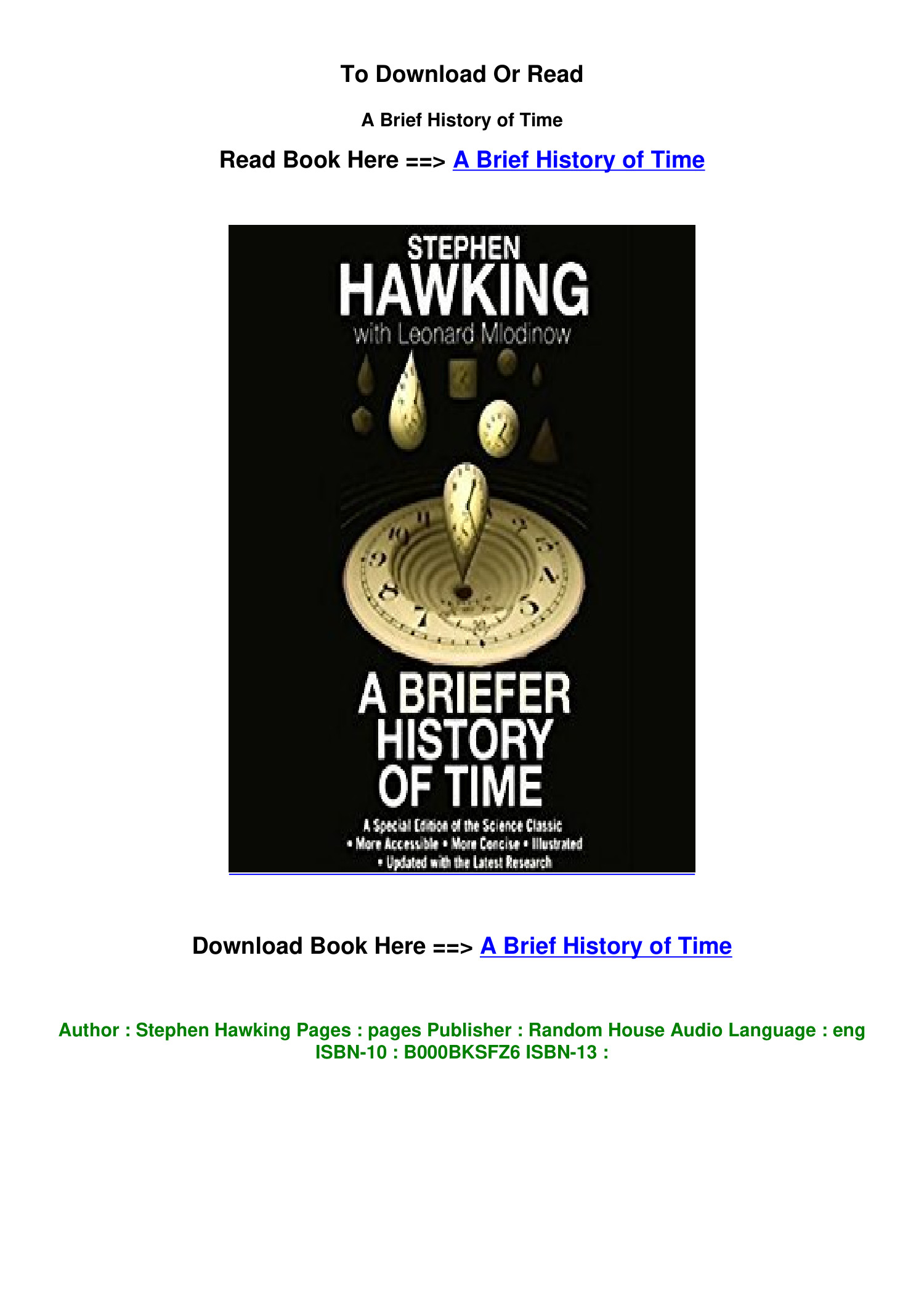
It is arguably the most unread bestseller in the history of the written word. You’ve seen it. That iconic black cover with the starfield, tucked away on a dusty shelf in a vacation rental or sitting prominently—and suspiciously pristine—on a friend's coffee table. When Stephen Hawking’s A Brief History of Time hit the shelves in 1988, nobody expected a book about theoretical physics to sell 25 million copies. It stayed on the Sunday Times bestseller list for more than four years. That’s wild. But let’s be honest for a second. Most people who bought it never actually finished it.
Physics is hard.
Hawking knew this. He was warned by his editors at Bantam Books that every single equation he included would cut his sales in half. He listened, mostly. He kept only one: $E=mc^2$. That single concession to the "lay reader" created a cultural phenomenon that bridged the gap between elite academia and the person sitting on a bus wondering where the universe came from. It wasn't just a book; it was a vibe. It was the collective human urge to understand the "Mind of God" without needing a PhD in mathematics.
The gamble that changed science writing
Before 1988, science books were mostly for scientists. You had your textbooks and your dense academic journals. Then came Hawking. He wanted to write a book that would sell in airport bookstores. People thought he was dreaming. At the time, he was already struggling with the escalating effects of ALS, communicating through a clicker and a speech synthesizer. The sheer physical effort required to "write" this manuscript is mind-boggling.
He didn't want to just talk about stars. He wanted to talk about the beginning and the end. He tackled the Big Bang, black holes, and the arrow of time with a tone that felt... strangely personal? Even though the subject matter was literally universal.
The book's success wasn't just about the science, though. It was about the man. Hawking became a symbol of the triumph of the mind over the body. When you read A Brief History of Time, you aren't just reading about General Relativity. You're participating in Hawking's personal quest to solve the universe while his own physical world was shrinking. That context matters. It’s why the book resonated then and why it still feels vital today.
What actually happens inside a Black Hole?
This is the part where everyone usually gets stuck around chapter four or five. Hawking spends a lot of time on black holes because, well, that was his "thing."
Most of us think of a black hole as a giant cosmic vacuum cleaner. You get too close, you get sucked in, game over. But Hawking introduced the world to something much weirder: Hawking Radiation. This was a massive deal in the 70s and 80s because it suggested black holes aren't actually black. They leak. Because of quantum effects at the "event horizon"—the point of no return—particles can escape.
Imagine a pair of "virtual particles" popping into existence right at the edge of the hole. One falls in, the other escapes. To an outside observer, it looks like the black hole is emitting radiation.
The Information Paradox
This leads to a massive fight in the physics world. If a black hole eventually evaporates and disappears (which Hawking argued it would), what happens to all the stuff that fell in? If you throw a library into a black hole and the hole disappears, is the information in those books gone forever?
- Standard physics says information can't be destroyed.
- Hawking's original theory suggested it could be.
- The "Black Hole War" with Leonard Susskind lasted for decades.
Eventually, Hawking conceded. He admitted he was probably wrong about information loss. That’s the mark of a real scientist, honestly. Being willing to stand up in front of the world and say, "Yeah, I miscalculated that one." It didn't make the book any less important; it just showed how science is a living, breathing argument.
Why the "Arrow of Time" is so confusing
Have you ever wondered why we can remember the past but not the future? It sounds like a stupid question. Of course we can't remember the future. But if you look at the fundamental laws of physics—the math behind how atoms move—there isn't really a preferred direction for time. The equations work just as well backwards as they do forwards.
Hawking breaks this down through the concept of entropy. Basically, things tend to get more messy over time. You can turn an egg into an omelet, but you can't turn an omelet back into an egg.
He identifies three "arrows" of time:
- Thermodynamic arrow: The direction in which disorder increases.
- Psychological arrow: The way we feel time passing (remembering the past).
- Cosmological arrow: The direction in which the universe is expanding.
He argues these are all linked. We can only exist in a universe where the thermodynamic arrow and the cosmological arrow point the same way. If the universe started contracting, would we see "broken" cups reassembling themselves on tables? Hawking eventually decided no, we wouldn't. The messiness (entropy) would still increase. Even in a collapsing universe, you're still getting older. Sorry.
The "No Boundary" Proposal: No Beginning?
One of the most mind-bending parts of A Brief History of Time is Hawking’s collaboration with James Hartle. They came up with the "No Boundary" proposal.
Think about the Earth. If you walk North, you eventually hit the North Pole. But what happens if you try to go further North? You can't. Not because there's a wall or an edge, but because the surface of the Earth is curved. The North Pole is just a point on a sphere.
Hawking suggested the universe might be like that. If you go back in time to the Big Bang, you don't hit a "start" button or a wall where a Creator had to step in. Instead, time becomes like another dimension of space. The "beginning" of the universe is just like the North Pole. It’s a point, but it doesn't have an edge.
This was controversial. It basically tried to remove the need for a "First Cause." If the universe has no boundaries and no edges, it just is. This is where he famously asked, "What place, then, for a creator?" It wasn't necessarily an atheist manifesto, but it was a push to see if physics could explain everything without needing a "hand" to start the clock.
Is it actually readable in 2026?
Honestly? Some of it is dated. Since 1988, we've discovered Dark Energy. We've photographed a black hole (M87*). We’ve detected gravitational waves. The "Theory of Everything" that Hawking hoped was just around the corner is still, frustratingly, just around the corner.
But the core of the book—the way it explains the conflict between the very big (General Relativity) and the very small (Quantum Mechanics)—is still the best primer out there.
If you try to read it today, don't feel bad if you have to read a page three times. Or ten times. Even the best physicists struggle with the implications of imaginary time. The value isn't in memorizing the facts; it's in the shift in perspective. It makes your daily problems—the car lease, the annoying coworker, the Wi-Fi being slow—feel incredibly small. In a good way. You’re a temporary collection of atoms on a tiny blue dot in a 13.8 billion-year-old story.
Actionable Steps for the "Brief History" Novice
If you actually want to finish the book this time and understand what Hawking was getting at, don't just start at page one and hope for the best.
Watch the 1991 documentary first. Errol Morris directed a film with the same title. It’s not a beat-for-beat adaptation of the book, but it gives you the biographical context of Hawking’s life. Understanding the man makes the abstract concepts feel more grounded.
Supplement with "The Illustrated A Brief History of Time." It was released later and includes 240 full-color illustrations. If your brain works visually, this is a lifesaver. Seeing a diagram of a light cone is a thousand times more helpful than reading a paragraph describing one.
Read "A Briefer History of Time" if you get stuck. Hawking released this in 2005 with Leonard Mlodinow. It’s shorter, clearer, and updates some of the science. It’s not "cheating"; it’s just being efficient.
Focus on the "Why" not the "How." Don't get bogged down in the mechanics of particle spins. Focus on what it means for the nature of reality. If Hawking is right about the No Boundary proposal, it changes how we think about existence itself. That’s the "hook" that keeps you turning pages.
The book isn't a manual for how the universe works—it's a travelogue of a brilliant mind trying to find its place in the cosmos. It’s worth the headache.
Next Steps for Deepening Your Understanding:
- Locate a copy of the 1996 Updated and Expanded edition. This version includes chapters on wormholes and time travel that weren't in the 1988 original. It's the "definitive" version for most collectors.
- Compare the book's predictions with the 2019 Event Horizon Telescope image. Seeing the "shadow" of the black hole in M87 validates many of the visual descriptions Hawking struggled to put into words decades ago.
- Explore the "Hawking-Penrose Singularity Theorems." If you want to go deeper into the academic roots, look up Roger Penrose’s work. He won the Nobel Prize in 2020 for the work he started with Hawking in the late 60s.
- Listen to the audiobook. Sometimes hearing the words read aloud—especially the sections on the expansion of the universe—helps the concepts "click" in a way that silent reading doesn't.