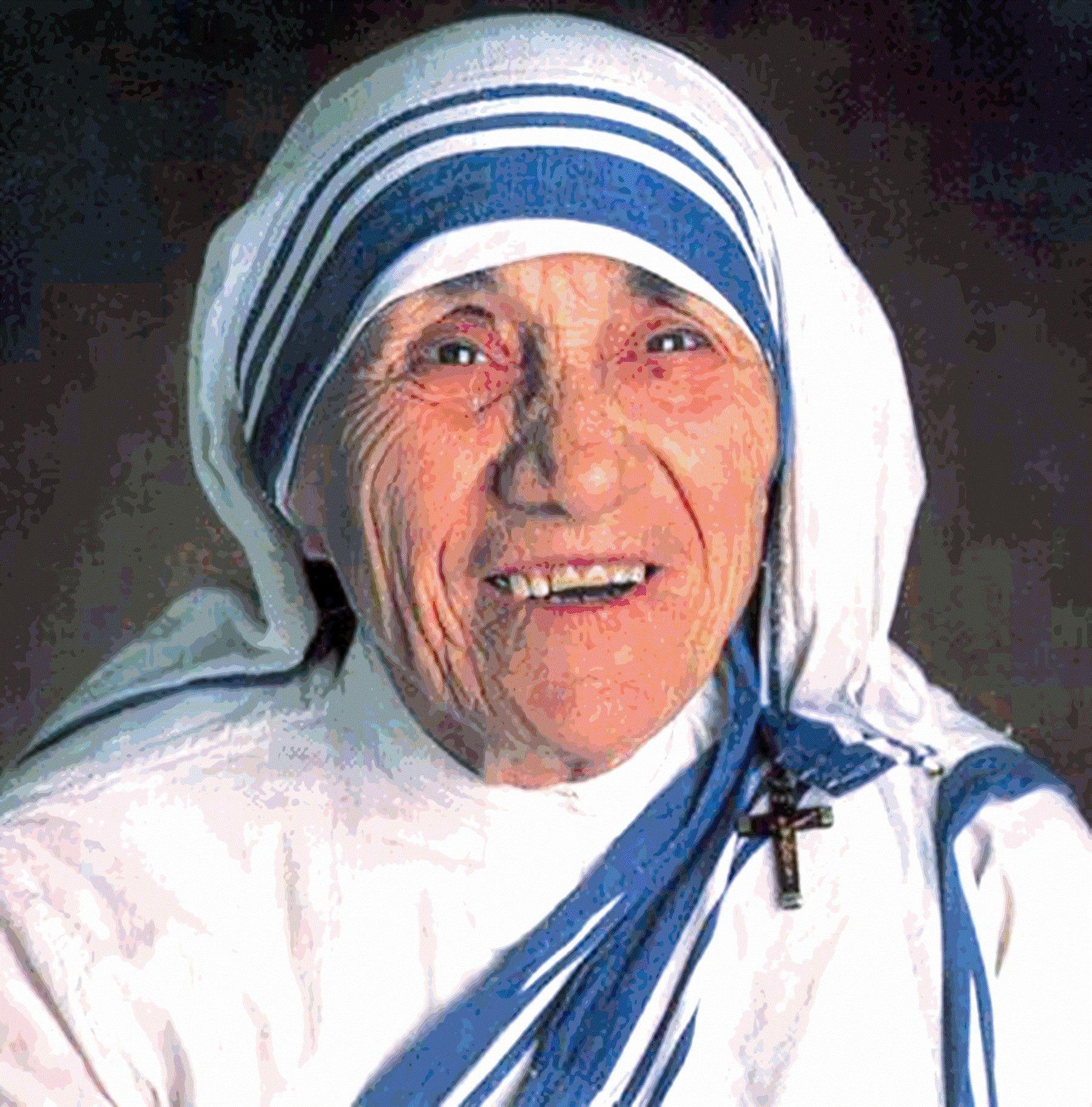
You’ve seen the face. It’s on postage stamps, posters in high school classrooms, and grainy news footage from the eighties. A tiny, hunched-over woman in a white sari with blue stripes. She’s often held up as the literal gold standard for human goodness. If someone does a favor for you, you might joke, "Okay, Mother Teresa, calm down." But who was Mother Teresa behind the iconography and the Nobel Peace Prize?
She wasn't just a "nice lady" who liked helping people. Honestly, she was a powerhouse, a polarizing figure, and a woman who wrestled with a crushing internal darkness that the public didn't see until years after she died. To understand her, you have to look past the stained glass.
The Woman Before the Veil: Agnes Gonxha Bojaxhiu
Before the world knew her as Mother Teresa, she was Agnes. She was born in 1910 in what is now Skopje, North Macedonia. Her family was Albanian and deeply Catholic. Her father died when she was only eight, a trauma that many biographers, including Christopher Hitchens (her most famous critic) and Navin Chawla, suggest shaped her intense reliance on her faith.
By 18, she left home. She never saw her mother or sister again. Think about that for a second. At an age when most of us are worried about college or dating, she moved to Ireland to join the Sisters of Loreto. She wanted to learn English so she could become a missionary in India. She arrived in Calcutta (now Kolkata) in 1929 and spent nearly twenty years teaching at St. Mary’s High School.
She was a principal. She was comfortable. But then came the "call within a call."
The Moment Everything Changed in 1946
It happened on a train. On September 10, 1946, while traveling to Darjeeling for a retreat, she claimed she heard the voice of Jesus telling her to leave the convent and live among the poorest of the poor. This wasn't just a suggestion; it was an order.
It took two years of bureaucratic red tape with the Vatican to get permission. When she finally stepped out of the convent gates in 1948, she had five rupees in her pocket and zero plan. She traded her traditional habit for the cheap white cotton sari that would become her trademark. She took a basic medical course in Patna and then just... started. She began teaching children in the slums, drawing letters in the dirt with a stick.
She didn't have a building. She didn't have staff. She had a bowl and a sense of duty.
The Missionaries of Charity: A Global Empire of Compassion
By 1950, she had official Vatican approval to start her own order: the Missionaries of Charity. The goal was simple but brutal: to care for "the hungry, the naked, the homeless, the crippled, the blind, the lepers, all those people who feel unwanted, unloved, uncared for throughout society."
She opened the Nirmal Hriday (Home for the Dying) in an abandoned temple. People were literally being stepped over in the streets of Calcutta, dying in gutters. She brought them in so they could die with dignity. If they were Hindu, they got water from the Ganges. If they were Muslim, they had the Quran read to them. If they were Catholic, they received the last rites.
Growth and the Nobel Prize
The work exploded. What started as one woman in a slum became thousands of sisters in hundreds of countries. In 1979, she won the Nobel Peace Prize. When they offered her the traditional ceremonial banquet, she refused. She asked that the $192,000 budget for the dinner be given to the poor in Calcutta instead.
She told the committee that "the greatest destroyer of peace today is abortion." She was never one to shy away from controversy or soften her Catholic dogma for a secular audience.
Why the World Started Arguing About Her
Now, this is where the story gets complicated. For decades, she was untouchable. Then came the critics. The most vocal was the British journalist Christopher Hitchens, who wrote The Missionary Position: Mother Teresa in Theory and Practice. He argued that she wasn't a friend of the poor, but a "friend of poverty."
The criticisms generally fall into three buckets:
- Medical Care Standards: Doctors who visited her clinics, like Dr. Robin Fox of The Lancet, were often horrified. They reported a lack of painkillers, the reuse of needles, and a lack of basic hygiene. The argument was that she had millions of dollars in donations but refused to modernize her clinics because she believed suffering brought people closer to Christ.
- Political Friendships: She accepted money from dictators. She took a donation from Jean-Claude "Baby Doc" Duvalier of Haiti and praised the regime. She also took money from Charles Keating, the man behind the Lincoln Savings and Loan scandal in the US. When asked to return the money, she stayed silent.
- The Focus on Conversion: Critics argued her primary goal wasn't healthcare, but proselytization. They claimed her sisters would "secretly" baptize dying patients of other faiths.
Was she a saint or a fanatic? Honestly, she was likely a bit of both. She never claimed to be a doctor or a social worker. She saw herself as a religious figure performing a spiritual task. To her, the suffering wasn't a problem to be solved with modern medicine; it was a path to holiness.
The "Dark Night" of Her Soul
This is the part that shocks people who only know the Hallmark version of her life. After she died in 1997, her private letters were published in a book called Come Be My Light.
They revealed that for the last 50 years of her life, she felt absolutely no presence of God.
She felt empty. She felt "the darkness," "the loneliness," and "the torture." She wrote to her superiors that she felt like a hypocrite because she was out there preaching the love of God while feeling nothing but silence inside.
"The place of God in my soul is blank," she wrote.
This revelation actually made her more human to many. It showed that her work wasn't fueled by some "spiritual high" or easy comfort. She did the work even when she felt abandoned. That is a level of grit most people can't even fathom.
Looking at the Legacy of Mother Teresa Today
Mother Teresa was canonized as Saint Teresa of Calcutta by Pope Francis in 2016. Today, her order operates in over 130 countries. They run soup kitchens, mobile clinics, orphanages, and schools.
The debate over her methods hasn't gone away. If you talk to people in Kolkata today, you'll find a divide. Some see her as a woman who gave the city a bad name by focusing only on the "black hole" image of poverty. Others point out that before she arrived, there was literally no one else willing to touch a leper or wash a dying beggar.
She was a woman of her time, bound by a very specific, traditionalist Catholic worldview. She wasn't a progressive reformer. She was a missionary.
What You Can Learn From Her Life
Whether you view her as a saintly figure or a flawed religious zealot, her life offers some pretty heavy lessons:
- Small things matter. She famously said, "Not all of us can do great things. But we can do small things with great love." This is her most enduring piece of advice. You don't need a global foundation to help the person next to you.
- Conviction is uncomfortable. She lived in the same conditions as those she served. She didn't have a private jet or a mansion. She slept on a thin mattress and owned two saris.
- Doubt is part of the process. Her "dark night of the soul" proves that even the most committed people struggle with their "why."
How to Apply the "Teresa Mindset" (Without the Controversy)
If you're looking to make an impact like she did, but maybe with more modern sensibilities:
- Find your "Calcutta": You don't have to travel across the world. There is someone in your immediate orbit—a lonely neighbor, a struggling coworker—who needs attention.
- Prioritize the "Unwanted": Her specific focus was on those society had discarded. Check your own biases. Who are you ignoring because they are "difficult" or "ugly" to deal with?
- Act without the feeling: Don't wait until you "feel" like being a good person. She did the work for 50 years while feeling spiritually dead. Discipline beats motivation every time.
Ultimately, who was Mother Teresa is a question with a million different answers depending on who you ask. She was a sister, a mother, a CEO of a global charity, a controversial political figure, and a woman who suffered in silence. She was, more than anything, a reminder that one person with a singular, stubborn focus can actually shift the axis of the world, for better or worse.
If you want to dive deeper into the actual history of her order, you can look into the official Missionaries of Charity archives or read the 2003 biography by Anne Sebba for a more balanced, journalistic look at her life.
Start small. Look around. Do something today that doesn't benefit you at all. That’s the most authentic way to understand her.