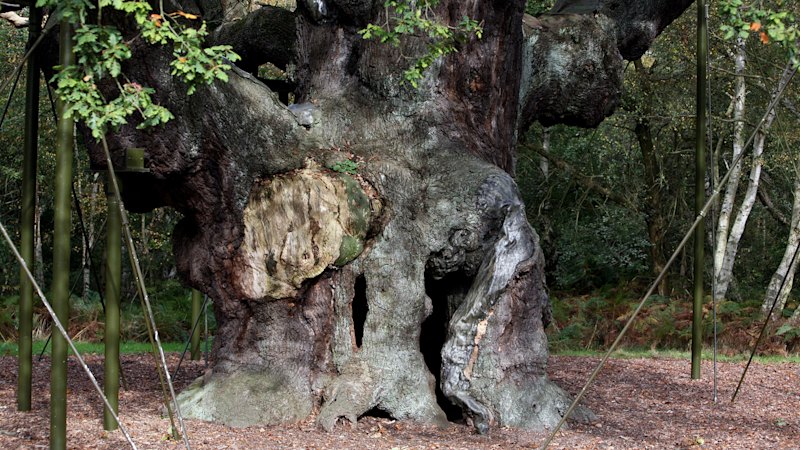
The air in Sherwood Forest smells of damp earth, bruised ferns, and ancient patience. If you stand perfectly still beneath the canopy, you can almost hear the soft, rhythmic hum of a living creature that watched the Magna Carta being signed.
It is a tree. But it is also a monument, a myth, and a victim.
For more than a thousand years, the Major Oak has anchored this stretch of Nottinghamshire. Its massive, twisted limbs stretch outward like the gnarled hands of a giant rising from the underworld. According to folklore, these very branches once offered sanctuary to Robin Hood and his band of outlaws. Whether the legendary thief actually slept within its hollow trunk is beside the point. The myth gave the tree a soul, and the soul drew the world to its feet.
That is where the tragedy began.
We tend to think of destruction as an act of malice. We picture chainsaws, bulldozers, and smoke. But some things are broken by affection. The Major Oak is not dying of neglect. It is being suffocated by love.
The Slow Crush of Admiring Feet
Consider what happens when a human foot meets the forest floor. A single step seems weightless, inconsequential. The soil absorbs it, rebounding easily.
Now, multiply that single step by hundreds of thousands of people every year. Decade after decade. Generation after generation.
The ground changes. Under the relentless pressure of millions of boots, sneakers, and sandals, the delicate pores in the earth collapse. This process is called soil compaction, but a better description is strangulation. Soil is supposed to be a living sponge, filled with tiny pockets of air and water. When humans trample it repeatedly, it turns to concrete.
For a tree, the root system is everything. It is the mouth, the lungs, and the anchor. The Major Oak’s roots extend far beyond the spread of its crown, reaching out into the forest floor to drink in the rain and breathe the oxygen trapped in the soil. When the earth becomes hardened by tourist foot traffic, the water cannot penetrate. The oxygen is squeezed out. The roots begin to starve in the dark.
Imagine trying to breathe through a straw that someone is slowly pinching shut. That is the daily reality for the most famous tree in Britain.
I remember standing near the perimeter fence a few years ago, watching a young family approach the site. The parents were eager, pointing toward the colossal trunk, recounting tales of bows and arrows to their wide-eyed children. They wanted to touch history. They wanted to press their palms against the rough, furrowed bark and connect with something timeless.
Their intentions were pure. They loved the tree. Yet, every step they took toward its roots was a tiny, microscopic blow to its survival.
The Invisible Scars of Survival
Trees operate on a timeline that humans struggle to comprehend. A wound inflicted on an oak today might not show its true damage for half a century. Because they move so slowly, we often mistake their silence for invulnerability.
The Major Oak is not invulnerable. It is incredibly fragile.
Look closely at the tree today, and you will see a network of elaborate steel struts and wooden crutches cradling its massive lower limbs. These are not decorations; they are life support. The branches are so heavy, and the structural integrity of the tree so compromised by age and environmental stress, that without these artificial bones, the tree would collapse under its own weight.
The hollow center of the trunk, which once allegedly hid outlaws, is now a delicate chamber vulnerable to rot and fungal infections. The very feature that made it a legend is also its greatest weakness.
Forestry experts and conservationists realized decades ago that the situation was critical. The soil around the tree was dead, stripped of its natural nutrients and compressed into a suffocating tomb. The solution seemed obvious but painful: humans had to be pushed back.
A fence was erected around the Major Oak to keep the crowds at bay. It was a necessary act of exclusion. For the tree to live, the people who loved it had to be denied the right to touch it.
But fences only solve part of the problem.
The Anatomy of a Rescue Mission
To save an ancient giant, you cannot simply tell people to stay away. You have to undo the damage already ground into the earth.
Arborists began a delicate, painstaking process to revive the soil. They used specialized tools to inject compressed air deep into the hardened ground around the tree, a technique designed to fracture the compacted dirt and reintroduce the air pockets that had been crushed out over the centuries. They spread thick layers of organic mulch and leaf litter to mimic the natural forest floor that had been worn away by a billion footsteps.
They had to teach the earth how to breathe again.
It is a strange, delicate dance between preservation and accessibility. Sherwood Forest is a public treasure, a place where people go to escape the noise of modern life and reconnect with the wild. The Major Oak is the crown jewel of that experience. If you hide it away completely, you lose the cultural connection that makes people care about conservation in the first place. If you open it up completely, it dies.
This tension is playing out all over the globe. From the fragile ecosystems of the Galápagos Islands to the eroding stone steps of Machu Picchu, our collective desire to witness the wonders of the world is actively destroying them. We are consuming the very things we cherish.
The Silent Witness
The sun begins to dip lower in the Nottinghamshire sky, casting long, fractured shadows through the birch and oak canopy. The tourists are beginning to filter back toward the visitor center, their voices fading into the rustle of the evening breeze.
The Major Oak remains.
It has survived the clearance of the ancient wildwood, the rise and fall of empires, the industrial revolution, and two world wars. It has stood firm while the world around it transformed from a wilderness of wolves and outlaws into a managed park surrounded by roads and bustling towns.
It did not ask for our legends. It did not ask for our fame. It simply grew, century by century, rings of history expanding hidden beneath its bark.
We cannot undo the centuries of pressure we have placed upon this forest floor. We cannot erase the footsteps of the millions who came before us. But we can change how we walk through the world today.
The fence around the Major Oak is a boundary, but it is also a mirror. It forces us to confront a uncomfortable truth about our relationship with nature: sometimes, the most profound act of love is to step back, lower our hands, and simply admire from afar.