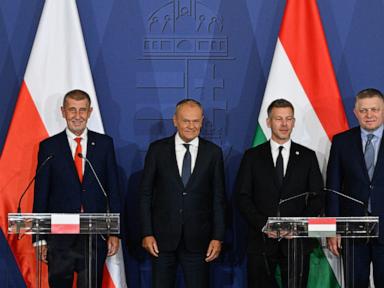
The Visegrad Four is dead in all but name. When the prime ministers of Poland, the Czech Republic, Slovakia, and Hungary gathered in Budapest for what was billed as a regional reboot, the polite handshakes for the cameras could not mask a deeper institutional rot. For three decades, this alliance functioned as a formidable voting bloc within the European Union, leveraging collective bargaining power to punch above its weight in Brussels. Today, ideological polarization over the war in Ukraine and the rule of law has turned the alliance into an empty shell. The Budapest summit was not a resurrection. It was an exercise in damage control.
Central Europe is no longer a cohesive political unit. The dividing lines are sharp, structural, and likely permanent. Meanwhile, you can find related developments here: The Great Uncoupling and the Quiet Regret of a Nation.
The Illusion of a Shared Border and a Shared Mindset
Geographic proximity does not guarantee geopolitical alignment. For years, Western analysts treated the Visegrad group—frequently abbreviated as the V4—as a monolithic bloc of post-communist skeptics. This was always a lazy simplification. The alliance succeeded only when its members shared a common enemy or a highly specific, transactional goal. They united to enter NATO, they synchronized their entries into the European Union, and they stood shoulder-to-shoulder during the 2015 migration crisis to reject mandatory migrant quotas.
Once those immediate crises faded, the underlying differences reemerged. To see the bigger picture, check out the detailed article by USA Today.
The current friction centers on a fundamental disagreement regarding regional security. Poland and the Czech Republic view Russian expansionism as an existential threat. Warsaw is rapidly expanding its military spending toward four percent of its gross domestic product, purchasing hundreds of main battle tanks and artillery systems from the United States and South Korea. Prague has led international initiatives to source hundreds of thousands of artillery shells for Ukrainian forces from non-EU countries.
Meanwhile, Hungary and Slovakia have pivoted toward a policy of accommodation. Budapest has consistently delayed EU aid packages to Kyiv and maintained deep energy dependencies on Moscow, securing exemptions from maritime oil embargoes. Bratislava, following its recent electoral shifts, halted state-sponsored military aid to Ukraine, pivoting toward a stance that prioritizes immediate peace negotiations over territorial integrity.
When an alliance cannot agree on the primary security threat to its neighborhood, it ceases to be an alliance. It becomes a debating society.
The Economic Realities Overriding Political Theater
Behind the rhetoric of regional cooperation lies a harsh economic truth. The V4 countries do not primarily trade with each other. Their economies are structurally hardwired into the industrial supply chains of Western Europe, specifically Germany.
The German Locomotive and the Automotive Trap
The economic heartbeat of Central Europe is dictated by the automotive factories of Bavaria and Baden-Württemberg. Poland, the Czech Republic, Slovakia, and Hungary function as the engine room for German industry. They supply the labor, the assembly plants, and the component manufacturing that keep Western European brands competitive globally.
Consider the sheer concentration of automotive dependency. Slovakia produces more cars per capita than any other nation on earth. Hungary has transformed itself into a major hub for electric vehicle battery manufacturing, drawing massive investments from Chinese conglomerates alongside established German luxury brands. The Czech Republic’s economic health is structurally tied to the export performance of its industrial manufacturing sector.
This shared dependency creates competition, not cooperation. These four nations routinely engage in bidding wars against one another, offering massive state subsidies, tax holidays, and infrastructure concessions to attract the exact same foreign direct investment. When a major automotive manufacturer looks to build a new assembly plant in Central Europe, the V4 partners do not cooperate. They compete aggressively behind closed doors.
The transition to electric vehicles has intensified this rivalry. As internal combustion engines are phased out, the supply chains that sustained regional growth for twenty-five years are being torn up. Each capital is scrambling to secure its own survival in the new industrial order. Hungary has gambled heavily on becoming a bridge between Chinese battery tech and Western carmakers. Poland has focused on building an ecosystem for commercial electric vehicles and battery components.
These individual survival strategies leave no room for a coordinated regional economic policy.
The Institutional Paralysis in Brussels
In the halls of the European Parliament and the European Council, the V4 used to operate as a diplomatic force multiplier. If one member faced pressure from Brussels over budgetary issues or regulatory non-compliance, the other three could provide defensive cover. The threat of a collective veto gave the region immense leverage during multi-year budget negotiations.
That defensive shield has shattered.
The turning point arrived with the invocation of Article 7 proceedings—the EU’s mechanism for punishing member states deemed at risk of breaching core European values. For years, Poland under its previous administration and Hungary ran interference for each other, effectively blocking the unanimity required to impose meaningful sanctions or strip voting rights.
The political shift in Warsaw changed everything. The current Polish administration has aggressively moved to align itself back with the European mainstream, systematically unravelling the judicial changes that had put it at loggerheads with Brussels. This pivot yielded immediate financial dividends, unlocking tens of billions of euros in frozen pandemic recovery funds and cohesion grants.
V4 Geopolitical Realignment (Post-2024)
─────────────────────────────────────────────────────────────
Atlanticist / Pro-Mainstream Bloc:
  - Poland: Unlocked EU funds, aggressive military expansion
  - Czech Republic: Sourcing global munitions, pro-Western integration

Sovereigntist / Accommodational Bloc:
  - Hungary: Frozen EU funds, Chinese investment hub, Russian energy ties
  - Slovakia: Halted state military aid, nationalist coalition shift
─────────────────────────────────────────────────────────────
Poland's realignment left Hungary isolated. Prague had already grown weary of Budapest's frequent usage of the veto to stall consensus on broader European security decisions. The Czech leadership openly questioned the utility of participating in summits where foreign policy discussions ended in a stalemate.
Slovakia's recent political trajectory has added another layer of volatility. The government in Bratislava shares much of Budapest’s rhetoric regarding sovereignty and skepticism of Western defense frameworks. Yet, Slovakia operates under a constraint that Hungary does not share. Slovakia is part of the Eurozone.
Adopting the single currency binds Bratislava to European financial institutions and regulatory frameworks in a way that Budapest, which retains the forint, avoids. Slovakia cannot afford total diplomatic isolation; its banking system and fiscal stability are hardwired into Frankfurt. This economic reality prevents a seamless political axis between Hungary and Slovakia from fully replacing the old V4 dynamic.
The Structural Failure of Regional Infrastructure
If the V4 were a functional regional alliance, it would be held together by physical infrastructure. It is not.
Thirty years after the fall of the Iron Curtain, infrastructure in Central Europe remains stubbornly oriented on an East-West axis. It is remarkably easy to catch a high-speed train or drive on a modern highway from Prague to Munich, or from Poznań to Berlin. Try traveling efficiently from northern Poland down to southern Hungary via rail, and you enter a labyrinth of delayed connections, outdated tracks, and administrative bottlenecks.
The North-South transit corridor remains an unfinished patchwork. The Via Carpathia highway project, designed to link the Baltic ports of Poland with the Aegean Sea, has suffered from decades of uneven funding, varying environmental standards, and shifting political priorities across different borders. Pipeline networks tell a similar story. While Western Europe built extensive networks, the interconnectors necessary to move gas and electricity seamlessly between Poland and its southern neighbors were treated as secondary priorities until geopolitical shocks forced a chaotic realignment.
This lack of physical integration is the truest indicator of political priority. Governments build infrastructure where they intend to do business. For the V4, the money, the goods, and the people still move toward the West or, increasingly, toward individual global partners, leaving the rhetoric of central European unity exposed as a diplomatic fiction.
The Shift Toward Fragmented Alliances
The failure of the V4 does not mean Central European states will stop talking. It means they are moving toward more fluid, ad-hoc coalitions that reflect current realities rather than historical nostalgia.
We are seeing the rise of mini-lateralism. Poland is increasingly looking to the Weimar Triangle—a diplomatic framework connecting Warsaw, Paris, and Berlin—to cement its status as a heavyweight in European defense policy. Simultaneously, Poland has strengthened ties with the Baltic states and the Nordic countries, forming a highly focused, security-driven northern tier that views regional stability through an identical lens.
The Czech Republic has frequently operated within the "Slavkov format," a trilateral grouping with Austria and Slovakia that focuses on Central European logistics, border management, and localized economic cooperation. This smaller grouping allows Prague to engage its immediate neighbors without the heavy ideological baggage that now accompanies every V4 interaction.
Hungary, finding itself decoupled from its traditional regional partners, has turned its attention outward. It has aggressively courted non-Western capital, positioning itself as a primary European landing pad for Chinese infrastructure initiatives and manufacturing facilities. This strategy aims to leverage external partnerships to offset its diminishing influence within the internal councils of the European Union.
These shifting dynamics demonstrate that the Budapest meeting was a formality, a legacy obligation fulfilled by leaders who know the old framework no longer serves their national interests. The Visegrad Four survived as long as it did because it was a low-cost mechanism for amplification. The moment the costs of association outweighed the benefits of collective bargaining, the architecture collapsed. The summit in Hungary did not fix the foundation; it merely put a fresh coat of paint on a building that everyone is already moving out of.