The lights in a boxing ring are not designed for mercy. They are high-output, unforgiving halogen beasts that turn sweat into diamonds and blood into black ink. When you stand under them, there is no place to hide. Your flaws, your fatigue, and your fears are broadcast in high definition to thousands of people who paid specifically to see a man stripped down to his most primal components.
The crowd doesn't just want the punch. They want the truth.
In a recent middleweight bout, the truth arrived in a way that had nothing to do with a left hook or a stinging jab. It happened in the fourth round. The rhythm was standard: breathing, leather on leather, the squeak of canvas. Then, a glancing blow caught the side of a fighter’s head—not enough to rattle his brain, but just enough to disrupt the adhesive that held his dignity in place.
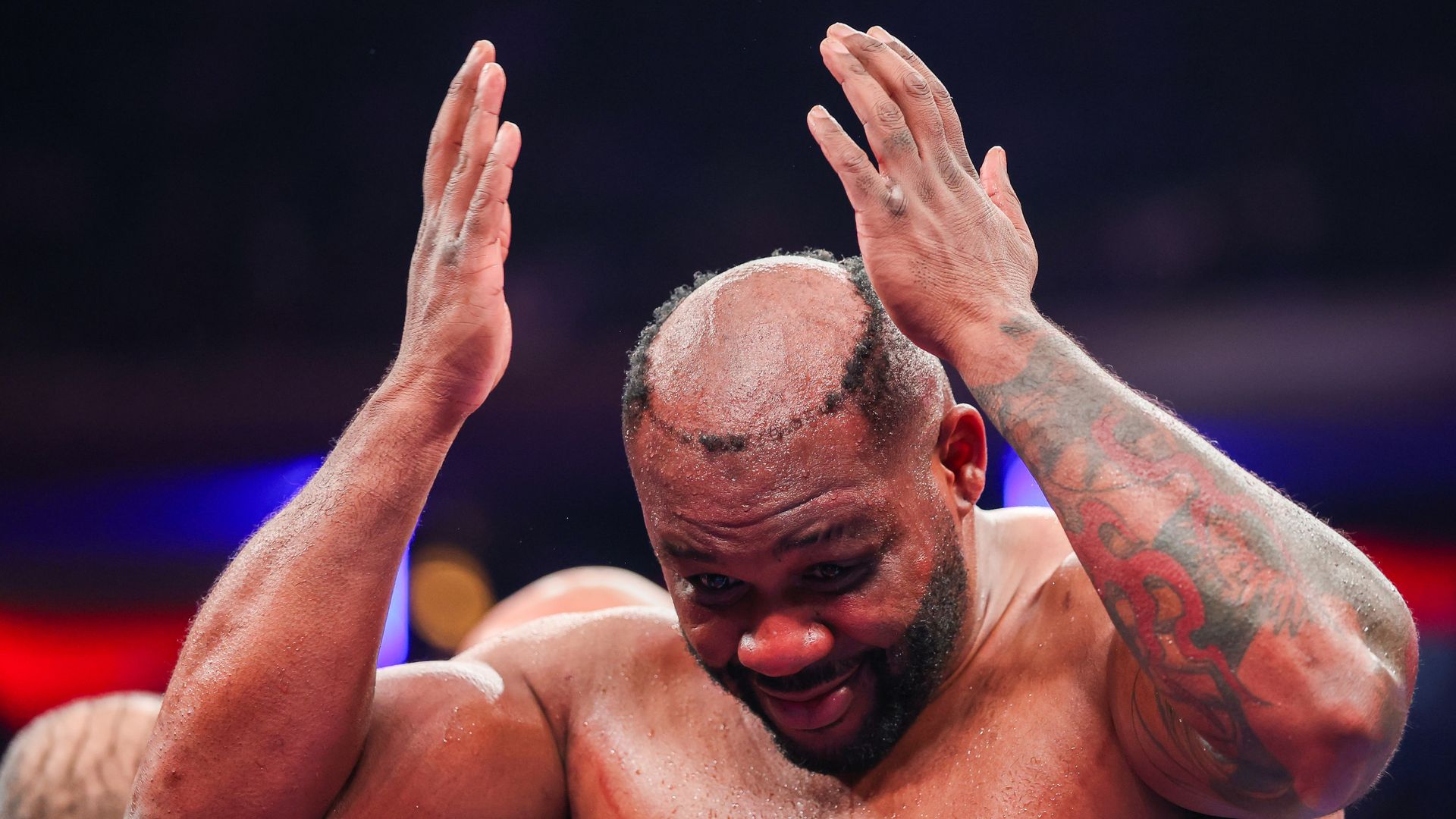
His hairpiece fell.
It didn't just slide. It tumbled, a dark, synthetic intruder landing on the white floor like a dead bird. The referee, trained to look for mouthguards and low blows, paused. The opponent froze. For a fleeting, agonizing second, the violence of professional boxing was replaced by a silence so heavy it felt like it might collapse the arena.
The Invisible Armor
We talk about boxers in terms of "chin" and "heart." We analyze their reach and their footwork. But we rarely talk about the specific, frantic vanity that haunts a man whose job is to be an icon of hyper-masculinity. To the casual observer, a hairpiece in a boxing ring is a punchline. It is a viral clip, a GIF to be shared with a mocking caption, a moment of slapstick in a theater of war.
But look closer.
To the man in the ring, that hairpiece was part of his armor. It was the version of himself he felt he had to project to be taken seriously in a world that equates physical perfection with power. When it hit the floor, he wasn't just losing a cosmetic accessory; he was suffering a public flaying. Imagine the psychological weight of entering a cage with another human being who is trying to break your ribs, while your mind is split, half-focused on your guard and half-focused on whether the glue is holding under the torrent of sweat.
The sheer cognitive load is staggering.
Boxing is a game of millimeters and split-second decisions. If you are worried about your hairline, you aren't worried about the overhand right. That hairpiece was a liability he carried because the alternative—the vulnerability of showing his true self—was more terrifying than a concussion.
The Anatomy of the Moment
Let's dissect the physics of the disaster. A boxing ring is essentially a sauna. Your core temperature spikes to 102 degrees Fahrenheit within minutes. Sweat isn't just water; it’s a mixture of salt and oils that act as a universal solvent for most medical-grade adhesives.
Consider a hypothetical fighter we’ll call "The Ghost." He’s been thinning since he was twenty-two. Every time he looks in the mirror, he sees his father, a man who lost his hair and, in the Ghost’s mind, his edge. So, he buys the best "system" money can afford. He tests it in the gym. He runs in the rain. He thinks it’s bulletproof.
But a gym session isn't a title fight.
In a title fight, the adrenaline causes your scalp to swell slightly. The friction of the clinch—the way boxers lean their heads against one another’s shoulders to rest—is like sandpaper. By the third round, the Ghost’s hairpiece isn't an extension of his body anymore. It’s a foreign object struggling to stay grounded.
When it finally gave way in that real-world bout, the fighter didn't rage. He didn't cover his face. He simply stood there, exposed. In that moment, he was no longer a gladiator. He was a man. He was every man who has ever looked in a mirror and felt a piece of his youth slipping away. He was every person who has ever worn a metaphorical mask to work, terrified that someone might see the insecurity lurking beneath the professional veneer.
Why We Laugh and Why We Shouldn't
The laughter from the rafters was reflexive. It’s a defense mechanism. We laugh because the situation is absurd, yes, but also because it is relatable in its horror. It is the "naked in school" dream made manifest in front of a global audience.
There is a cruel irony in the sport of boxing. It is a discipline built on the "sweet science," yet it remains the most visceral, honest display of human struggle. There is no equipment to blame. There is no teammate to pass the ball to. It is just you.
When the hairpiece fell, the "science" vanished.
The crowd’s reaction shifted from mockery to a strange, uncomfortable empathy as the fighter’s corner scrambled to deal with the situation. They weren't just fixing his hair; they were trying to patch a hole in his soul. They were trying to give him back his persona so he could go back to the business of being hit in the face.
But the damage was done. Not to his record—the fight continued—but to the illusion.
The Cost of the Mask
The "Hidden Cost" of this event isn't the price of a high-end toupee. It’s the energy spent maintaining a lie. In any industry—business, entertainment, or sports—the more we obsess over the "look" of success, the less we have left for the "act" of it.
This fighter spent years building a brand. He was the "Bad Boy," the "Handsome Champ." He sold tickets based on an image of invulnerability. But the most "invulnerable" thing he could have done was to walk into that ring exactly as he was.
There is a peculiar power in authenticity that we often ignore because it feels like weakness. We see a bald fighter like Marvin Hagler or George Foreman and we see strength. We see a man who has nothing to hide. Their lack of hair becomes a statement: I am here to fight, not to pose.
By trying to hold onto a vestige of his youth, the fighter in the ring that night created a weakness where none existed. He turned his scalp into a target. Not for his opponent's gloves, but for the world's judgment.
The Second Round of Life
The fight ended, as all fights do. The scores were tallied. The ring was cleared. But the video remained.
In the aftermath, the conversation shouldn't be about the quality of the glue or the name of the hairpiece manufacturer. It should be about the crushing pressure we place on men to never age, to never show a flaw, and to remain frozen in a state of perpetual, rugged perfection.
If a man who literally fights for a living is afraid to show a receding hairline, what does that say about the rest of us? What does it say about the executive who dyes his hair in the bathroom sink before a board meeting, or the father who won't go swimming with his kids because he’s self-conscious about his torso?
We are all wearing hairpieces of one kind or another.
Some are made of synthetic fibers. Others are made of inflated resumes, filtered social media photos, or the forced stoicism we use to hide our grief. We spend our lives in the ring, terrified that a glancing blow will knock our mask sideways and show the world that we are just human, just aging, and just as scared as everyone else.
The fighter who lost his hairpiece that night didn't lose his dignity. He was robbed of a disguise he never should have felt forced to wear. The real tragedy wasn't the hair on the floor. It was the fact that for one moment, a champion felt small because he was seen for exactly who he was.
The lights in the ring are still bright. They are still unforgiving. But perhaps the next time a fighter steps into that circle, he’ll realize that the crowd isn't just there for the knockout. They are there to see someone survive the truth.
The hair stayed on the canvas. The man walked out. And in the cold air of the arena corridor, far from the halogens and the cameras, he was finally, mercifully, himself.