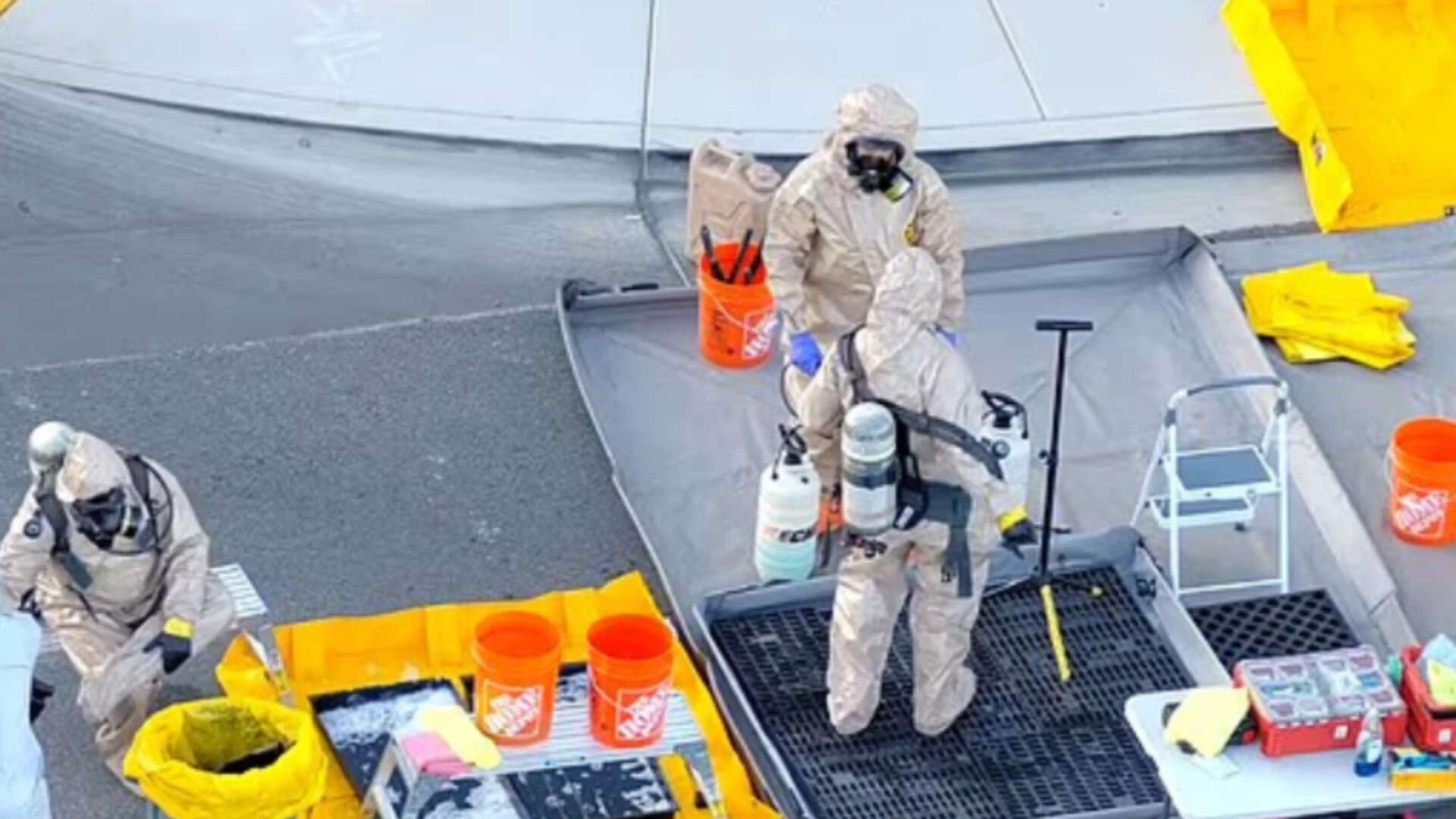
The warehouse looked like a place where dreams of small businesses go to die. It sat on an unremarkable street in Reedley, California, a town better known for its fruit packing than for international intrigue. To any passerby, the building at 850 I Street was a concrete shell, a relic of Central Valley commerce. But inside, the air didn't smell like dusty boxes or old machinery. It smelled like a secret.
When local code enforcement officer Jesalyn Harper first walked through the door in late 2022, she wasn't looking for a geopolitical flashpoint. She was looking for a garden hose. A simple violation—a hose poking out of a wall where it shouldn't be—led her into a labyrinth that would eventually summon the FBI, the CDC, and the harrowing realization that the infrastructure of global biology is far more fragile than we care to admit.
What she found wasn't just a messy floor plan. It was a makeshift laboratory humming with the sound of industrial-grade cooling units and the frantic scuttle of nearly a thousand bioengineered mice.
The Room of Floating Names
The scale of the discovery is difficult to grasp until you look at the labels. In the silence of that unauthorized facility, investigators found vials. Hundreds of them. Some were neatly organized; others were tucked away in cheap, consumer-grade freezers that belonged in a garage, not a high-security lab.
The names on those vials read like a roster of humanity’s greatest fears. HIV. Hepatitis. Chlamydia. Malaria. Even the words that make seasoned epidemiologists hold their breath: Ebola and SARS-CoV-2.
Imagine a world—no, don't imagine it. Look at the reality of it. A technician, perhaps working for a company called Prestige BioTech, reaches into a freezer. They aren't wearing a pressurized suit. They aren't passing through a triple-filtered airlock. They are in a warehouse in a town of 25,000 people, handling pathogens that could jumpstart a local catastrophe with a single broken glass slide.
This wasn't a state-of-the-art research center. This was a shadow.
The Cost of the Invisible
We often think of biological threats as something that happens in movies, involving sleek underground bunkers and scientists in glowing masks. The Reedley lab strips away that comfort. It tells us that the real danger is mundane. It is a lack of paperwork. It is a company registered in Nevada but linked to entities in China, operating under the radar because the gaps in our regulatory net are wide enough to drive a semi-truck through.
The "human element" here isn't just the people who ran the lab. It is the community living blocks away. It is the parents taking their kids to the park, unaware that a few streets over, nearly 1,000 mice were being kept in squalid conditions, specifically bred to catch and carry the human immune system’s worst nightmares. These weren't pets. They were biological mirrors, designed to reflect our own vulnerabilities back at us.
When the CDC finally descended on the site, the tension was thick enough to taste. They found that the lab was unlicensed, uninspected, and fundamentally chaotic. The owner of the facility, a man later identified as Jia Bei Zhu, had a history of legal entanglements and lived under various aliases. He wasn't a cartoon villain; he was a ghost in the machine of global trade.
A System Built on Handshakes
How does this happen? The answer is a bitter pill of logic.
Our modern world is built on the speed of commerce. We want things fast, cheap, and global. We have created a system where a company can ship biological materials across borders as easily as someone might ship a pair of shoes. When Prestige BioTech moved from Canada to California, they didn't trigger a massive red flag. They simply moved.
The expertise required to manipulate these viruses is no longer confined to the elite corridors of Harvard or the high-containment labs of the CDC. The democratization of technology means that the tools for synthetic biology—the stuff of "God’s work"—are available to anyone with a credit card and a shipping address.
But the wisdom to manage those tools? That hasn't kept pace.
We are living in an era where the hardware of the future is being operated with the safety standards of a 19th-century sweatshop. In Reedley, the cooling systems for the virus samples were failing. The power was inconsistent. If the grid had flickered out on a hot July afternoon, the result wouldn't have just been a spoiled inventory. It would have been a biological slurry, potentially leaking into the groundwater or being handled by unsuspecting cleanup crews.
The Mouse in the Maze
Consider the mice.
Seven hundred and seventy-three of them were found alive; nearly two hundred were already dead. They were "transgenic," a clinical term that masks a profound reality. Their DNA had been tinkered with to ensure they would respond to viruses exactly like a human would.
In a proper lab, these animals are treated with a strange, clinical reverence. They are the frontline of defense. In the Reedley warehouse, they were clutter. They were stacked in plastic bins, living in their own waste, a frantic, squeaking biomass that represented a staggering breach of every ethical and safety protocol known to modern science.
The tragedy isn't just that this lab existed. The tragedy is that we only found it because of a garden hose.
It wasn't a high-level intelligence operation that cracked the case. It wasn't a satellite scan or a whistleblower in a lab coat. It was a local employee noticing something physically wrong with a building. It was the intuition of a small-town official who felt, in her gut, that something didn't belong.
The Fragile Shield
There is a certain vulnerability in admitting we don't know how many more "Reedleys" are out there. The United States has strict laws for its own legitimate labs, but what about the labs that don't claim to be labs? What about the "testing centers" and "medical supply depots" that are actually functioning as makeshift research hubs for foreign interests?
The investigation into the Reedley facility revealed links to a web of Chinese companies and bank accounts. This introduces a layer of geopolitical friction that is hard to ignore. When biological research happens in the dark, without oversight, the line between "public health research" and "bioweapon development" becomes a smear of gray.
Trust is the currency of science. We trust that when a needle goes into an arm, the liquid inside was made in a clean room. We trust that the pathogens studied by our government are locked behind doors that require more than a bolt-cutter to open. The Reedley lab spent months spending that currency without our permission.
Beyond the Concrete
Eventually, the city of Reedley had to deal with the aftermath. They had to figure out how to destroy thousands of gallons of hazardous waste and biological material. They had to figure out how to euthanize nearly a thousand mice and incinerate the remains without releasing a plume of contagion into the California sky.
The cost ran into the hundreds of thousands of dollars. The emotional cost to the community is harder to quantify. There is a new kind of silence in that part of town now. It’s the silence of looking at an empty building and wondering what else is breathing behind the bricks of the warehouse next door.
We often talk about the "next pandemic" as if it will arrive on a plane from a distant continent. We imagine a wet market or a jungle clearing. We rarely imagine a nondescript office park in a fruit-growing town, where the air conditioning is humming just a little too loud and the freezers are filled with names that belong in a high-security vault.
The mystery of Jia Bei Zhu and Prestige BioTech isn't just a story about a crime. It is a story about the end of the illusion of distance. In the 21st century, the most dangerous things in the world don't need an invitation. They just need a landlord who doesn't ask too many questions and a door that stays closed.
The garden hose is gone now. The warehouse is empty. The mice are dead. But the questions remain, vibrating in the air like the hum of a cheap freezer, reminding us that the invisible stakes of our modern world are often hidden in plain sight, just waiting for someone to notice the wrong thing in the right place.
The most terrifying thing about the unmarked door wasn't what was behind it, but how long it stayed shut.