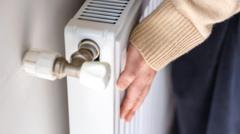
The erosion of fixed-income purchasing power by volatile energy commodities represents a systemic failure of household risk management. When a retired individual reports that the majority of their pension is consumed by home heating oil, they are describing a terminal collision between stagnant income indexation and unhedged exposure to the global Brent Crude market. This phenomenon, often colloquially termed "heat or eat," is more accurately defined as a liquidity trap driven by inefficient thermal envelopes and high-alpha commodity exposure.
To solve the crisis of fuel poverty, we must deconstruct the household energy equation into its component variables: the thermal efficiency of the structure, the seasonal price volatility of Kerosene (C12-C15 hydrocarbons), and the rigid nature of fixed-pension disbursements.
The Triad of Thermal Vulnerability
The vulnerability of a household to energy price shocks is determined by three primary drivers. Most public discourse focuses on price, yet price is the only variable the consumer cannot influence.
- Thermal Leakage (The Efficiency Floor): Older residential stocks often lack cavity wall insulation or modern glazing. This creates a high "base load" of energy required just to maintain a physiological minimum temperature of 18°C.
- The Poverty Premium of Batch Procurement: Unlike natural gas, which is metered and paid in arrears, home heating oil requires large upfront capital outlays for 500 or 1,000-liter deliveries. Households with low liquidity are forced to buy smaller quantities at higher unit costs, exacerbating the financial strain.
- Commodity Beta: Heating oil (Kerosene) correlates highly with international crude prices. While gas and electricity markets are subject to varying degrees of regulatory price caps or hedging by utilities, the individual heating oil consumer is a "price taker" in a raw commodity market.
The Physics of Financial Displacement
The core of the problem lies in the Energy Burden Ratio. In a stable economic environment, energy costs should ideally represent less than 10% of a household’s net income. For a pensioner reliant on a state-provided stipend, a 300% spike in heating oil prices—common during geopolitical instability—can push this ratio toward 40% or 50%.
This displacement is not linear. Because caloric intake and medical expenses are also non-discretionary, the energy spike forces a "survival trade-off." The logic of the home heating oil market dictates that as the price per liter rises, the consumer’s ability to maintain a healthy living environment inversely collapses.
The Efficiency Gap Equation
The heat required to maintain a temperature ($T_i$) against an external temperature ($T_e$) is governed by the heat loss coefficient of the building ($U$).
$$Q = U \times A \times (T_i - T_e)$$
Where:
- $Q$ is the heat loss.
- $U$ is the thermal transmittance of the building materials.
- $A$ is the surface area.
For a pensioner in an uninsulated 1950s bungalow, the $U$ value is high. To keep $T_i$ at a safe level, the heat input $Q$ must be massive. When the cost of producing $Q$ via oil exceeds the disposable income allocated for that month, the only remaining variable is $T_i$. The resident allows the internal temperature to drop, leading to secondary health costs including respiratory distress and increased cardiovascular strain, which eventually shift the financial burden from the individual’s wallet to the public healthcare system.
Structural Bottlenecks in Rural Infrastructure
A significant portion of the population reliant on heating oil lives "off-grid." This geographic isolation creates a logistical bottleneck. The lack of natural gas infrastructure removes the possibility of a regulated utility buffer. These households are tethered to a delivery-truck model that is sensitive to:
- Last-mile delivery costs: Fuel surcharges for delivery vehicles.
- Regional Monopolies: Limited competition among local distributors in rural areas.
- Storage Limitations: Small or aging tanks that prevent buying in bulk during summer price troughs.
The inability to switch fuels—due to the high capital expenditure required for heat pump installation or biomass boilers—traps the pensioner in a legacy system. The "pensioner’s dilemma" is thus a capital expenditure (CAPEX) problem disguised as an operating expense (OPEX) crisis. They cannot afford the $15,000 to $20,000 required to transition to renewables, so they continue to pay a $4,000 annual "tax" in the form of inefficient oil consumption.
Quantifying the Policy Failure
Current government interventions typically focus on Direct Transfer Payments (e.g., Winter Fuel Allowances). From a systems-engineering perspective, this is a suboptimal "band-aid" strategy.
- Inflationary Pressure: Direct cash transfers in a supply-constrained market can sometimes lead to price floors being maintained by distributors.
- Efficiency Neglect: Giving a pensioner £500 to buy oil for a house that leaks 40% of its heat through the roof is an inefficient use of state capital.
- Short-termism: The payment addresses the immediate liquidity crisis but leaves the underlying thermal deficiency untouched for the following year.
A more rigorous approach involves Fabric-First Intervention. If the state redirected the cumulative value of five years of emergency fuel payments into a one-time deep retrofit (insulation, air sealing, and high-efficiency windows), the base load $Q$ would drop significantly. This would move the household toward "Passive House" standards, where the Energy Burden Ratio remains stable regardless of commodity price swings.
The Strategic Path Forward
The resolution of energy poverty in oil-dependent households requires a transition from reactive subsidy to proactive asset optimization.
1. Cooperative Procurement Models
Individual pensioners have zero bargaining power. The formation of community-led "Oil Clubs" allows for bulk purchasing and optimized delivery routes. This reduces the "poverty premium" by leveraging economies of scale. By aggregating the demand of 50 households, a community can negotiate a "spot-plus" pricing model rather than accepting the retail price quoted on the day of a low-tank emergency.
2. High-Efficiency Thermal Storage
Oil boilers are often operated inefficiently in short bursts. Integrating large thermal stores (water tanks) allows the boiler to run at its maximum steady-state efficiency, storing heat for gradual release. This decouples the combustion cycle from the heating demand, reducing fuel consumption by an estimated 10-15%.
3. Graduated Retrofit Financing
Since the primary barrier to leaving the oil market is the upfront cost of heat pumps or solar thermal systems, the financial sector must develop "Green Annuities" or "Property-Linked Loans." In this model, the cost of the energy upgrade is repaid via the savings on the monthly energy bill. If a pensioner saves $200 a month on oil, $150 of that can be diverted to pay off the insulation or heat pump, leaving them with $50 in increased monthly liquidity and a more valuable, warmer home.
The current trajectory for oil-dependent pensioners is one of diminishing returns. As global carbon pricing increases and fossil fuel extraction costs rise, the "old-pension-for-old-oil" trade becomes unsustainable. The only viable exit strategy is a total decoupling of domestic comfort from liquid fuel combustion. This necessitates a shift in focus from the price per liter to the kilowatt-hour per square meter.
The immediate strategic priority for any individual or policymaker is the elimination of thermal waste. Every dollar spent on fuel that escapes through a ceiling is a dollar stripped from the pensioner's quality of life. The objective is not to make oil cheaper; it is to make oil unnecessary. This requires a ruthless prioritization of insulation over subsidy and a transition from a commodity-dependent heating model to a technology-driven one.
Identify the highest-loss surfaces in the dwelling today. Seal the building envelope before the next heating season begins. Divert all available emergency subsidies into permanent R-value improvements. This is the only way to break the cycle of energy-induced poverty.