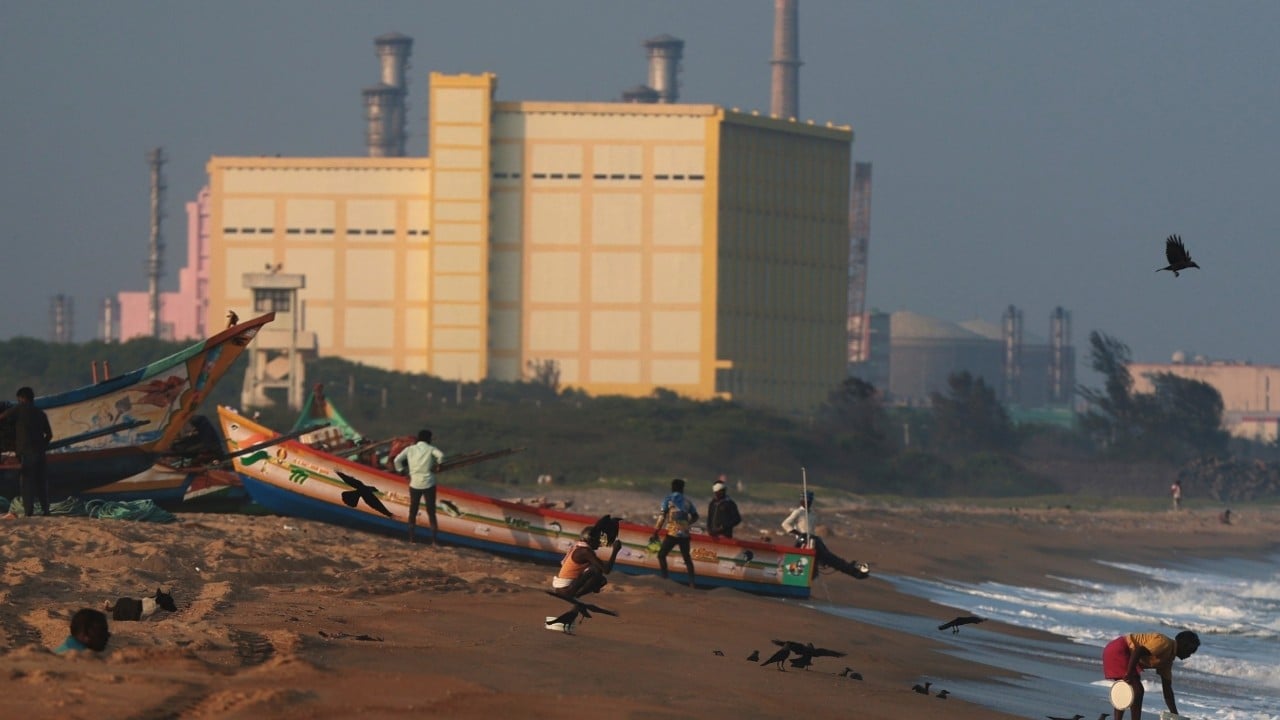
India has finally moved the needle on a nuclear dream that has eluded the rest of the world for seven decades. With the commencement of core loading at the Prototype Fast Breeder Reactor (PFBR) in Kalpakkam, the nation is no longer just theorizing about energy independence. It is building the physical architecture for it. This isn't about mere incremental gains in power generation; it is a high-stakes bet on the Stage II of a three-tier nuclear program designed to eventually tap into the world’s largest deposits of thorium. While the global north retreats into the perceived safety of renewables or stalls on aging pressurized heavy water reactors, New Delhi is attempting to master the physics of "breeding" more fuel than it consumes.
Success here means India can bypass the geopolitical stranglehold of the Uranium Suppliers Group. Failure would mean billions of dollars sunk into a liquid-sodium-cooled experiment that several other nations, including France and Japan, eventually abandoned due to technical volatility. For a different look, see: this related article.
The Physics of Self Sufficiency
To understand why this matters, one must look at the fuel cycle. Most of the world’s reactors run on a "once-through" cycle using Uranium-235. This isotope makes up less than 1% of natural uranium. It is a scarce resource. India, however, sits on roughly 25% of the world’s thorium. The catch is that thorium itself is not fissile. You cannot just put it in a reactor and expect a chain reaction. It is "fertile," meaning it must be converted into Uranium-233 inside a reactor before it can produce energy.
The PFBR serves as the bridge. It uses a mix of Uranium and Plutonium to create a high-energy neutron environment. These neutrons strike a "blanket" of depleted uranium, transforming it into more plutonium. Eventually, this same logic applies to thorium. By mastering the breeder reactor, India creates a machine that acts as a fuel factory. Further coverage on this matter has been provided by The Verge.
It is a closed loop. If the PFBR reaches stable commercial operation, India can transition to Stage III, where thorium-fueled reactors provide a carbon-free grid for centuries. This isn't just a technical milestone. It is an act of defiance against a global energy order that has long relegated developing nations to the role of technology importers.
The Sodium Problem and Engineering Risks
The road to Kalpakkam has been littered with delays. This reactor was originally supposed to go online over a decade ago. The reason for the stall is simple: handling liquid sodium is an engineering nightmare.
Unlike water-cooled reactors, a fast breeder uses liquid sodium as a coolant because it doesn't slow down neutrons. But sodium is temperamental. It burns instantly upon contact with air and reacts explosively with water. Managing these risks requires a level of metallurgical precision that tests the limits of industrial manufacturing.
- Corrosion Management: Sodium circulates at temperatures exceeding 500 degrees Celsius. Every pipe, valve, and weld must withstand this caustic environment for decades.
- Thermal Shocks: Fast reactors experience rapid temperature shifts that can fatigue the structural steel of the reactor vessel.
- Neutron Economy: The margin for error in maintaining the "breeding ratio" is razor-thin. A slight deviation in core geometry can tank the efficiency of the entire fuel cycle.
Critics often point to the Monju reactor in Japan or the Superphénix in France. Both were ambitious breeder projects that suffered from sodium leaks and political opposition, eventually leading to their decommissioning. India is betting that its indigenous design has accounted for these failures. The Department of Atomic Energy (DAE) argues that their pool-type design, where the main components are submerged in a large tank of sodium, inherently limits the risk of catastrophic leaks. It is a bold claim that only years of continuous operation can verify.
Chokepoints in the Supply Chain
While the physics is sound, the industrial reality is more complex. Building a fleet of these reactors requires a specialized supply chain that currently barely exists. India has relied heavily on the Bharatiya Nabhikiya Vidyut Nigam Limited (BHAVINI) to spearhead the construction, but the private sector involvement remains fragmented.
For the three-stage program to scale, India needs more than one prototype. It needs a production line of reactors. This requires massive investment in specialized steel alloys and precision heavy engineering. The global market for these components is restricted. Because India is not a signatory to the Nuclear Non-Proliferation Treaty (NPT), it has historically faced "technology denial" regimes. While the 2008 civil nuclear deal eased some of these pressures, the most sensitive fast-reactor technologies remain closely guarded secrets.
Consequently, the PFBR is almost entirely indigenous. This is a source of pride, but also a bottleneck. If a specific custom-built component fails, there is no international catalog to order a replacement from. Everything must be fabricated at home.
The Financial Burden of Innovation
Nuclear power is never cheap upfront. The cost of the PFBR has ballooned significantly since its inception. When you factor in the research and development costs spanning three decades, the price per kilowatt-hour looks daunting compared to solar or wind.
However, looking at the "overnight cost" of a reactor is a mistake. Solar power in India is cheap because of geography, but it lacks the baseload reliability needed for heavy industry. Battery storage at a national scale remains a distant prospect. Nuclear provides that 24/7 "always-on" power. When India calculates the cost of thorium, it isn't just looking at the electricity bill. It is looking at the cost of national security.
Every ton of uranium India has to import is a point of geopolitical vulnerability. During the 1974 and 1998 nuclear tests, the world cut off fuel supplies, leaving Indian reactors running at half capacity. The thorium plan is the insurance policy against that ever happening again.
Environmental Paradoxes
The narrative of nuclear energy is often dominated by the fear of waste. In a traditional uranium reactor, the "spent fuel" remains radioactive for tens of thousands of years. The breeder reactor changes this math.
By "burning" long-lived transuranic elements, the fast breeder process can actually reduce the volume and toxicity of the waste. It turns what would be high-level waste into fuel for the next generation of reactors. This makes the long-term storage problem much more manageable.
Furthermore, the land footprint of a nuclear plant is a fraction of what is required for a solar farm of equivalent output. In a country as densely populated as India, land acquisition is often the death knell for large-scale infrastructure projects. A single nuclear site can generate gigawatts of power while occupying a few hundred acres.
The Geopolitical Shift
India’s progress in fast breeder technology is being watched closely by China and Russia. Russia currently leads the world in operational fast reactors with its BN-600 and BN-800 models. China is aggressively pursuing its own CFR-600 breeder program.
The West, meanwhile, has largely ceded the field. The United States and the United Kingdom, once leaders in breeder research, have pivoted toward Small Modular Reactors (SMRs). While SMRs are easier to finance and build, they do not solve the fundamental fuel scarcity issue that the breeder reactor addresses.
By sticking to the thorium roadmap, India is positioning itself as a potential exporter of Stage II and Stage III technology to other thorium-rich nations like Brazil or Turkey. If the PFBR proves successful, the "Global South" may soon have a nuclear leader that isn't a member of the traditional Western atomic club.
The Operational Litmus Test
The next 24 months are the most critical in the history of Indian science. Moving from "core loading" to "full commercial power" is a journey fraught with technical hurdles. Every sensor, pump, and control rod will be tested under the extreme conditions of a fast-neutron flux.
We must also consider the human element. Operating a breeder reactor requires a specialized workforce with a deep understanding of fast-reactor kinetics. The DAE has spent years training a new generation of scientists, but the real-world experience of managing a sodium-cooled core cannot be simulated.
There is no room for "almost" in nuclear engineering. The PFBR must achieve a high Capacity Factor to be economically viable. If the reactor is constantly offline for maintenance or safety checks, the dream of thorium-based independence will remain just that—a dream.
Reforming the Nuclear Regulatory Framework
For this technology to proliferate, India’s regulatory environment must evolve. The Atomic Energy Regulatory Board (AERB) currently operates under the umbrella of the Department of Atomic Energy. This has led to concerns regarding the independence of safety audits.
For the public to trust a nationwide rollout of fast breeder reactors, the regulator must be seen as an autonomous body with the power to shut down projects that don't meet international safety benchmarks. Transparency isn't just a buzzword; it is a prerequisite for the "social license" needed to build nuclear plants near population centers.
Strategic Autonomy and the End of the Uranium Era
The global energy transition is often framed as a choice between fossil fuels and renewables. This is a false binary. For a nation of 1.4 billion people with a rapidly growing industrial base, the solution has to be a "both/and" approach.
The Kalpakkam breeder reactor represents the final piece of the puzzle. It is the machine that turns a common beach sand mineral into the backbone of a superpower’s economy. If India can keep the sodium flowing and the neutrons breeding, it will have achieved something no other nation has: a permanent exit from the era of fuel scarcity.
The true measure of this breakthrough won't be found in a press release. It will be found in the stability of the Indian grid in 2050, when the first commercial thorium reactors begin to take the load. Until then, the PFBR stands as a lonely, courageous, and incredibly dangerous experiment in the future of energy.
The engineering is finished. The physics is certain. Now, we wait for the heat.