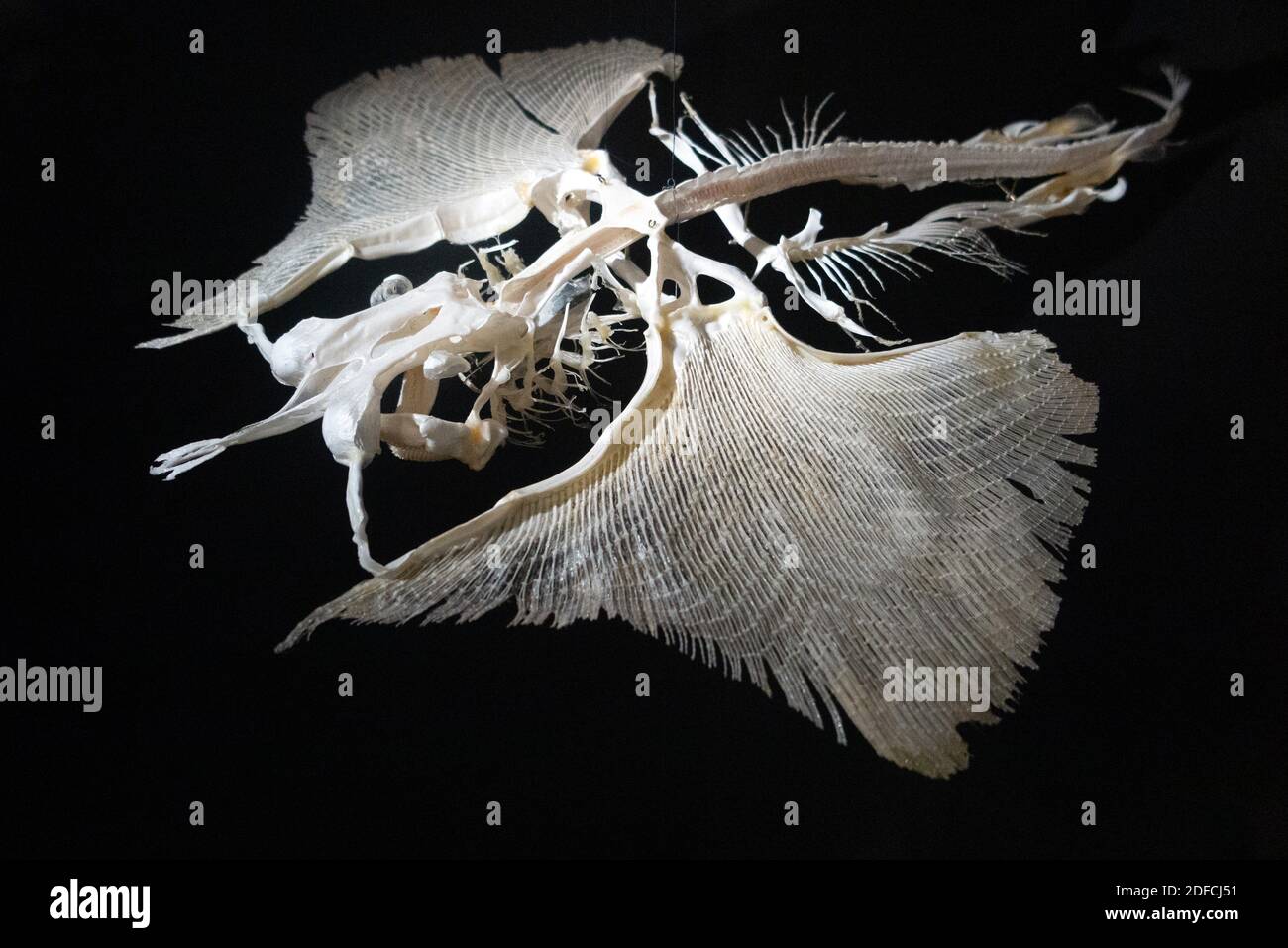
If you’ve ever touched a stingray at an aquarium touch tank, you probably noticed they feel a bit like wet suede or a giant portobello mushroom. They’re squishy. They’re flexible. They glide through the water with a grace that seems impossible for a creature that can grow to be the size of a small car. The reason for that weird, fluttery movement is simple: the skeleton of a stingray contains zero bone.
Not one.
It's all cartilage. Think about the end of your nose or the top of your ear. That’s the material we’re talking about. This isn't just a quirky biological footnote; it’s a massive evolutionary advantage that has kept these animals swimming since before the dinosaurs took over the land. While most of the world's fish—the teleosts—invested in heavy, rigid calcium-based bones, stingrays (and their cousins, the sharks and skates) went a different route. They are Chondrichthyans. That’s just a fancy Greek-derived way of saying "cartilage fish."
Why a Skeleton of a Stingray Isn't "Weak"
Some people hear "cartilage" and think "fragile." That’s a mistake. If a stingray had a skeleton made of dense bone, it would likely be too heavy to maintain the neutral buoyancy it needs to hover just above the sandy seafloor. Cartilage is roughly half the density of bone. It’s lightweight. It’s springy.
Basically, the skeleton of a stingray acts like a high-performance composite material.
Because they lack a ribcage, stingrays can't "break" a bone in the way we do. However, they face a different challenge. Cartilage is generally soft, which isn't great if you need to anchor massive pectoral muscles for swimming or protect a brain. Evolution solved this through a process called prismatic calcification. If you were to look at a stingray’s "bones" under a microscope, you’d see tiny, hexagonal tiles of calcium salts called tesserae. These tiles coat the cartilage, creating a chain-mail effect. It makes the skeleton stiff enough to handle the torque of swimming but flexible enough to squeeze into tight spots or withstand the crushing pressure of the deep ocean.
The tesserae are particularly thick in the jaws. Stingrays love eating hard-shelled snacks like crabs, clams, and mussels. Without that extra reinforcement, a stingray would literally shatter its own face every time it tried to eat dinner. Researchers like Dr. Marianne Porter at Florida Atlantic University have spent years studying how these mineralized tiles allow the skeleton to be both stiff and stretchy simultaneously. It’s a mechanical feat that human engineers are still trying to copy for lightweight construction materials.
The Mystery of the Stingray's "Wings"
When you look at the skeleton of a stingray, the most striking part isn't the spine—it’s the fins. We call them wings, but biologically, they are just massively overgrown pectoral fins.
They are supported by long, finger-like rods of cartilage called radials.
Imagine your own hand. Now imagine if your fingers were six feet long and had dozens of extra joints. That’s essentially what’s happening inside a stingray’s wing. These radials are branched and segmented, allowing the ray to ripple its fins in a wave-like motion (undulation) or flap them like a bird (oscillation). This isn't just for show. This skeletal structure allows for incredible maneuverability. A stingray can turn on a dime, stop instantly, or bury itself in the sand with a few quick shudders of its flexible frame.
The Spine and the Stinger
The central axis of the ray is the vertebral column. Even though it's made of cartilage, it’s remarkably strong. In older rays, these "vertebrae" can become so calcified that they almost look like bone to the naked eye. In fact, scientists often use these vertebral rings to age a stingray, much like counting the rings on a tree.
Then there’s the tail.
The tail is a continuation of the spine, but it serves a very different purpose. Most people worry about the "stinger," which is technically a modified dermal denticle. It’s not actually part of the internal skeleton, but rather an external structure that sits on top of the tail. It’s made of vasodentine—a strong, bony material—and coated in a serrated sheath that can deliver venom. When a ray loses its stinger, it grows back, much like a fingernail. It’s one of the few parts of the animal that feels truly "hard" like a rock.
The Ghostly Skull: Protecting the Brain
The "skull" of a stingray is called a chondrocranium. Since it isn't made of fused plates like a human skull, it’s more like a single, molded helmet of reinforced cartilage. It’s surprisingly small compared to the rest of the body.
Inside this protective box sits the brain, but also the sensory organs. Stingrays have something called the Ampullae of Lorenzini. These are tiny pores in the skin that lead to the skeletal structure of the head, allowing the ray to "see" the electric fields of living things. This is why a stingray can find a shrimp buried under six inches of sand in total darkness. The skeleton acts as the framework for this electrical sensory suite, holding everything in the perfect position to hunt.
You’ve probably seen dried "mermaid purses" on the beach—those are the egg cases of skates, which are very similar to rays. But the actual skeletons of these animals rarely wash up. Why? Because cartilage doesn't fossilize well. When a stingray dies, its "bones" usually rot away long before they can become stone. This makes the fossil record of the skeleton of a stingray a bit of a nightmare for paleontologists. We mostly find their teeth and their stingers, which are the only parts hard enough to survive the eons.
Common Misconceptions About Ray Anatomy
Honestly, the biggest lie we’re told is that sharks and rays are "primitive."
People assume that because they don't have "real" bones, they are somehow an evolutionary prototype that never finished loading. That’s total nonsense. Having a cartilaginous skeleton is a specialized, highly evolved trait. It’s a choice, not a limitation. Bone is heavy. Bone breaks. Bone requires a massive amount of metabolic energy to maintain. By ditching bone, the stingray became a faster, lighter, and more efficient predator.
Another weird fact? They don't have a ribcage. If you pull a large stingray out of the water, its own body weight can actually crush its internal organs. The water provides the support that their skeleton can’t provide on land. This is why researchers have to be incredibly careful when handling large rays; without the buoyancy of the ocean, the skeleton of a stingray basically sags under the pressure of gravity.
Practical Takeaways for Divers and Enthusiasts
If you’re ever lucky enough to see a ray in the wild, or if you’re a diver watching one glide by, keep these points in mind regarding their unique anatomy:
- Respect the "no-bone" rule: Because they lack a ribcage, never step on a ray (even accidentally). You aren't just stepping on "flesh"; you are putting direct pressure on their heart and liver because there's no bony cage to protect them.
- Watch the movement: Notice the rippling of the wings. That is the work of hundreds of individual cartilage radials working in sequence. It’s one of the most complex mechanical movements in the animal kingdom.
- Identification: Skates and rays look similar, but their skeletons differ at the tail. Skates have "fleshier" tails with small fins, while rays usually have whip-like tails, often with a stinging spine.
- Sustainability matters: Because their skeletons are slow-growing and they rely on specific calcification processes, rays are very sensitive to ocean acidification. Changes in water chemistry make it harder for them to "harden" their cartilage, which can lead to malformed jaws and fins.
Understanding the skeleton of a stingray is really about understanding the beauty of "less is more." They took the standard blueprint for a vertebrate, stripped out the heavy parts, and ended up with a design so successful it hasn't needed a major update in 150 million years. Next time you see one, don't think of it as a fish without bones. Think of it as a masterclass in flexible engineering.
To truly appreciate this anatomy, your next step should be looking into the specific biomechanics of "tessellated cartilage." Scientists are currently researching how the hexagonal structure of a stingray's jaw could help us design better prosthetic limbs and aerospace components. The more we look at their "soft" skeletons, the more we realize how much they have to teach us about strength.