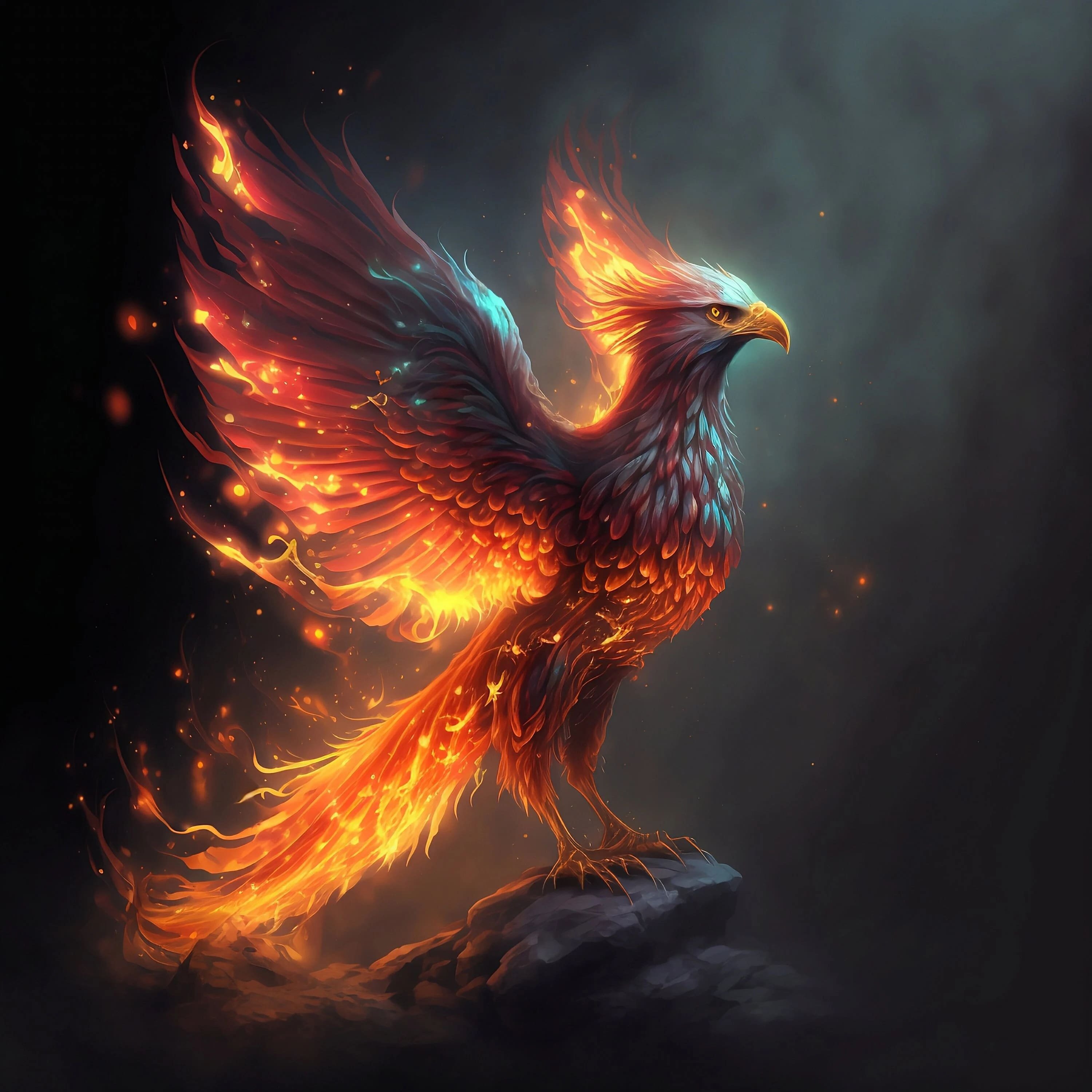
Everyone knows the basic gist. A bird catches fire, dies, and then pops back up out of the soot looking brand new. It’s the ultimate comeback story. But honestly, the story of phoenix bird is way weirder and more complicated than what you saw in Harry Potter or on a random tattoo parlor wall. People have been obsessed with this thing for thousands of years, and they didn't even agree on what it looked like or how long it lived.
Some said it stayed alive for 500 years. Others claimed 1,461 or even 12,994 years. That’s a pretty big margin of error.
Where the story of phoenix bird actually started
You’ve probably heard it’s Greek. And yeah, the name phoenix is Greek, likely tied to the word for purple-red or the Phoenician people. But the Greeks basically "borrowed" the idea from Egypt.
The Egyptians had the Bennu. This wasn't some eagle-sized fire hawk; it was a gray heron. It represented the soul of Ra, the sun god, and was linked to the flooding of the Nile. It symbolized creation and renewal. But when the Greeks, specifically guys like Herodotus, got a hold of the tale around the 5th century BCE, they spiced it up. Herodotus actually admitted he’d never seen the bird himself, only "in pictures." He described it as gold and red, shaped like an eagle.
He also wrote down this bizarre detail: the bird supposedly packs its father’s corpse into a ball of myrrh and carries it to the Temple of the Sun. Kinda macabre, right?
The Roman twist and the cult of immortality
The Romans took the story of phoenix bird and turned it into a political PR tool. They put the bird on their coins to say, "Hey, Rome is eternal. We aren't going anywhere." It became a symbol of the Roman Empire's "Invincible" status. When the empire eventually started crumbling, early Christians snatched the symbol for themselves. It was a perfect metaphor for the resurrection of Christ.
It’s funny how one bird can go from an Egyptian swamp heron to a Roman political logo to a Sunday school lesson.
What the bird actually (supposedly) looks like
If you ask ten different ancient poets what the phoenix looks like, you’ll get ten different answers. Claudian, a Roman poet, went all out with the descriptions. He talked about a bird that has a "heavenly light" in its eyes and a crest that glows like the sun.
- It’s usually eagle-sized.
- The feathers? A mix of gold, purple, and azure.
- The tail is often described as having rose-colored feathers mixed with blue.
But it’s not just about the look. It’s about the smell. Ancient texts emphasize that the phoenix doesn't eat normal bird food like seeds or worms. Instead, it lives on "tears of incense" and "frankincense." When it’s time to die, it builds a nest out of cinnamon, spikenard, and myrrh. It basically turns itself into a giant, expensive candle before it goes up in flames.
It’s not just a Western thing
While the Mediterranean was busy with its version, China had the Fenghuang. People often call it the "Chinese Phoenix," but that’s a bit of a lazy translation. The Fenghuang is its own thing.
Originally, the Feng was male and the Huang was female. Over time, they merged into a single feminine entity often paired with the dragon (the male). While the Western phoenix is all about death and rebirth, the Fenghuang is about grace, virtue, and the union of yin and yang. It supposedly only appears in places where there is peace and prosperity. If you see one, your government is doing a great job.
In Russia, you’ve got the Firebird. It’s not exactly a "die and reborn" bird, but it’s a glowing bird of prey that is a nightmare to catch and usually brings both a blessing and a curse to whoever finds its feather.
The science of a myth: Why did we invent this?
Why do we keep telling the story of phoenix bird? Some historians think it might have started with people seeing the mating displays of certain birds or even the way some birds use fire.
There’s a real behavior called "anting." Some birds will sit on anthills and let ants crawl over them because the formic acid kills parasites. Some birds have actually been observed using glowing embers or smoke to do the same thing. Imagine a prehistoric human seeing a bird flapping its wings in the smoke of a dying campfire. From a distance, it looks like a bird rising from the flames.
Then there’s the "Cinnamon Bird" theory. Aristotle and Pliny the Elder mentioned a bird that collected cinnamon sticks for its nest. Since cinnamon was a high-value trade secret back then, merchants might have invented the "fire bird" story to keep people from looking for where the spice actually came from.
Why the phoenix still matters in 2026
We love a comeback. Whether it’s a tech company that almost went bankrupt or a celebrity recovering from a scandal, we call it "rising like a phoenix."
But on a deeper, psychological level, the story of phoenix bird touches on the "Great Cycle." Life is messy. We fail. We get fired. Relationships end. The phoenix tells us that the "burning" part—the pain and the loss—is actually the fuel for the next version of ourselves. You can't get the new feathers without the fire.
Common misconceptions about the fire bird
- It’s always on fire. In most ancient legends, the phoenix only catches fire at the very end of its life cycle. It’s not just flying around like a flamethrower.
- There are many of them. Usually, the myth says there is only one phoenix alive in the world at any given time. It’s a lonely existence.
- It’s a symbol of destruction. Nope. It’s almost always seen as a "pure" creature that doesn't harm others. It doesn't kill to eat; it lives on air and spices.
How to use the phoenix mindset
If you’re feeling like you’re in the "ashes" phase of your life, the legend actually offers some pretty solid, if metaphorical, advice.
First, look at the nest. The phoenix builds its funeral pyre out of the most precious things it can find—myrrh and cinnamon. It doesn't just give up; it prepares for the transition. If you’re pivoting in your career or life, don't just "quit." Build a foundation out of your best experiences and skills.
Second, accept the heat. You can't have the rebirth without the fire. Most people try to avoid the discomfort of change, but the story of phoenix bird suggests that the fire is the only way to get rid of the old, weary parts of yourself that aren't working anymore.
To truly apply the wisdom of this myth, start by identifying one "dead" habit or project that is weighing you down. Instead of trying to fix it, let it go completely. Clear the space. Rebirth isn't about repair; it's about starting fresh with the lessons of the previous life. Focus on what you want the "new feathers" to look like rather than mourning the smoke. Look into the history of "Resilience Theory" in psychology—it’s essentially the modern, scientific version of the phoenix myth, proving that humans are biologically wired to bounce back from trauma stronger than before.