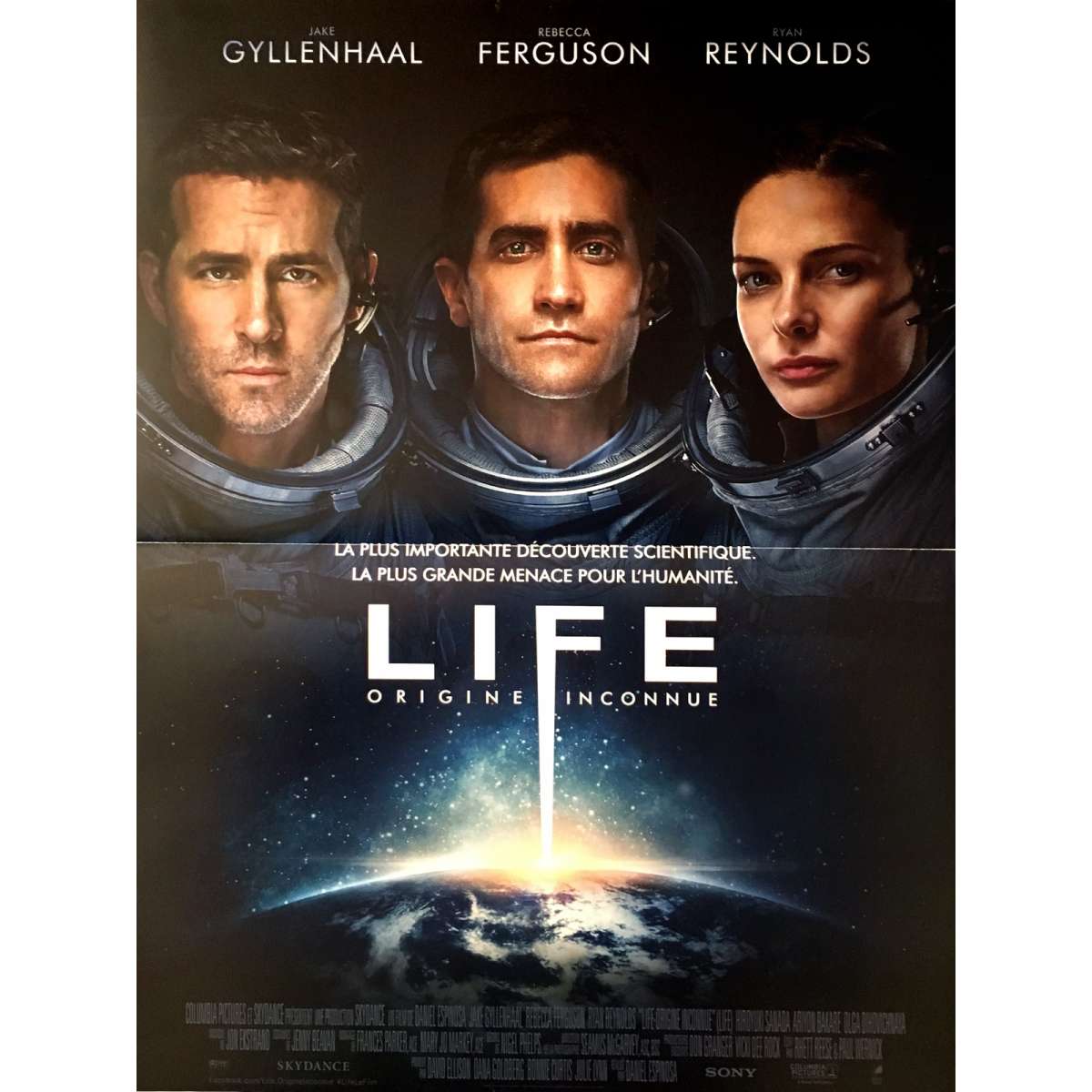
You know that feeling when you're watching a movie and you think you have the beats figured out? You’ve seen Alien. You’ve seen Gravity. You know how these high-stakes space thrillers usually wrap up. The hero makes a sacrifice, the monster gets blasted into the void, and someone makes it home to tell the tale.
But the life 2017 movie ending didn’t do that. It went for the throat.
Honestly, it’s one of the most mean-spirited, gut-wrenching final acts in modern sci-fi. Even years later, people are still debating the logistics of how Calvin—that terrifyingly clever Martian organism—managed to pull off the ultimate switcheroo. It wasn't just a plot twist; it was a total subversion of the "final girl" trope we've been fed for decades.
The Setup: Two Pods and a Choice
By the time we hit the final ten minutes, the International Space Station is basically a death trap. Everything is failing. Most of the crew is dead. We’re left with David Jordan (Jake Gyllenhaal) and Miranda North (Rebecca Ferguson). They have two escape pods left.
David realizes that Calvin, this amorphous blob that keeps evolving, is too dangerous to ever let touch Earth. It’s an extinction-level threat. He decides to be the martyr. His plan is simple but desperate: he’ll lure Calvin into one pod and manually pilot it out into deep space, leaving Miranda to take the other pod back home to Earth.
It felt right. It felt like the kind of noble ending we expect from a big-budget Hollywood film. Jake Gyllenhaal’s character has already stated he feels more at home in space than on Earth anyway. It made sense for him to stay behind.
The Psychological Horror of the "Switch"
Director Daniel Espinosa and writers Rhett Reese and Paul Wernick (who, interestingly enough, also wrote Deadpool) used a classic cinematic trick here: parallel editing. We see one pod spiraling out into the dark, and another pod hitting the atmosphere, glowing red with the heat of reentry.
The music swells. It’s triumphant, yet slightly off-key.
We see a pod splashing down in the ocean near some Vietnamese fishermen. They approach the capsule, looking through the thick, porthole-style window. You’re expecting to see Miranda, shaken but safe. Instead, the camera pans inside to reveal David. He’s encased in a web of translucent, organic matter—Calvin’s "body"—and he’s screaming. Not a "heroic" scream, but a frantic, muffled "don't open it" scream.
He failed. Calvin won.
How the Life 2017 Movie Ending Actually Worked
How did this happen? If you re-watch the scene carefully, you’ll notice a crucial moment where the pods collide with debris or move through a chaotic field. This is where the trajectory changed. David’s pod was supposed to be pushed away, but the struggle with Calvin inside the craft caused the manual controls to malfunction or be redirected.
While David was being physically consumed and restrained by Calvin, the creature was essentially "piloting" the situation. Calvin isn't just a mindless predator; the movie spends a lot of time establishing that every single cell in its body is both muscle and nerve. It’s incredibly smart. It likely understood that the pod David was in was the one going "somewhere," and it ensured that "somewhere" was the planet full of food.
Meanwhile, Miranda’s pod—the one that was supposed to go home—gets knocked off course by the station's debris. We see her screaming as her navigation systems fail and her craft is sent careening into the vacuum of deep space. She’s alive, but she’s effectively dead. She’s drifting into the nothingness with no way back.
Why the Twist Works So Well
Most movies are afraid to let the monster win. We live in an era of franchise-building where the protagonist usually survives for a sequel. Life didn't care about that. It leaned into the "cosmic horror" element popularized by H.P. Lovecraft. The universe doesn't care about your plans. The universe is cold, and sometimes, the thing that wants to eat you is just better at surviving than you are.
The life 2017 movie ending works because it rewards the creature's intelligence. Throughout the film, Calvin learns. It learns how to use a cattle prod. It learns how to navigate the cooling system. It makes sense that in the final struggle, it would "learn" how to survive the pod separation.
Comparing Life to Other Sci-Fi Endings
A lot of people compared Life to Alien, which is fair. But look at the endings. Alien ends with Ripley in stasis, a survivor. Life ends with the total defeat of humanity's safeguards.
There were also rumors for a long time that Life was secretly a prequel to Venom. People pointed to the black, gooey nature of Calvin and the fact that Sony produced both films. While the writers eventually shot this down, saying it was just a coincidence, it speaks to how much the ending stuck in people's brains. They wanted it to mean something more because the bleakness of the actual ending was so hard to swallow.
What Happens Next? (The Unseen Aftermath)
The movie cuts to black as the fishermen open the door, despite David's muffled warnings. It’s a "The End" that feels like a beginning—the beginning of the end of the world.
If we look at the biology of Calvin established earlier in the film, the creature grows exponentially based on how much it consumes. In the contained environment of the ISS, it stayed relatively small. Once it hits Earth’s biomass? It’s over. The ending implies that Calvin is about to become an unstoppable global parasite.
Actionable Insights for Fans of the Movie
If the ending of Life left you wanting more of that specific brand of "everything is going to go wrong" sci-fi, there are a few ways to dive deeper into the genre or the film itself:
- Watch for the visual cues: Re-watch the final pod sequence and look specifically at the joystick movements. You can actually see where the struggle shifts the trajectory of the pods.
- Explore the "Bleak Sci-Fi" subgenre: If you liked this ending, check out The Mist (2007) or Annihilation (2018). They share that DNA of "humanity is outmatched by something it doesn't understand."
- Check the "Venom" Theory: Even though it’s debunked, looking at the fan edits on YouTube that bridge Life and Venom is a fun exercise in how audiences try to make sense of nihilistic endings.
- Study the "Exobiology" of the film: The filmmakers consulted with real geneticists and astrobiologists to make Calvin's growth feel "realistic." Reading up on extremophiles (organisms that survive in space) makes the movie even scarier because it’s based on real-world biology.
The life 2017 movie ending isn't just a "gotcha" moment. It's a reminder that in the grand scheme of the universe, humans might just be a lower rung on the food chain. It’s uncomfortable, it’s dark, and it’s exactly why the movie stands out in a crowded genre. Next time you see a pod landing in a movie, you won't be so sure who's inside.
To fully appreciate the craftsmanship, pay attention to the sound design in those final seconds—the way David’s voice is drowned out by the sound of the ocean and the curiosity of the rescuers. That’s where the real horror lives.