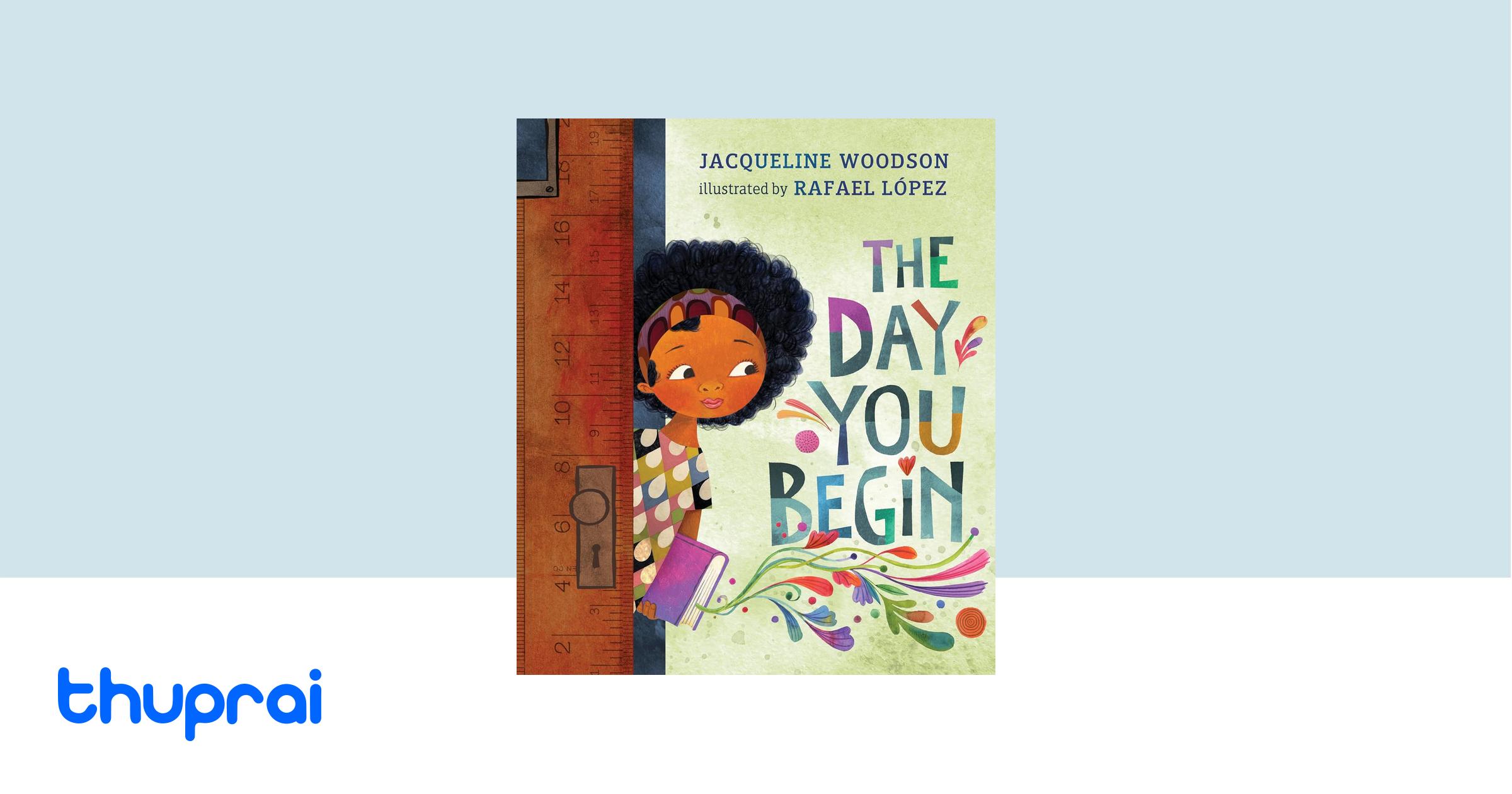
You know that feeling. It’s the heavy, cold sensation in the pit of your stomach when you walk into a room where no one looks like you. Or maybe they look like you, but they don't talk like you. Their summer stories are about French villas or expensive camps, and yours? Yours are about staying home because there simply wasn't any money for travel. This universal pang of "otherness" is exactly why The Day You Begin by Jacqueline Woodson, illustrated by Rafael López, has become a modern classic. It’s not just a kids' book. Honestly, it’s a manual for human survival in a world that often feels exclusionary.
Woodson didn't just write a story; she captured a frequency.
Sometimes the world feels like a place where you're standing on the outside looking in. You’ve probably been there. It happens in boardrooms. It happens on playgrounds. It happens when you’re the only one who didn't get the joke. This book addresses that silence—the space between who you are and who the world expects you to be. It was published back in 2018, but somehow, in 2026, the message feels even more urgent. We live in a hyper-connected era where we see everyone’s "highlight reel," making our own "real life" feel small or out of place.
What The Day You Begin Actually Teaches Us
Most people think this is just a book about diversity. That’s a shallow take. While it absolutely centers on characters of color and different socioeconomic backgrounds, its core is about the courage it takes to share your own story.
Jacqueline Woodson is a National Book Award winner for a reason. She has this way of using very few words to say everything. In The Day You Begin, she follows several children. One girl, Angelina, spent her summer at home looking after her little sister while other kids traveled. Then there’s Rigoberto, who just moved from Venezuela and gets laughed at because of his accent.
The turning point isn't that everyone suddenly becomes the same. That would be boring and fake.
The shift happens when Angelina finally speaks up. She tells the class about her summer—the books she read, the games she played, the heat of the city. She realizes that even though her story is different, it has its own beauty. That’s the "beginning" the title refers to. It’s the moment you stop hiding and start existing out loud.
The Psychological Weight of Being the "Only"
When we talk about The Day You Begin, we have to talk about the psychological impact of being "the only" in a room. Researchers call this "social identity threat." It’s exhausting. It’s that constant mental tax of wondering if you're being judged for your clothes, your lunch, or your hair.
Woodson captures this through the metaphor of a door that is closed.
- The lunch that looks "strange" to others.
- The skin that is a different shade.
- The language that feels heavy on the tongue.
But here is the thing: diversity isn't just a buzzword here. It's the literal fabric of the narrative. Rafael López uses bright, vibrant illustrations that look like murals. These visuals do heavy lifting. They show that even when a child feels "gray" or invisible, the world around them is actually bursting with color if they can just find the bridge to connect.
I’ve seen teachers use this book for everything from kindergarten empathy lessons to corporate DEI workshops. Why? Because the feeling of not belonging doesn't go away when you turn eighteen. It just changes shape. You might not be worried about your "strange" lunch anymore, but you might be worried that your non-traditional background makes you "less than" in a high-stakes meeting.
Why the Poetry Matters
Woodson writes in verse, or at least a very lyrical prose. It’s rhythmic. It’s repetitive in a way that feels like a heartbeat.
"There will be times when the room clears out and it’s just you standing there."
That’s a heavy line for a picture book. It doesn't sugarcoat the loneliness. Kids are smart; they know when they’re being lied to. They know that sometimes people are mean and sometimes things are unfair. By acknowledging the "empty" feeling first, Woodson earns the right to talk about the "full" feeling later.
The Day You Begin and the Power of Vulnerability
We often hear about Brené Brown and the power of vulnerability in the workplace. Well, The Day You Begin is basically the "Junior Edition" of that philosophy. Connection only happens when we take the risk of being seen.
Rigoberto, the boy from Venezuela, eventually finds a connection with Angelina. It’s a tiny thread. It’s not a grand explosion of friendship; it’s just a small acknowledgement. But that’s how real life works. You don’t usually have a cinematic montage of making friends. You have a thirty-second conversation that doesn't suck.
Common Misconceptions About the Book
Some critics or parents might think this book is "too sad" or focuses too much on the negative aspects of being different. I totally disagree. If you don't name the problem, you can't solve it. Ignoring the fact that some kids feel marginalized doesn't make the feeling go away; it just makes the kids feel like they’re crazy for feeling it.
- It’s not a "struggle" story. It’s a "resilience" story.
- It’s not just for kids of color. Every person, regardless of race, has felt like an outsider at some point.
- The ending isn't a "happily ever after." It’s a "happily ever beginning."
How to Use This Book in Real Life
If you’re a parent, don't just read this and put it back on the shelf. Use it as a conversation starter. Ask your kid if they’ve ever felt like the room was "quiet" when they walked in. Share a time when you felt out of place. Honestly, that’s where the magic happens.
In a school setting, The Day You Begin serves as a perfect "window and mirror" text. This is a concept developed by Dr. Rudine Sims Bishop. Books should be mirrors that reflect our own lives back at us, but also windows that let us see into the lives of others.
If you're a mirror for a kid who feels lonely, you're giving them a lifeline. If you're a window for a kid who has never felt "othered," you're giving them empathy.
Both are equally important.
Real-World Impact: The Numbers
While I’m not going to bore you with a spreadsheet, it’s worth noting that this book has spent significant time on the New York Times Bestseller list. It’s a staple in the "Global Read Aloud" program. It has been translated into multiple languages because the feeling of being "the new kid" is the same in Tokyo as it is in Topeka.
Jacqueline Woodson often talks about her own childhood in Brown Girl Dreaming, and you can see the echoes of her personal history in this fictionalized account. She knows what it’s like to have a "different" name. She knows what it’s like to have a family history that doesn't fit into a neat little box.
Actionable Steps for Finding Your Own "Beginning"
If you're feeling like the outsider today, here’s how to channel the energy of the book to move forward.
Own your narrative. Don't wait for someone to ask you about your background. Find a way to weave it into your identity. Your differences aren't just quirks; they are your "special sauce." In the book, Angelina’s summer of "staying home" becomes a story of imagination and sisterly bonds.
Listen for the "echo." In the story, the connection happens when someone hears something familiar in another person’s story. When you're in a new environment, listen more than you talk at first. Look for that one tiny piece of common ground. It might be a shared hobby, a similar fear, or even a mutual dislike of the office coffee.
Practice "The Brave First Step." Being the first person to speak in a room where you feel unwelcome is terrifying. Do it anyway. The book suggests that the "day you begin" is the day you decide to share your soul.
Create space for others. If you are the one who does feel like you belong, look around. Who is the Angelina in your room? Who is the Rigoberto? Your job isn't just to "be inclusive"—it’s to actively invite their story into the space.
Reflect on your "summer." We all have "summers" that feel less impressive than everyone else's. Maybe you didn't get the promotion. Maybe you’re struggling with a personal issue. Instead of hiding it, find the value in the "quiet" seasons of your life. There is often more growth in the stillness than in the travel.
The Day You Begin is a reminder that we are all walking around with stories that deserve to be heard. The world is a better place when we stop trying to blend in and start trying to connect. It starts with one sentence. It starts with you.
When you decide to be yourself, you give everyone else in the room permission to do the same. That’s the real power of the story. It's a chain reaction of authenticity. So, go ahead. Tell your story. Even if your voice shakes. Even if you think no one wants to hear it. Someone is waiting to hear exactly what you have to say so they can say, "Me too."