It's a weird time for electric hatchbacks. For years, everyone just wanted SUVs, but suddenly, the "hot hatch" is making a quiet, electrified comeback. Enter the BYD Seal 06 GT. If you've been following the Chinese EV market at all, you know BYD is basically throwing spaghetti at the wall to see what sticks, except most of their spaghetti is made of high-grade lithium iron phosphate and it's sticking everywhere.
The Seal 06 GT is an interesting pivot. It isn't just a chopped-down version of the Seal sedan we already know. It sits on the newer e-Platform 3.0 Evo, which sounds like marketing fluff until you realize it actually changes how the car handles charging and structural rigidity. Honestly, it’s refreshing to see a brand actually build a dedicated electric performance hatch instead of just lifting a sedan and calling it a "cross-coupe."
What Exactly is the BYD Seal 06 GT?
Let's get the positioning straight because BYD’s naming convention is a total mess right now. This car was originally teased as the Ocean-M concept at the Beijing Auto Show. People thought it was going to be a budget-friendly RWD hatch to rival the MG4 EV or the Volkswagen ID.3. It is that, but it’s also physically larger than you’d expect.
At roughly 4,630mm long, it’s actually bigger than a VW Golf. A lot bigger. It bridges that awkward gap between a compact hatch and a mid-size sportback. You’ve got a wheelbase of 2,820mm, which is where the "GT" part of the name starts to make sense. It’s long. This length isn't just for show; it’s about stability at high speeds and cramming enough batteries between the wheels to make it a viable road tripper.
The styling is aggressive. You’ve got the "Ocean Aesthetics" design language, which basically means it has lots of curvy lines and squinty LED headlights that look like they’re judging your driving skills. There’s a massive rear diffuser that looks like it belongs on a track car, though on the entry-level trims, it’s mostly there for the vibes.
The Tech Under the Skin
The e-Platform 3.0 Evo is the real star here. While the older Seal used the standard 3.0 version, the "Evo" bit brings a 12-in-1 electric drive system. Most people don't care about the number of components integrated into a single housing, but you should care about the efficiency. It's lighter. It's more compact.
One of the most impressive bits of kit is the CTB (Cell-to-Body) technology. Instead of having a battery pack sitting inside a frame, the battery is the frame. The top cover of the battery doubles as the floor of the passenger cabin. This lowers the center of gravity significantly. You feel this the moment you take a corner too fast; the car stays flat. It doesn't have that top-heavy "wobble" that plagues so many crossover EVs.
Charging is another area where BYD is trying to leapfrog Tesla. They’re using an 800V high-voltage system in the higher trims, which allows for some pretty rapid juice-ups. We're talking 30% to 80% in about 20 minutes. It also features an intelligent pulse self-heating technology for the battery. If you live somewhere cold, you know how much EV range sucks in the winter. This system uses the motor’s waste heat to warm the cells, keeping the chemistry happy even when it’s freezing outside.
Performance Specs and Motor Layouts
BYD didn't just make one version. They’re catering to both the "I want to save money on my commute" crowd and the "I want to embarrass sports cars at a red light" crowd.
- Single Motor RWD: This is the sensible choice. You’re looking at either 160kW or 165kW outputs. It’s punchy enough for daily driving, giving you that instant torque kick that makes merging onto highways effortless.
- Dual Motor AWD: This is the beast. It combines a 110kW front motor with a 200kW rear motor. Total output is around 310kW (roughly 415 horsepower). It’ll do 0-100 km/h in about 4.9 seconds. That’s proper hot hatch territory.
The battery options are mostly Blade Batteries (Lithium Iron Phosphate). You’ll see 59.52 kWh and 72.96 kWh packs. In terms of range, the Chinese CLTC cycle puts them at 505km and 605km respectively. Keep in mind, CLTC is notoriously optimistic. If you’re driving on a highway in the real world, expect closer to 400-480km depending on your lead foot.
Interior: Not Your Average Budget Hatch
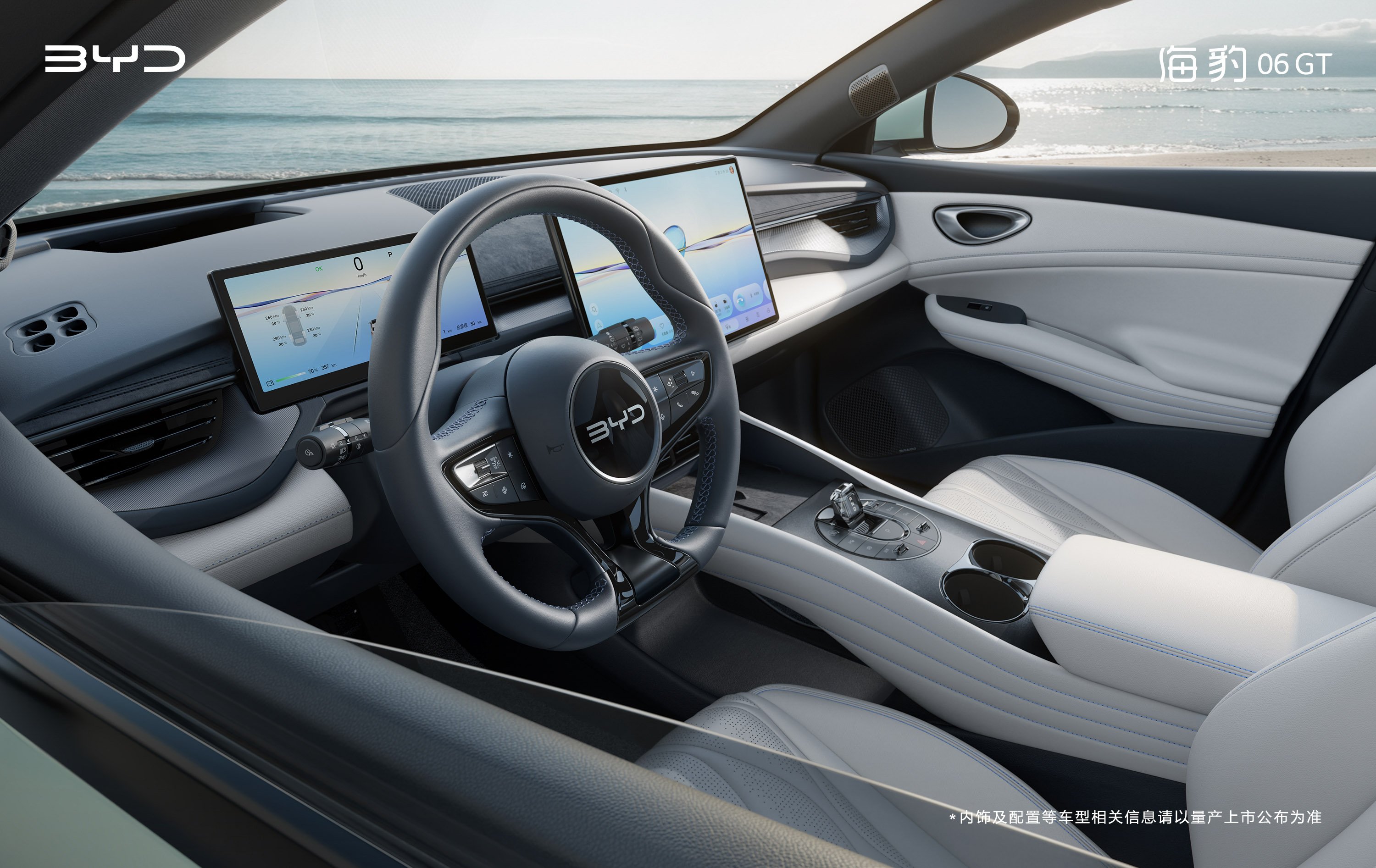
Inside, the BYD Seal 06 GT feels... expensive. That’s the best way to put it. There’s a 15.6-inch rotating touchscreen that dominated the dashboard. Yes, it still rotates from landscape to portrait mode. It feels like a gimmick until you use the navigation in portrait mode—it actually makes seeing the road ahead much easier.
The cockpit is wrapped in soft-touch materials, and the seats are heavily bolstered. They’re "sports seats," but they aren't rock hard. You could sit in these for four hours without needing a chiropractor. Interestingly, they’ve kept a decent number of physical buttons around the crystal gear shifter. It’s a smart move. Digging through menus just to defrost your windshield is a safety hazard, and BYD seems to have realized that.
The software is DiLink 100, which is powered by a customized D100 (6nm) chip. It’s smooth. There’s no lag when swiping between apps. It supports voice commands that actually work, and the 5G connectivity means OTA (Over-The-Air) updates happen in the background without you noticing.
The Handling Reality Check
Is it a Porsche Taycan killer? No. Let's be real. It’s a BYD. It’s built for the masses.
However, the suspension setup is surprisingly sophisticated. You’ve got MacPherson struts up front and a five-link independent suspension in the rear. This isn't the cheap torsion beam stuff you find on entry-level hatchbacks. The car handles bumps with a sophisticated "thump" rather than a "crash."
The steering is a bit light. It lacks that mechanical feedback that a BMW or a GTI might give you. It’s very "digital." But for a daily driver that you occasionally want to toss into a corner, it’s more than competent. The FSD (Frequency Selective Damping) shock absorbers do a great job of tightening up when the road gets twisty while staying soft on the highway.
Why the Seal 06 GT Matters Right Now
The European brands are sweating. That’s the reality. Volkswagen and Renault have been the kings of the hatchback for decades, but they are struggling to match BYD on price-to-performance. The Seal 06 GT offers more range, more tech, and faster charging for less money than most of its European rivals.
There is a catch, though. Brand heritage. BYD doesn't have the "cool factor" that a GTI badge carries. Not yet, anyway. But for the younger generation of buyers who care more about their Spotify integration and fast-charging speeds than what their dad drove in the 80s, the BYD Seal 06 GT is a massive threat.
Real-World Limitations
It’s not all sunshine and lithium. The software, while fast, can be a bit "busy." There are a lot of icons, a lot of colors, and it can feel overwhelming compared to the minimalism of a Tesla or a Polestar.
The luggage space is also just okay. Because of that aggressive rear styling and the sleek roofline, you lose some vertical space in the trunk. It’s fine for groceries or a couple of suitcases, but don't expect to fit a mountain bike in there without some serious Tetris skills.
Lastly, there’s the visibility. The rear window is tiny. Those thick C-pillars create some blind spots, so you’ll be relying heavily on the 360-degree cameras. Thankfully, the cameras are high-resolution, but it’s still something to keep in mind if you hate relying on tech to park.
Actionable Takeaways for Potential Buyers
If you are looking at the BYD Seal 06 GT, don't just look at the 0-100 km/h times. Performance in an EV is easy; it's the ownership experience that matters.
- Check your charging infrastructure first. If you can't install a 7kW or 11kW home charger, you won't get the most out of the 800V architecture during daily use. Public fast chargers are great, but the convenience of home charging is the real EV selling point.
- Test drive the RWD vs. AWD. Honestly, for most people, the RWD version is plenty fast and offers better efficiency/range. The AWD is fun for a week, but you’ll rarely use that 310kW output in city traffic.
- Look at the software updates. BYD is aggressive with OTAs. Ask the dealer about the recent history of software improvements in your region. Often, features like lane-keep assist or UI layouts are significantly improved months after the car hits the showroom.
- Compare the physical size. Don't assume this is a tiny car just because it's a "hatchback." Measure your garage. It’s longer than it looks in photos.
- Evaluate the "Blade Battery" benefit. Research why LFP (Lithium Iron Phosphate) is generally considered safer and longer-lasting than NCM (Nickel Cobalt Manganese) batteries. It handles 100% charging better, which means you can actually use the full range of the car every day without worrying about degradation.
The BYD Seal 06 GT represents a shift. It's the moment the Chinese EV industry stopped just making "cheap" cars and started making cars that are genuinely desirable for their engineering and design. It isn't perfect, but it's a warning shot to every other manufacturer in the segment. If you want a sporty, tech-heavy electric car that doesn't look like a generic blob, this is officially one you can't ignore.


