Western intelligence agencies and 24-hour news cycles just fell for the oldest trick in the book. Again.
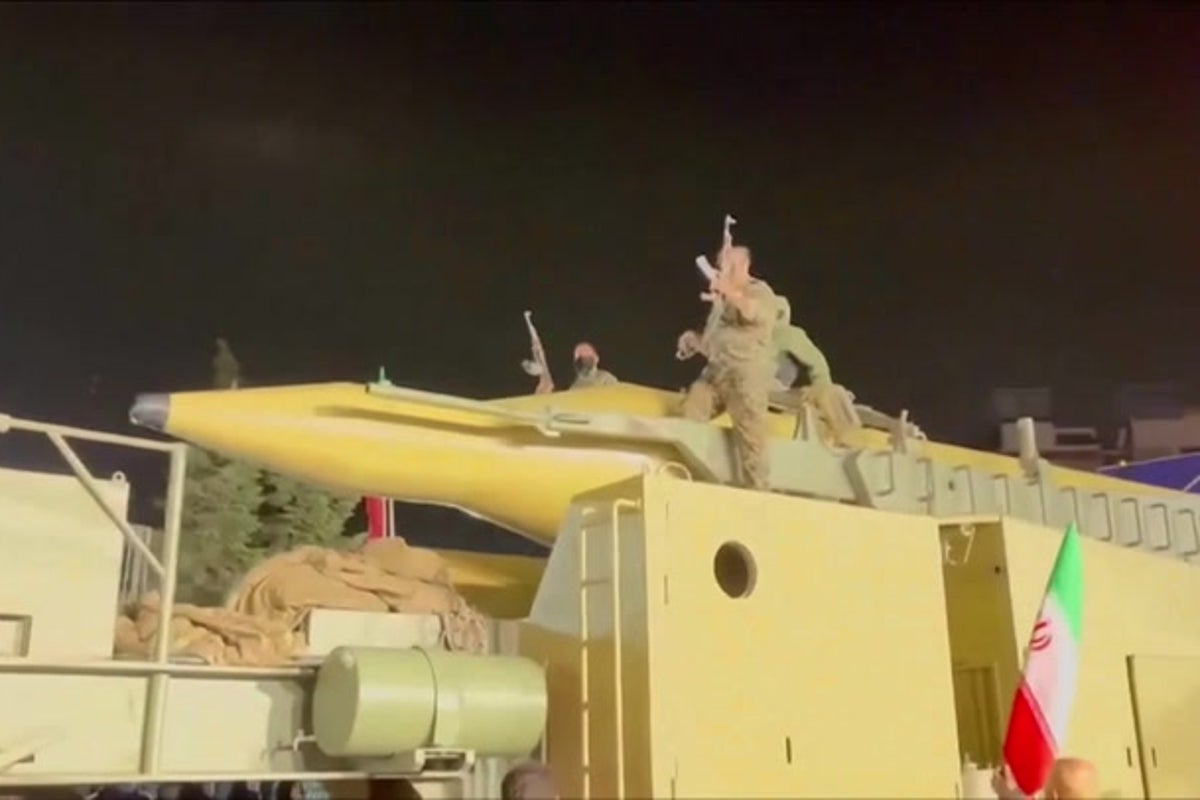
When Iran rolls a shiny, oversized tube through the streets of Tehran during a commemorative rally, the headline is always the same: "Iran Flaunts New Ballistic Capability." The subtext is always fear. We are told to worry about range, payload, and the ever-shrinking window of regional stability.
They are looking at the wrong end of the rocket.
The "lazy consensus" among defense analysts is that these public displays represent a linear progression of military might. They treat a parade like a product launch. But in the world of high-stakes geopolitics and asymmetric warfare, a parade is not a launch—it is a performance. If you are staring at the missile on the flatbed truck, you are missing the real war happening in the silicon and the shadows.
The Myth of the "New" Missile
Most "new" Iranian missiles are iterations, not innovations. They are the leftovers of Soviet-era liquid-fuel tech or North Korean designs polished with a fresh coat of paint and a provocative name.
When you see a missile like the Khaibar Shekan or any of its predecessors, the media focuses on the theoretical range. Can it hit Tel Aviv? Can it reach Southern Europe? This is the wrong question. The right question is: What is the circular error probable (CEP)?
In ballistic terms, the $CEP$ is the radius of a circle where 50% of the missiles are expected to land.
$$CEP = 0.5887 \times (\sigma_x + \sigma_y)$$
If your $CEP$ is measured in kilometers—which is often the case with unproven, parade-ready prototypes—you don't have a weapon. You have a very expensive firework. A missile that misses its target by 800 meters is useless against a hardened military site. It is only useful for terrorizing civilian populations, which, while tragic, does not change the strategic balance of power.
The Theater of Deterrence
We need to stop pretending these rallies are for us. They aren't.
I have spent years deconstructing how middle-tier powers use "strategic ambiguity" to mask internal fragility. These parades serve three masters, and none of them are Western generals:
- The Domestic Audience: It is a display of sovereignty for a population feeling the grind of sanctions. "Look what we built despite the world's boot on our neck."
- The Proxy Network: It signals to groups in Lebanon, Yemen, and Iraq that the "mother ship" is still potent.
- The Budget Office: Bureaucrats in every country, including Iran, need to justify their existence. A big parade ensures the Aerospace Force gets its funding over the conventional Navy.
The obsession with these "big sticks" ignores the fact that Iran’s most effective weapons are cheap, small, and buzzing. While we analyze the grain of the film on a ballistic missile carrier, Iranian-made Shahed drones are redefining the cost-to-kill ratio in modern conflict. A $20,000 drone that destroys a $5 million radar system is a revolution. A $10 million missile that sits in a silo and is never fired is a liability.
The Logistics of the Lie
Let’s talk about the hardware. If you look closely at the footage of these rallies, the "missiles" often lack the umbilical connections, venting ports, and heat-shielding textures required for actual flight.
In many cases, they are sheet-metal mockups. This isn't a secret. It’s a standard psychological operation. If I can make you spend $1 billion on a regional defense shield to counter a $50,000 piece of painted steel, I have already won.
Why the "Expert" Take is Flawed
Most defense analysts are incentivized to overstate the threat.
- Think Tanks: Need a "looming crisis" to secure grants.
- Defense Contractors: Need a "near-peer competitor" to sell the next generation of interceptors.
- Media: Needs a "ticking clock" to keep you from clicking away.
The reality is that Iran’s ballistic program is a 20th-century solution to a 21st-century problem. We are worried about a heavyweight boxer throwing a haymaker while a thousand mosquitoes with West Nile virus are already in the room.
The Silicon Gap
The true measure of a modern military is not the size of its rocket motor; it’s the quality of its guidance systems.
Iran is under some of the most stringent semiconductor sanctions in history. To build a truly modern ballistic missile, you need high-end FPGAs (Field Programmable Gate Arrays) and inertial measurement units (IMUs) that don't drift. You cannot reliably source these at scale through back-door channels for a fleet of thousands of missiles.
When you see a missile at a rally, you are seeing a mechanical achievement. You are not seeing a digital one. Without the digital, the mechanical is just a very fast rock.
Stop Focusing on the "What" and Start Focusing on the "Where"
If Iran wanted to threaten the West, they wouldn't do it with a missile that can be tracked by a Space-Based Infrared System (SBIRS) from the second it clears the gantry.
They do it through:
- Subsea Cable Sabotage: Which would collapse global financial markets in hours.
- Water Scarcity Exploitation: Using regional instability to control the flow of resources.
- Cyber-Attacks on Industrial Control Systems (ICS): Which can turn a power plant into a bomb without firing a single shot.
These are the real threats. But you can't put a cyber-attack on a flatbed truck and drive it through a square while crowds cheer. It doesn’t make for good television.
The Contrarian Reality
The "missile threat" is a comfortable narrative for both sides. Tehran gets to feel powerful; the West gets to feel justified in its containment strategies. It is a symbiotic ritual of escalation that avoids the much harder, much uglier truth: conventional military hardware is becoming obsolete in the face of decentralized, tech-driven disruption.
We are watching a 1950s playbook being executed in a 2026 world. The missiles are the distraction. The parade is the noise.
Stop looking at the sky. Start looking at the network.