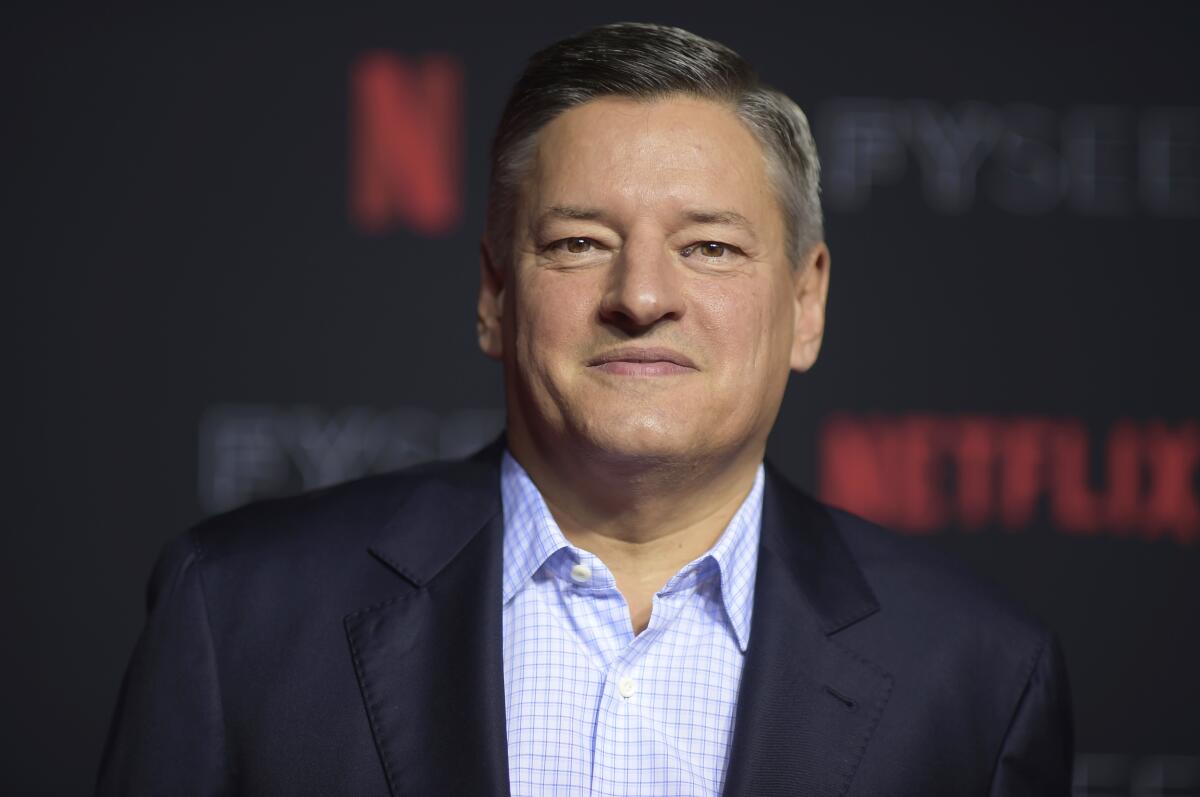
The prevailing narrative surrounding Ted Sarandos is a fairy tale for the digital age. Media critics love the "gate-crasher" trope. They paint a picture of a guy with a video store clerk's soul who rode a white horse into a stale, stagnant Hollywood and liberated storytelling through the sheer power of an algorithm.
It is a charming story. It is also fundamentally wrong.
Sarandos didn't crash the gates to free the artists; he crashed the gates to install a more efficient toll booth. The industry likes to credit him with a creative revolution, but Sarandos’s true genius has nothing to do with "finding the next Squid Game." His genius lies in recognizing that Hollywood was never a creative business—it was a distribution business with a massive, leaky bucket. He didn't change the art. He changed the math of the shelf space.
The Myth of the Creative Maverick
The "lazy consensus" suggests that Sarandos won because he has better taste than the old-school studio heads. People point to House of Cards as the moment the earth shifted. They claim Netflix "bet" $100 million on David Fincher and Kevin Spacey because they saw something others didn't.
That is nonsense.
Netflix didn't bet on Fincher's vision. They bet on a data set that showed people who liked the original British version of House of Cards also watched movies directed by David Fincher and starring Kevin Spacey. It wasn't a gamble; it was an arbitrage play.
In the old world, a studio head like Sherry Lansing or Richard Zanuck had to rely on "gut." Gut is expensive. Gut is prone to failure. Sarandos replaced the "gut" with a high-speed trading floor for eyeballs. He didn't become the ultimate Hollywood insider by being more creative; he became the ultimate insider by making creativity irrelevant to the bottom line.
When you have 260 million subscribers paying you every month regardless of whether they watch a masterpiece or a pile of reality TV trash, you haven't disrupted the "art" of filmmaking. You’ve just perfected the gym membership model for movies.
The Algorithm is a Mirror Not a Map
Industry observers often ask: "How does the Netflix algorithm find hits?"
They are asking the wrong question. The algorithm doesn't find hits. It creates them through brute-force visibility. If Sarandos decides to put a specific thumbnail in the "Hero" slot for every user globally, that show becomes a hit. It’s a self-fulfilling prophecy masquerading as a discovery engine.
The dark truth of the Sarandos era is the "flattening" of content. In the pre-Netflix era, a movie had to be good enough to make you leave your house, pay $15, and sit in a dark room. Now, a movie only has to be "good enough" to prevent you from clicking "back" to the menu.
This has led to the rise of "Ambient TV"—shows designed to be watched while you are looking at your phone. Sarandos didn't liberate the storyteller; he gave the storyteller a smaller, more distracted box to play in. He understood that in a world of infinite choice, the most valuable commodity is not excellence, but availability.
I’ve seen legacy studios try to copy this. They spend billions on their own "Plus" services, trying to hire their own "Ted." They fail because they still think they are in the movie business. Sarandos knows he is in the "reduced churn" business. Every $200 million blockbuster he greenlights isn't an attempt to win an Oscar—though the Oscars are nice for the brand—it’s a $200 million "Please Don't Cancel" button.
The Death of the Long Tail
The great lie of the early streaming era was the promise of the "Long Tail." We were told that the internet would allow niche, artistic projects to find their audience.
Sarandos did the opposite.
By shifting the focus to "completion rates" and "first 28-day viewership," he created a climate more ruthless than the network television era he supposedly destroyed. If a show doesn't explode in its first weekend, it is buried. There is no "slow burn" in the Netflix ecosystem. There is no time for a show like Seinfeld or The Office—both of which struggled in their first seasons—to find their voice.
The "gate-crasher" simply replaced the old gates with invisible ones made of code.
The Cost of Efficiency
We need to talk about the "Plus-One" problem. In the old Hollywood model, a hit like Titanic or The Godfather created a massive surplus of capital that could be used to fund ten weird, experimental failures.
In the Sarandos model, there is no surplus. The money is immediately recycled into more "content" to feed the beast. The result is a high-volume, medium-quality output that provides a steady stream of "content" but very few "events."
- Old Hollywood: High Risk, High Reward, Cultural Impact.
- Sarandos Hollywood: Low Risk (diversified), Predictable Reward, Cultural Noise.
He has turned the dream factory into a utility company. You don't "love" your water provider, but you pay the bill every month because you need the taps to run. That is the Netflix relationship.
Why the "Data-Driven" Defense is Flawed
The standard defense of Sarandos’s reign is that he "gives the people what they want."
If you ask a thousand people what they want for dinner, they will probably say pizza. If you give them pizza every night, they will eventually grow tired of it, even if they keep eating it because it’s there.
Sarandos has built the world’s most efficient pizza delivery system. But by relying so heavily on what people already watch, he has created a feedback loop that stifles genuine innovation. Data is inherently backward-looking. It can tell you that people liked Stranger Things. It cannot tell you what the next thing that doesn't look like Stranger Things is.
This is the "Innovator’s Dilemma" applied to the red envelope. By optimizing for the current subscriber base, you lose the ability to capture the next generation of culture-shifters. We are seeing this now as Netflix leans harder into live sports and "basic" reality programming. It’s not a creative evolution; it’s a retreat to the mean.
The Producer's Burden
If you are a creator in the Sarandos era, you aren't an artist; you are a service provider.
The "Cost-Plus" model, which Netflix popularized, is the most anti-entrepreneurial structure in the history of the business. Netflix pays for the production plus a small fee, but they keep 100% of the backend. They keep the upside.
In the old days, if you created Friends, you became a billionaire. In the Sarandos world, if you create the next global phenomenon, you get a nice bonus and maybe a bigger budget for your next project, but Netflix owns the "pipes" and the "water."
They have successfully de-risked the business for the company while de-valuing the talent. This is why the "gate-crasher" label is so ironic. He didn't crash the gates for the actors and writers; he crashed them for the shareholders.
The Reality of Globalism
Sarandos is often praised for "globalizing" content. Money Heist from Spain, Dark from Germany, Squid Game from Korea.
This isn't altruism. It’s a labor play.
Producing a top-tier show in Seoul or Madrid is significantly cheaper than producing one in Los Angeles. Sarandos realized that a "global" audience doesn't care where the pixels come from as long as the subtitles are decent. He didn't just disrupt Hollywood; he outsourced it.
By creating a global standard for what a "Netflix Show" looks and feels like (the color grading, the pacing, the cliffhangers every eight minutes), he has created a homogenized global culture. It’s the McDonaldization of cinema. It tastes the same in Paris as it does in Peoria.
Stop Calling Him a Rebel
Ted Sarandos is the most successful corporate executive of the 21st century. He managed to convince an entire industry to destroy its own lucrative DVD and syndication businesses to chase a "subscriber growth" metric that he had already cornered.
He didn't win by being a rebel. He won by being a better accountant.
He understood that the value of a library isn't in its prestige, but in its volume. He understood that the "gate" wasn't the theater or the cable box—it was the internet connection.
If you want to understand the future of entertainment, stop looking at the directors Sarandos hires and start looking at the bandwidth he consumes. The "gate-crasher" didn't break the system; he just bought the neighborhood and raised the rent.
Quit looking for the "next Netflix." The era of the streamer as a creative savior is over. We are now in the era of the streamer as a boring, necessary infrastructure.
Go build something that doesn't fit in a thumbnail.