The air in Houston during July doesn’t just sit; it weighs. It is a physical presence, a humid, heavy blanket that clings to the back of your throat and makes every breath feel like a negotiation. Now, take that weight and add 70,000 screaming voices, the heat radiating off a pitch, and twenty-two of the finest athletes on the planet sprinting until their hearts hammer against their ribs like trapped birds.
This is the hidden opponent of the 2026 World Cup. It isn’t a rival striker or a tactical formation. It is the climate.
For the first time, the tournament will sprawl across three nations—Canada, Mexico, and the United States—hosting 48 teams in a logistical marathon. But while the headlines focus on stadium capacities and ticket prices, a quiet, invisible crisis is brewing in the atmosphere. The 2026 World Cup will be the hottest on record, and the stakes go far beyond the final score.
The Anatomy of a Heat Stroke
Consider a hypothetical midfielder named Elias. He’s 24, playing in his first World Cup for a nation that hasn't qualified in decades. It’s the 70th minute in Kansas City. The thermometer reads 95°F, but the "wet-bulb" temperature—a measure that accounts for humidity’s effect on the body’s ability to cool itself—is creeping toward the danger zone.
Elias feels a dull throb behind his eyes. His jersey is soaked, adding three pounds of dead weight to his frame. When he tries to track a runner, his legs feel like they’re moving through deep mud. This isn't just fatigue; it’s physiology. When the human body operates in extreme heat, it diverts blood away from the muscles and toward the skin to facilitate sweating.
His heart rate spikes. His brain, sensing the rising internal temperature, begins to dial back his physical output to prevent total organ failure. To the fans in the stands, Elias looks like he’s "losing his edge." In reality, his body is fighting a desperate internal war to stay alive.
The risk isn't limited to the players. In the stands, a grandfather from Monterrey and a teenager from Toronto are sitting in the same sweltering soup. When humidity hits a certain threshold, sweat stops evaporating. The cooling mechanism of the human species simply breaks. If the 2026 organizers don't account for these micro-climates, we won't just be counting goals; we’ll be counting medical emergencies.
A Continent Divided by Weather
The sheer scale of this tournament creates a chaotic meteorological map. A team could play an opening match in the cool, rain-slicked evenings of Vancouver, only to fly four hours south into the blistering, high-altitude furnace of Mexico City.
Mexico City presents a unique challenge: the thin air. At over 7,000 feet above sea level, the air contains significantly less oxygen. When you combine that oxygen debt with temperatures that can easily soar in June, you create a cocktail of physical exhaustion that favors whoever can endure the misery longest.
Conversely, the Northeast corridor—New York, Philadelphia, Boston—is prone to sudden, violent thunderstorms. We’ve seen it in Major League Soccer matches: the sky turns a bruised purple, the sirens wail, and the game is halted for hours. For a tournament built on the rigid timing of global broadcast rights, a two-hour lightning delay isn't just an inconvenience. It’s a logistical nightmare that ripples across the entire bracket.
The "Heat Dome" phenomenon, which has become a recurring character in North American summers, could park itself over the Midwest for weeks. If that happens, the 2026 World Cup will become a test of infrastructure as much as a test of skill. Can the power grids handle the surge of millions of air conditioners running at full tilt? Can the grass pitches, often laid over turf for these events, stay hydrated enough to not turn into scorched earth?
The Cooling Break is a Band-Aid
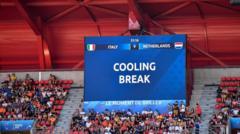
FIFA has introduced mandatory cooling breaks when the "Wet Bulb Globe Temperature" exceeds $32^{\circ} \mathrm{C}$ ($89.6^{\circ} \mathrm{F}$). During these three-minute windows, players rush to the sidelines to douse themselves in ice water and wrap cold towels around their necks.
It helps. But it’s a Band-Aid on a bullet wound.
The real solution lies in the shadows—literally. Architects are now racing to maximize shade in stadiums that weren't originally designed for mid-day July kickoffs. Some venues, like the Mercedes-Benz Stadium in Atlanta or the NRG Stadium in Houston, have retractable roofs. These will be closed, turning the matches into indoor spectacles where the climate is controlled to a crisp 72 degrees.
But football is a game of the elements. Moving it entirely indoors feels like a concession. It strips away the wind, the sun, and the atmospheric drama that defines the sport. Yet, when the alternative is a player collapsing in the center circle, the choice becomes clear. The 2026 World Cup might be the moment we realize that the "beautiful game" can no longer be played under an open sky in a warming world.
The Invisible Stakes for the Fans
We often forget the pilgrimage. Millions of fans will be traveling between cities, waiting in long security lines, and walking miles from transit hubs to stadium gates.
Imagine a family of four visiting Miami for a quarter-final. They aren't elite athletes with a team of doctors. They are tourists. The heat index in Florida can reach 110 degrees. If the "fan zones"—those massive outdoor viewing areas—aren't equipped with misting stations, industrial fans, and free water, they become dangerous environments.
The 2022 World Cup in Qatar was moved to the winter to avoid this exact scenario. North America 2026 doesn't have that luxury. It is locked into the summer window. This puts the burden on the host cities to rethink urban cooling. We are looking at a future where "Fan Experience" isn't about the quality of the jumbo-tron, but the availability of shade.
A Game of Adaptation
Climate change is often discussed in abstract percentages and distant years. But the 2026 World Cup makes it visceral. It brings the reality of a changing planet to the most popular stage in existence.
Coaches are already changing how they scout. They aren't just looking for the fastest wingers anymore; they are looking for "heat-tolerant" athletes. Sports scientists are experimenting with "pre-cooling" techniques, where players drink slushies made of electrolytes to lower their core temperature before they even step onto the grass.
There is a certain irony in it. We spend billions on stadiums and broadcast rights, yet the entire multi-billion dollar enterprise can be humbled by a high-pressure system sitting over the Atlantic.
As the sun beats down on the pitch in Miami or Los Angeles two years from now, the players will look for a breeze that might not come. They will squint against a glare that feels sharper than it did twenty years ago. And the rest of us, watching from the stands or our living rooms, will have to reckon with a hard truth.
The game is changing because the world is changing. We can adjust the tactics, we can close the roofs, and we can hand out all the ice water in the world. But we are playing on a pitch that is shrinking, under a sun that is growing less forgiving every year.
Elias stands on the pitch, his chest heaving, looking at the shimmering heat rising off the grass. He waits for the whistle. He has to play. We all do.
The whistle blows, the ball moves, and the sweat begins to fall, evaporated by a heat that no one can outrun.