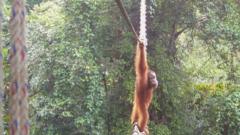
In the Kinabatangan floodplain of Malaysian Borneo, the canopy no longer exists as a continuous highway. It is a series of green islands separated by brown scars. For the local orangutan population, these gaps are more than just an inconvenience. They are genetic dead ends. Recently, footage of a male orangutan tentatively crossing a man-made rope bridge went viral, framed as a heartwarming success story. But that single crossing represents a desperate, low-tech intervention in a high-stakes ecological crisis. We are witnessing a radical experiment in habitat engineering because the traditional methods of conservation have failed to keep pace with industrial expansion.
The Engineering of a Genetic Lifeline
Orangutans are the largest arboreal mammals on earth. They are physiologically built to live high above the ground, moving through a three-dimensional world of interlocking branches. When that world is fragmented by drainage canals, roads, or palm oil plantations, the animals are grounded. On the forest floor, they are vulnerable to predators and, more importantly, they are trapped.
The rope bridges being deployed in Sabah are not simple swings. They are heavy-duty structures designed to withstand the weight of a 200-pound flanged male and the relentless humidity of a tropical rainforest. Constructing them requires a mix of maritime knot-tying and arboriculture.
Conservationists use thick, industrial-grade ropes, often donated by shipping companies or repurposed from heavy industry. These are rigged across rivers and man-made clearings to reconnect fragmented forest patches. The goal is simple. We must give these primates a way to move between isolated populations to prevent the catastrophic effects of inbreeding. When a population is cut off, the gene pool shrinks. Diversity vanishes. Eventually, the group becomes susceptible to disease and developmental defects that lead to localized extinction.
Why the Bridges Took Years to Work
Critics of these projects often point to the "lag time." For years, these ropes hung empty, swinging in the wind while orangutans watched from the sidelines. The skepticism was loud. If the animals wouldn't use them, the bridges were nothing more than expensive ornaments.
Orangutans are remarkably cautious. They are not impulsive jumpers; they are methodical planners who test the strength of every branch before committing their weight. In the wild, a fall is often fatal. This innate risk-aversion meant that the bridges had to become part of the "accepted" landscape.
The breakthrough came when younger, more adventurous individuals started testing the ropes. These early adopters paved the way for the rest. In the viral footage that captured the world's attention, we see a mature male utilizing the bridge with the practiced ease of someone walking a tightrope. He wasn't just crossing a river. He was demonstrating that the species can adapt to human-built infrastructure if given enough time and the right materials.
The Palm Oil Paradox
It is impossible to discuss these bridges without addressing the elephant—or rather, the plantation—in the room. The Kinabatangan region is a patchwork of protected forest and commercial agriculture. The very reason these bridges are necessary is the aggressive expansion of palm oil estates that have carved up the jungle over the last four decades.
There is a tension here that most "feel-good" news stories ignore. Some plantation owners have cooperated with conservationists, allowing bridges to be anchored on their land. This is a PR win for the companies, but it doesn't solve the underlying issue. A rope bridge is a bandage. It does not replace a lost corridor of primary rainforest.
The industry often uses these interventions to argue that biodiversity and intensive farming can coexist. It is a convenient narrative. While the bridges do work, they only facilitate the movement of certain species. They do nothing for the thousands of smaller organisms, from insects to soil microbes, that cannot cross a rope and require the complex floor-to-canopy environment of a real forest to survive.
A Crude Tool for a Complex Problem
If we look at the data, the scale of the challenge is staggering. Borneo has lost roughly half of its orangutan population in the last twenty years. The remaining groups are often stuck in "forest fragments" that are too small to support them long-term.
The rope bridge strategy is a gritty, boots-on-the-ground response to a lack of political will. It is much cheaper to string up a few lengths of nautical rope than it is to repossess land and reforest a corridor. This is the reality of modern conservation. It is an exercise in the art of the possible.
The success of these bridges has led to more sophisticated designs. Some now feature double-layer webbing or "vines" made of fire hoses, which provide more grip and stability. Engineers are even looking at thermal imaging to track exactly which animals use the bridges and at what times. This data is vital. It proves to donors and governments that these structures are not just symbolic gestures but functional tools.
The Real Cost of Fragmentation
When we see a video of a primate crossing a bridge, we feel a sense of relief. We think the problem is solved. It isn't. The isolation of these communities has long-term consequences that we are only beginning to understand.
When groups are separated, their social structures crumble. Orangutans are semi-solitary, but they rely on a "cultural" exchange of information. Mothers teach their young which fruits are safe and how to navigate the canopy. When a community is split, that chain of knowledge is broken. A bridge allows a male to find a mate in another fragment, but it doesn't necessarily restore the complex social fabric of a continuous forest.
Furthermore, these bridges are high-maintenance. The tropical sun and heavy rains degrade the fibers quickly. Without constant monitoring and replacement, a bridge can become a death trap. A rope that snaps while a mother and infant are mid-cross is a disaster. This means that these projects require permanent funding and a permanent human presence. They are not "set it and forget it" solutions.
Beyond the Viral Moment
The focus needs to shift from the novelty of the bridge to the necessity of the corridor. The global community likes the story of the "brave" orangutan because it suggests that nature is resilient enough to handle our mistakes. It places the burden of adaptation on the animal.
True success would look like the removal of these bridges. It would look like the restoration of natural land bridges where the trees actually touch. Until that happens, we are essentially building a zoo with no fences, where the inmates are forced to use tightropes to survive.
The bridges are a testament to human ingenuity and the tireless work of local rangers. They are also a stinging indictment of our failure to protect the most basic requirement for life: space. Every time a ranger climbs a tree to secure a new line, they are fighting against a clock that is ticking toward total habitat loss.
We should celebrate the fact that these animals are smart enough to use our tools. We should be far more concerned that they have to. The next phase of this work isn't about better ropes. It is about demanding that the legal protections for these "islands" of forest are enforced and expanded before the islands disappear entirely.
Stop looking at the bridge as a triumph. See it as an emergency exit.