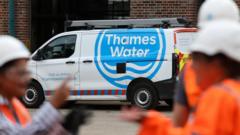
Thames Water currently operates as a failed experiment in highly leveraged infrastructure management, where the cost of debt service has structurally decoupled from the regulatory asset base's ability to generate cash. The fundamental crisis is not merely a liquidity shortfall but a terminal breakdown in the "Regulatory Asset Base" (RAB) model. When a primary investor signals that administration is the only viable path, they are acknowledging that the equity is mathematically zero and the debt stack requires a coercive haircut that only a state-led insolvency process can facilitate. This situation represents a transition from a private utility model to a de facto state-liability, where the primary objective shifts from shareholder return to systemic risk mitigation.
The Trilemma of Utility Insolvency
The collapse of Thames Water is governed by three mutually exclusive pressures that create a deadlock for private resolution. For a different perspective, read: this related article.
- CAPEX Requirements vs. Dividend Constraints: To meet environmental standards and aging infrastructure mandates, Thames Water requires multibillion-pound injections. However, the regulator (Ofwat) cannot allow the tariff increases necessary to fund this investment without triggering a political crisis regarding "water poverty."
- Debt Servicing in a High-Rate Environment: A significant portion of Thames Water’s £15 billion debt is inflation-linked. In a low-interest era, this was a manageable hedge. In the current macro environment, the interest expense creates a cash-flow bleed that exceeds operational efficiencies.
- Equity Wipeout and Investor Flight: Existing shareholders, including major pension funds, face a "sunk cost" fallacy. To save the utility, they must inject more capital into a vehicle that is restricted from paying dividends until specific, arguably unreachable, performance metrics are met.
The Mechanics of Special Administration Regime (SAR)
Special Administration is a bespoke insolvency framework designed to ensure that "essential services" continue regardless of the corporate entity's balance sheet health. Unlike a standard Chapter 11 or UK Administration, the primary goal of a SAR is not the maximization of creditor recovery but the continuity of service.
The process triggers a transfer of control to an appointed administrator, usually under the direction of the Secretary of State and Ofwat. The legal architecture allows the administrator to override existing debt covenants. This is the "nuclear option" because it effectively nationalizes the losses while keeping the operational assets in a holding pattern for a future, cleaner sale. Similar coverage on this matter has been shared by MarketWatch.
The second-order effect of a SAR is the revaluation of the entire UK regulated utility sector. If the government allows a SAR for Thames Water, the "implied sovereign guarantee" that has historically kept utility borrowing costs low will vanish. This creates a contagion risk where the cost of capital for every other water and energy company in Britain rises instantly, as lenders price in the reality that no utility is "too big to fail."
The Debt-to-Equity Distortion
The root cause of this insolvency is the aggressive use of "whole business securitization." In this model, the company was not run as a service provider but as a financialized spread-play. By loading the operating company (OpCo) with debt to pay dividends at the holding company (HoldCo) level, the previous owners stripped the entity of its shock-absorbing capacity.
The current leverage ratio—roughly 80% of its Regulatory Capital Value (RCV)—leaves no margin for error. When operational failures occur, such as sewage leaks or pipe bursts, the resulting fines from the Environment Agency and Ofwat act as a "margin call" on the company’s remaining liquidity.
$$Interest Coverage Ratio (ICR) = \frac{EBITDA - Tax}{Interest Expense}$$
When the ICR falls below 1.0, the company is effectively a "zombie" entity, existing only to transfer its dwindling cash reserves to senior bondholders. The investor's call for administration is a recognition that the ICR cannot be restored to a sustainable level through organic growth or minor tariff adjustments.
The Regulatory Trap and the Cost of Failure
Ofwat is trapped in a binary choice. It can either allow "super-normal" price hikes—effectively a tax on 15 million customers to bail out private debt holders—or it can hold the line on prices and force the company into the SAR.
The technical breakdown of the proposed £2.5 billion rescue package reveals the desperation. This capital was contingent on Ofwat easing regulations and allowing a 40% increase in customer bills. By rejecting these terms, Ofwat has signaled that the era of "regulatory capture," where the regulator prioritizes the financial health of the firm over the service delivery to the consumer, is over.
The resulting gap creates a "death spiral":
- Reduced investment leads to deteriorating infrastructure.
- Deteriorating infrastructure leads to higher regulatory fines.
- Higher fines reduce the cash available for investment.
- The credit rating drops, making future debt refinancing more expensive or impossible.
The Valuation Gap in Infrastructure Assets
There is a fundamental misalignment in how Thames Water's assets are valued. The company points to its RCV, which is approximately £19 billion. However, the market value of the debt is trading at a significant discount. This "market-to-book" divergence indicates that the secondary market does not believe the RCV is a recoverable amount.
Investors are now pricing in "Regulatory Risk," which is the probability that the rules of the game will change mid-match. If the government intervenes, it will likely prioritize the "social license to operate" over the "contractual right to return." This shifts the utility from a low-risk, bond-proxy investment to a high-risk distressed asset.
Strategic Implications for the UK Infrastructure Landscape
The fallout from a Thames Water administration extends beyond the water sector. It serves as a case study for the limits of the Private Finance Initiative (PFI) legacy. The logic of the 1980s and 90s privatizations was that private capital would bring efficiency. The reality in the Thames case is that private capital brought financial engineering while the state retained the ultimate downside risk.
The restructuring will likely follow a "Good Bank / Bad Bank" split:
- The Operational Core: A new entity, possibly a Public Interest Company (PIC) similar to Glas Cymru (Welsh Water), which operates on a non-profit basis where surpluses are reinvested into the network.
- The Legacy Debt Vehicle: A shell entity that holds the £15 billion in liabilities, where creditors compete for cents on the pound through years of litigation.
This bifurcated approach is the only way to decouple the physical necessity of water delivery from the toxic financial structure of the current corporate parent.
The Creditor Hierarchy and the Inevitable Haircut
In any administration scenario, the "waterfall" of payments becomes the primary battleground. Class A bondholders, who believe they are secured against the physical assets, will find themselves in direct conflict with the government's mandate to fund a £50 billion long-term upgrade plan.
The "Economic Cost of Capital" (ECC) for the water sector is currently being redefined. Historically, this was calculated as a modest premium over Gilts (UK government bonds). Moving forward, the ECC must include a "Political Risk Premium." This means that even if Thames Water is restructured, the cost of funding the UK’s wider infrastructure needs—from high-speed rail to the energy grid—will be structurally higher because the "safe" utility asset class has been compromised.
The Necessary Strategic Pivot
For the UK government, the strategic play is no longer about "saving" Thames Water, but about "managed demolition."
- Trigger the SAR immediately: Every month of delay allows for further cash depletion and infrastructure decay.
- Impose a "Hard Haircut" on Junior Debt: Send a clear signal to the markets that reckless leverage in essential services will not be subsidized by the taxpayer.
- Reform the Regulatory Mandate: Move Ofwat's primary directive from "ensuring the financeability of the companies" to "ensuring the resilience of the resource."
The investor's admission that the company should go into administration is not a threat; it is an invitation to acknowledge a mathematical reality. The current structure cannot be "fixed" with incremental capital. It must be liquidated and rebuilt on a foundation where the capital stack is secondary to the operational mandate. The end of Thames Water as a private, leveraged entity is not a failure of the market, but a necessary correction of a model that mistook a vital resource for a high-yield derivative.