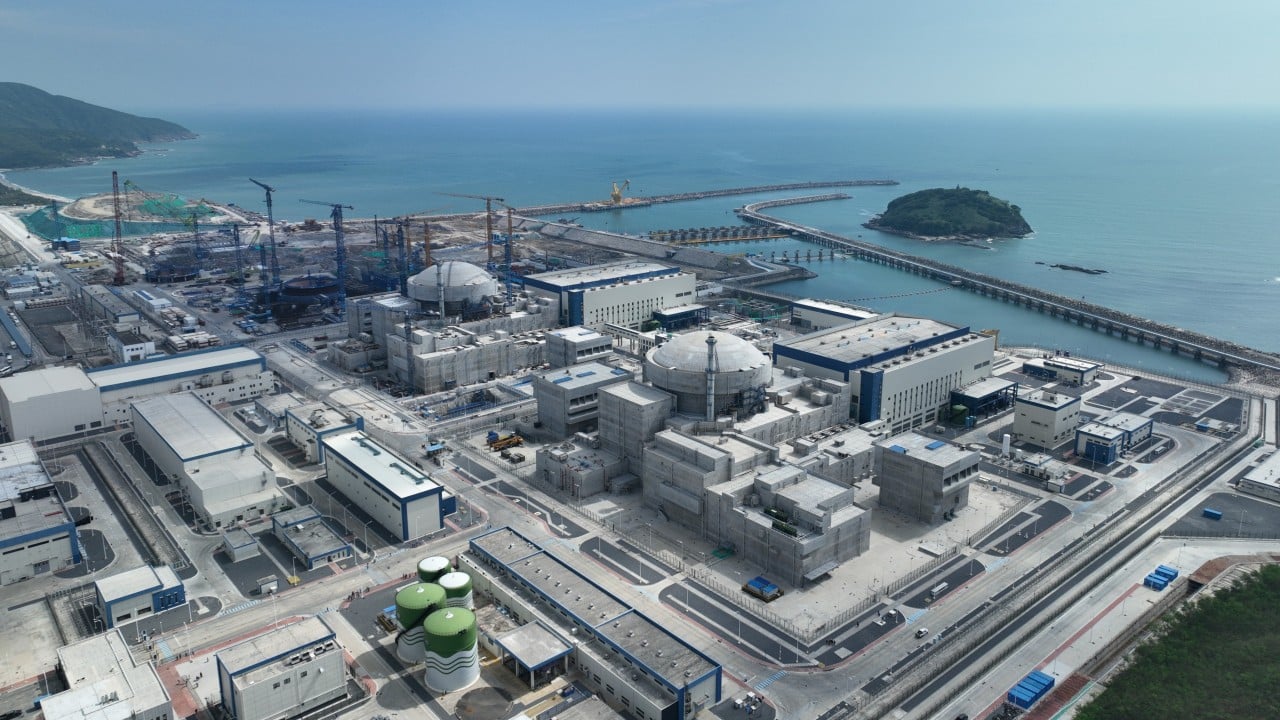
China has transitioned from a localized nuclear energy program to an industrialized assembly line capable of maintaining 50 concurrent reactor projects. This capacity is not merely a result of state funding but a byproduct of vertical integration and the standardization of the Hualong One (HPR1000) design. While Western nations approach nuclear construction as bespoke, generational engineering projects, China treats reactor deployment as a high-frequency manufacturing exercise. This shift allows for a predictable reduction in the cost of capital and an accelerated learning curve that competitors cannot currently match.
The Triad of Chinese Nuclear Scalability
The ability to build 50 reactors simultaneously rests on three structural pillars: design standardization, supply chain localization, and the institutionalization of the labor force.
1. Design Standardization as a Cost Reductant
The primary failure of nuclear programs in the United States and Europe often stems from "first-of-a-kind" (FOAK) risks. Every deviation from a blueprint requires new regulatory approvals, new component sourcing, and unique construction sequences. China has largely bypassed this through the Hualong One. By freezing the design specifications, the State Council ensures that the tenth unit is functionally identical to the first.
This standardization triggers the "Nth-of-a-kind" (NOAK) effect. In economic terms, the learning rate for nuclear construction suggests that doubling the number of units built leads to a 10% to 15% reduction in total cost. By committing to a fleet of 50, China is driving down the unit cost of electricity through sheer volume, effectively turning nuclear power into a commodity.
2. Full-Spectrum Supply Chain Localization
China has achieved approximately 90% localization for its primary reactor components. This includes the heavy forging required for pressure vessels, steam generators, and the specialized pumps used in cooling systems.
- Pressure Vessel Forging: The Shanghai Electric Group and China First Heavy Industries have developed the capacity to forge ultra-large components that previously required imports from Japan or France.
- Fuel Cycle Integration: Beyond construction, China is securing the entire value chain, from uranium enrichment to waste management, reducing the risk of external geopolitical shocks halting the domestic energy transition.
3. The Institutionalization of Specialized Labor
Construction delays in Western nuclear projects are frequently attributed to a lack of "nuclear-qualified" welders and engineers. In China, the continuous pipeline of projects ensures that the workforce never enters a period of atrophy. A welder who finishes work at the Sanmen site can be immediately deployed to the Haiyang site. This creates a permanent class of specialized labor that maintains high-level certifications and operational muscle memory.
The Capital Expenditure Function and Financing Advantage
The economic viability of a nuclear plant is almost entirely dependent on the cost of capital. Because nuclear projects have long lead times and high upfront costs, even a 1% increase in interest rates can make a project unbankable.
China utilizes a state-directed financing model where the "Big Three"—China National Nuclear Corporation (CNNC), China General Nuclear Power Group (CGN), and State Power Investment Corporation (SPIC)—receive low-interest loans from state-owned banks. The interest rates are often rumored to be between 2% and 4%, whereas private developers in market economies might face 7% to 10% when accounting for risk premiums.
Deconstructing the Levelized Cost of Energy (LCOE)
The LCOE for Chinese nuclear projects is estimated at $40 to $50 per megawatt-hour. Compare this to the $150 to $200 per megawatt-hour range seen in recent U.S. and U.K. projects like Vogtle or Hinkley Point C. The discrepancy is not due to cheaper materials, but rather:
- Reduced Interest During Construction (IDC): Faster build times (roughly 60 to 70 months) mean less time for interest to accrue before the plant generates revenue.
- Regulatory Synchronization: The National Nuclear Safety Administration (NNSA) in China operates in tandem with construction timelines rather than as an adversarial bottleneck.
Operational Logic of the 50-Reactor Capacity
To understand how a nation manages 50 simultaneous builds, one must look at the modularity of the construction process. China has adopted "Open-Top" construction methods where massive modules are pre-assembled in factory settings and lifted into the containment building.
This shifts the work from a chaotic construction site to a controlled environment.
- Component Parallelism: While the foundation is being poured, the internal cooling loops are being fabricated 500 miles away.
- Standardized Safety Systems: Passive safety features in the Hualong One reduce the complexity of the backup power systems, which were a significant cost driver in older Gen II designs.
The Limitation of Geographic Concentration
While the capacity is vast, it is currently concentrated along the eastern coastline. This is a deliberate strategy to meet the energy demands of industrial hubs like Guangdong and Zhejiang while utilizing the sea for cooling water. The transition to inland nuclear power remains a point of internal debate due to concerns over water scarcity and thermal pollution in river systems. This geographic constraint suggests that while 50 reactors can be built, the siting of the next 100 will face steeper environmental and social hurdles.
Geopolitical Implications of a Mature Export Model
China’s domestic saturation serves a secondary purpose: establishing a global export standard. By proving the Hualong One at scale, China positions itself as the primary alternative to Russia’s Rosatom.
The strategy for international dominance follows a specific sequence:
- Technology Transfer: Offering to build reactors in partner nations (e.g., Pakistan) while training their local workforce.
- Financing Packages: Providing the same low-interest state loans to export customers that domestic firms receive.
- Regulatory Influence: As more countries adopt Chinese designs, the global standards for safety and operation shift toward Chinese protocols, creating a "lock-in" effect for future maintenance and fuel contracts.
The Risks of High-Velocity Expansion
Rapid scaling is not without systemic risks. The primary threat to this 50-reactor momentum is not technological, but administrative.
- Quality Control Dilution: As the number of active sites grows, the demand for high-level inspectors increases. If the bureaucratic oversight does not scale at the same rate as the concrete pouring, the risk of a systemic design flaw being replicated across dozens of units increases.
- Uranium Dependency: Despite advancements in domestic mining and reprocessing, a fleet of 150+ reactors (China's 2035 goal) will require massive amounts of imported uranium. This creates a new strategic vulnerability, trading a reliance on coal or gas for a reliance on global uranium markets.
The Theoretical Peak of Nuclear Manufacturing
The current ceiling of 50 reactors is likely a function of the heavy forging industry's throughput. A single reactor pressure vessel requires months of specialized heat treatment and precision machining. To move beyond 50 units, China would need to commission additional "First Heavy" style industrial complexes, a process that takes five to seven years.
Therefore, the 50-reactor figure represents the "steady state" of Chinese industrial capacity. It is the equilibrium point where the rate of new starts matches the rate of grid connections.
Strategic Trajectory
The global energy market must acknowledge that the "nuclear renaissance" is currently a mono-national event. The competitive advantage held by China is not based on a secret scientific breakthrough, but on the application of 20th-century industrial logic to 21st-century energy needs.
For Western stakeholders, the path forward involves a binary choice: either adopt the Chinese model of state-backed standardization and multi-decade planning, or pivot entirely to Small Modular Reactors (SMRs) to bypass the heavy industrial requirements where China currently holds a monopoly. Attempting to compete on large-scale pressurized water reactors using fragmented, private-market frameworks will continue to result in projects that are double the cost and twice the duration of their Chinese counterparts.
The real metric of success for China is not the 50 reactors today, but the establishment of a "closed-loop" nuclear economy by 2040, where fast-breeder reactors and domestic reprocessing eliminate the need for external fuel, rendering the nation's energy grid entirely sovereign.


