We love a good victim story.
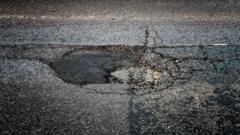
For twelve months, a local news team tracked a single, cavernous depression in the asphalt. They watched cars swerve. They filmed neighbors planting flowers in it. They interviewed furious commuters who treated this 2-foot patch of broken pavement like a monument to municipal failure.
It makes for great television. It makes for abysmal urban planning.
The lazy consensus screams that a pothole is a sign of government laziness. The prevailing narrative demands a reactive, hyper-local war on every crack in the street. Neighbors want a crew dispatched within twenty-four hours. Politicians promise "pothole hotlines" to secure reelection.
They are all wrong.
obsessing over individual potholes is exactly why our infrastructure is crumbling. The panic-and-patch approach is a financial black hole that actively destroys municipal budgets, rewards inefficient infrastructure design, and delays the systemic overhauls our transit networks actually need.
The Fatal Flaw of the Reactive Repair Cycle
Let's look at the actual physics and economics of road maintenance, rather than the emotional outrage of a driver who just blew a tire.
When a city dispatches a crew to patch a single pothole because of a viral social media post, it executes a "cold patch" or a quick "throw-and-go" repair. Workers shovel cold asphalt aggregate into the hole, compact it with a truck tire or a hand tamper, and move on.
It is a cosmetic band-aid.
[Water Infiltration] -> [Freeze-Thaw Expansion] -> [Sub-base Erosion] -> [Pavement Collapse]
                               ▲                                              │
                               └─────────── [Reactive Cold Patch] ◄───────────┘
The underlying structural failure is almost never addressed. The sub-base remains compromised. The next freeze-thaw cycle hits, water seeps right back into the unsealed edges, and the patch ejects within weeks, often leaving a larger cavity than before.
I have watched mid-sized municipalities waste up to 30% of their annual public works discretionary budgets on these repetitive, reactive field operations. It is a classic operational trap: spending thousands of dollars in labor and materials over five years to repeatedly patch a spot that requires a single, comprehensive structural resurfacing.
By demanding immediate gratification for minor road blemishes, citizens force cities to diverted funds away from long-term asset management. We are burning capital to treat symptoms while the disease rots the core asset.
The Misleading Premise of Public Infrastructure Complaints
If you look at typical municipal data, the questions people ask about infrastructure reveal a profound misunderstanding of asset depreciation.
Why does it take so long for the city to fix a reported pothole?
The brutal truth is that if a city is managing its budget correctly, your specific neighborhood pothole should be a low priority. Civil engineers rank road repairs using the Pavement Condition Index (PCI), a numerical rating from 0 to 100. A brand-new road is 100; a completely failed track is 0.
Maximizing the lifespan of a street network requires spending money on roads that are at a 70 or 75 PCI—applying slurry seals and preservation treatments before the structural integrity fails. Once a road drops below a 40 PCI and starts throwing chunks of asphalt into the air, it is already dead. Spending limited funds to patch a dead road is throwing good money after bad. It must wait for full reclamation, and scheduling that requires systemic planning, not algorithmic panic based on citizen complaints.
Aren't potholes costing drivers billions in repairs every year?
Yes. The American Society of Civil Engineers routinely quantifies these costs. But the contrarian reality is that subsidizing free, high-speed, heavy-vehicle storage and transit on public pavement costs even more.
We have built a sprawling, car-centric layout that requires trillions of square feet of asphalt to connect low-density developments. The math does not work. The tax base generated by a suburban cul-de-sac cannot generate enough revenue over a 30-year lifecycle to pay for the replacement of the asphalt serving it. The pothole is not an administrative failure; it is a mathematical certainty born of unsustainable zoning.
The Asset Management Playbook
If we want functional infrastructure, we have to stop treating public works departments like concierge services for drivers. True asset preservation requires cold, counter-intuitive prioritization strategy.
1. Enforce the 80/20 Rule on Deficit Maintenance
Eighty percent of your citizen complaints will focus on twenty percent of the worst-looking roads. Ignore them.
Instead, redirect those operational funds toward preventative maintenance on roads that are currently in "good" or "fair" condition. It costs roughly one-tenth to preserve a square yard of pavement with a rejuvenator or micro-surfacing than it does to reconstruct it once it fails entirely. If you let a good road fail while chasing potholes on a ruined road, you are compounding your liabilities exponentially.
2. Implement Automated Distress Detection
Ditch the citizen hotline. Human reporting is biased toward wealthy neighborhoods where residents have the free time to log complaints on city apps. This distorts equity and engineering logic.
Deploy transit vehicles and garbage trucks equipped with simple, downward-facing cameras and LiDAR sensors. These systems continuously map the entire street network, measuring crack frequency, rutting depth, and raveling objectively. Let the data determine the maintenance schedule, completely removed from political grandstanding or neighborhood advocacy.
| Metric | Citizen Hotline Method | Automated LiDAR Method |
|---|---|---|
| Data Bias | Heavily skewed toward affluent areas | Objective, 100% network coverage |
| Cost Per Data Point | High (manual verification required) | Negligible (passive collection) |
| Strategy | Reactive, emergency patches | Predictive, scheduled preservation |
3. Price the Pavement Usage Accurately
Asphalt does not degrade from standard passenger use. Pavement damage follows the Generalized Fourth Power Law, which states that the stress inflicted on a road by an axle increases to the fourth power of the axle load.
$$Damage \propto \left(\frac{Axle\ Load}{Standard\ Axle\ Load}\right)^4$$
A single heavy commercial delivery truck or a massive electric SUV causes thousands of times more structural fatigue than a compact sedan. If our road user fees, registration taxes, and delivery surcharges do not scale exponentially with vehicle weight, we are forcing light-vehicle owners to subsidize the destruction of their own streets by commercial fleets.
The Hard Truth of Infrastructure Preservation
Adopting a rigorous, data-driven preservation model has an immediate downside that most politicians cannot stomach: things will look worse before they get better.
When you pivot funding away from emergency patching and into long-term preservation, the highly visible, catastrophic potholes on your worst streets will remain open longer. The local news will still run their sensationalist segments. Drivers will still vent on community forums.
It takes immense institutional spine to look at a furious voter and say, "We are leaving that crater alone because spending $500 to patch it today prevents us from saving a three-mile stretch of road two neighborhoods over."
But leadership is not about eliminating every inconvenience. It is about capital efficiency. We can continue our sentimental, hyper-localized obsession with individual potholes while our entire national infrastructure silently decays beneath us. Or we can grow up, look at the asset depreciation curves, and realize that the best way to manage a road network is to let the dead roads stay dead until we can actually afford to rebuild them right.
Stop looking at the hole. Look at the balance sheet.