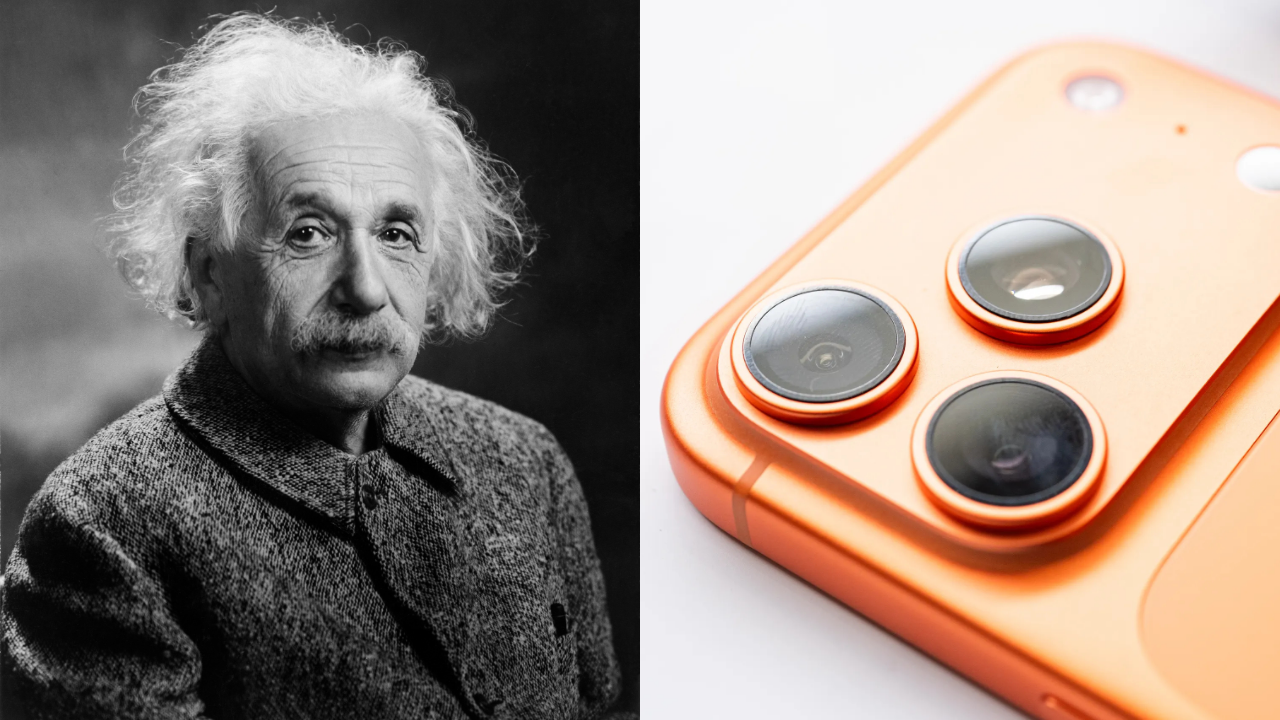
Tech journalists love a cozy, intellectual origin story. For years, the copy-paste media machine has peddled the same romantic narrative: every time you snap a selfie, you owe a debt of gratitude to Albert Einstein’s 1905 paper on the photoelectric effect. They tell you that the father of modern physics handed us the keys to digital imaging on a silver platter, winning a Nobel Prize for it, and that your smartphone is a direct descendant of his genius.
It is a beautiful story. It is also historically lazy and functionally wrong.
Einstein did not build your smartphone camera. In fact, if you trace the actual engineering lineage of the image sensors in our pockets, you find a narrative of bitter academic feuds, accidental discoveries, and corporate defiance. Einstein’s actual contribution to your camera was a theoretical abstraction—one that he spent the later years of his life trying to complicate, and a concept that the true pioneers of digital imaging had to completely bypass to make the technology practical.
Your phone camera exists in spite of the scientific establishment Einstein anchored, not because of it.
The Photoelectric Flaw: What the Tech Blogs Got Wrong
Let’s dismantle the foundational myth right now. The common narrative states that the photoelectric effect is the mechanism behind digital camera sensors.
It works like this in the textbooks: light hits a material, and electrons get kicked out. This is true for a vacuum phototube from 1920. It is radically different from how a modern Complementary Metal-Oxide-Semiconductor (CMOS) sensor operates.
Your smartphone camera does not use the external photoelectric effect where electrons escape a material. It relies on the internal photoelectric effect within a semiconductor lattice, specifically localized inside a pinned photodiode. When a photon strikes the silicon, it doesn't send an electron flying out into space; it merely shifts an electron from the valence band to the conduction band, creating an electron-hole pair. The electron remains trapped inside a microscopic potential well.
Einstein’s 1905 paper didn't mention silicon. It didn't mention semiconductors. It didn't predict the behavior of localized charge packets in a solid-state matrix. To say Einstein invented the digital camera sensor is like saying Democritus invented the atomic bomb because he dreamed up the concept of atoms in ancient Greece.
Furthermore, Einstein despised the philosophical baggage that came with his own discovery. The photoelectric effect proved light was quantized, sparking the quantum mechanics revolution. Einstein spent his remaining decades fighting the implications of quantum mechanics, famously muttering about God not playing dice. The very randomness and probability metrics used today to calibrate low-light noise reduction algorithms in Apple and Samsung sensors are based on the Copenhagen interpretation of quantum mechanics—a school of thought Einstein openly rejected.
The Real Architects: Bell Labs and the Accidental Memory Chip
If we are going to worship the creators of digital imaging, we need to stop looking at European theoretical physics and start looking at mid-century corporate desperation in New Jersey.
In 1969, Willard Boyle and George Smith were working at Bell Labs. They weren’t trying to build a camera. They weren't trying to revolutionize photography. They were trying to invent a new type of electronic memory for computers to compete with magnetic core memory. They were under intense pressure from management to produce a viable semiconductor memory device or risk having their funding slashed.
Over the course of a single afternoon, brainstorming on a blackboard, they sketched out the architecture for the Charge-Coupled Device (CCD).
The breakthrough wasn't figuring out how light creates a charge; it was figuring out how to move that charge along a conveyor belt of MOS capacitors without losing the data. Think of it as a bucket brigade line during a fire. Each pixel is a bucket. The light fills the bucket with water (electrons), and the sensor shifts the water from bucket to bucket down the line until it reaches an amplifier at the edge of the chip.
[Light photons] -> [Pixel Buckets (Charge Packets)] -> [Shift Register] -> [Amplifier] -> [Digital Output]
Boyle and Smith realized almost as an afterthought that their memory chip was sensitive to light. When they ran the experiment, they saw that light could inject the initial charges into the buckets. That was the birth of the digital image sensor. It wasn't an epiphany about the majesty of light; it was an engineering hack to save a failing memory project.
The CCD Myth and the Executive Who Killed It
Even after the CCD was invented, the road to the smartphone camera required breaking another industry consensus. For decades, the CCD was hailed as the undisputed king of imaging. It powered astronomical telescopes, high-end broadcast cameras, and early consumer camcorders.
The industry consensus throughout the 1980s and 1990s was clear: CCD was the only way to get high-quality images. Silicon chips made with standard CMOS processes—the cheap stuff used to make computer microprocessors—were deemed too noisy, too flawed, and utterly incapable of capturing a clean picture.
I have seen engineering teams in major tech conglomerates burn through tens of millions of dollars trying to force obsolete architectures into modern form factors because "that's the way it's always been done." That same dogmatic blindness almost choked digital photography in its infancy.
The dominant camera companies of the late 20th century dug their heels in. They believed that a camera sensor should be manufactured on boutique, highly specialized fabrication lines dedicated solely to CCDs. This made sensors incredibly expensive, power-hungry, and difficult to integrate with other electronics. If the industry had stayed on that path, your phone today would be two inches thick, cost $4,000, and its battery would die after ten photos.
The NASA Renegade Who Saved Your Pocket Camera
The true leap to the smartphone camera happened because an outsider decided the industry elites were dead wrong.
In the early 1990s, an engineer named Eric Fossum was working at NASA’s Jet Propulsion Laboratory (JPL). NASA needed smaller, lighter cameras for interplanetary spacecraft. CCDs required massive amounts of power and complex external circuitry to clock those "buckets" of charge across the chip. Fossum looked at the standard, cheap CMOS manufacturing lines that the rest of the imaging world ridiculed and saw an opportunity.
He invented the CMOS Active-Pixel Sensor (APS).
Instead of moving the charges across the entire chip to a single amplifier at the corner, Fossum put a tiny amplifier inside every single pixel.
The imaging establishment reacted with mockery. They claimed that putting transistors inside the pixels would block the light, increase noise, and produce garbage images. They were right about the initial prototypes—the images looked like static on an old analog television. But Fossum’s architecture allowed for something CCD could never achieve: integrating the sensor, the timing circuitry, and the analog-to-digital converters onto a single piece of silicon. The "camera on a chip" was born.
Without Fossum's CMOS sensor, the modern smartphone is physically impossible. CMOS sensors consumed one-hundredth of the power of a CCD. They could be manufactured on the exact same high-volume fabrication lines as computer CPUs, driving costs down from hundreds of dollars per sensor to pennies.
Yet, when Fossum tried to license the technology, the major American camera manufacturers turned him down. They were too invested in their legacy CCD lines. It took years of grinding grit, spinning off his own company (Photobit), and fighting entrenched industry bias before CMOS finally dethroned CCD to become the engine inside every smartphone on earth.
The Paradox of Modern Mobile Imaging
Here is the ultimate counter-intuitive truth of the device in your pocket: your smartphone camera is no longer actually a camera.
In traditional photography, the sensor captures the light that passes through the glass, and that is your image. If you try that with a phone, the physics break down completely. The lenses are too small. The sensors are microscopic. The physical laws of optics dictate that a lens the size of a pea cannot gather enough photons to create a clean, noise-free image in a dimly lit room.
By all laws of classical physics, your night-mode smartphone photos should be a muddy, blurred mess of digital noise.
They aren't, but it isn't because of a breakthrough in sensor hardware or a new understanding of the photoelectric effect. It is because of computational photography.
When you tap the shutter button on a modern phone, the device doesn't take one picture. It takes anywhere from 10 to 45 images in a fractions-of-a-second burst before and after you press the button. It captures these images at different exposures, then hands them off to a dedicated Neural Processing Unit (NPU).
The NPU uses alignment algorithms to stitch the frames together, pixel by pixel. It runs statistical probability models to determine whether a speck of green on a sensor pixel is a genuine piece of data or random thermal noise. It dynamically replaces textures, sharpens edges, and artificially relights faces based on machine learning models trained on millions of professional photographs.
Your phone camera doesn't capture reality; it computes a plausible simulation of reality based on a brief burst of noisy data.
If Einstein were alive today to see an iPhone use predictive matrix math to artificially brighten a low-light landscape photograph, he wouldn't recognize it as an extension of his work. He would likely view it as a terrifying, probabilistic distortion of physical reality.
Stop Looking Backwards
The lazy narrative linking modern mobile tech directly to the giants of early 20th-century physics is a comforting lie. It suggests progress is a clean, linear baton pass from one genius to the next.
The reality is messy, chaotic, and driven by pragmatism. Your smartphone camera exists because NASA needed to save weight on satellites, because two engineers at Bell Labs needed to protect their research budget, and because a handful of renegades looked at standard, cheap computer chips and realized they could do what the boutique imaging industry said was impossible.
Stop crediting the theorists who wrote the abstract laws of the universe for the tools built by the engineers who wrestled those laws into submission. The genius of your phone camera isn't that it understands quantum physics; it's that it manages to cheat physics every single time you take a photo.



/arc-anglerfish-arc2-prod-mco.s3.amazonaws.com/public/BHPBP5TJJFF5XBWKSOQWZ6G55A.JPG)