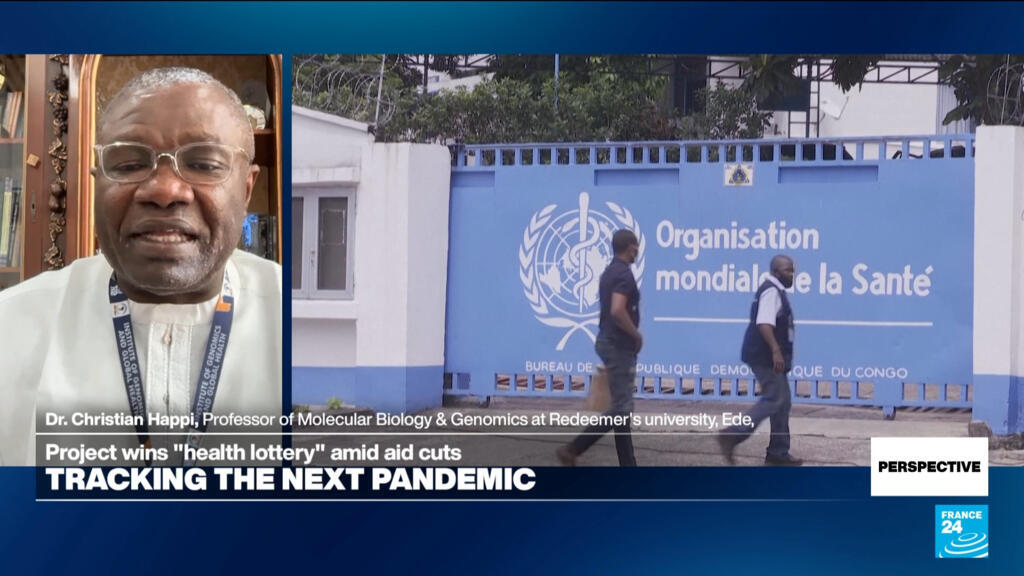
The global health establishment is addicted to the "When, Not If" narrative. It is a comfortable, high-stakes bedtime story that keeps the grant money flowing and the panicked headlines clicking. Experts like Christian Happi and the architects of the WHO’s latest preparedness treaties want you to believe that we are sitting ducks waiting for a random genetic mutation to wipe out the species.
They are wrong. They are focusing on the spark while standing in a room filled with gasoline they poured themselves.
The obsession with "early detection" and "viral surveillance" in the deep jungle is a massive, expensive distraction. We are currently pouring billions into hunting for viruses that haven't even jumped to humans yet, under the delusion that we can "stop the next one at the source." This isn't science; it's a frantic, geopolitical vanity project.
The real threat isn't the virus hiding in a bat cave in rural Africa. The threat is the very infrastructure we are building to find it.
The Surveillance Trap
The prevailing wisdom suggests that if we just had better eyes on the ground—more labs, more genomic sequencing, more real-time data—we could snip a pandemic in the bud.
This ignores the fundamental reality of biological evolution. By the time you identify a novel pathogen in a remote village, it’s already on a plane. Genomic sequencing is a rearview mirror. It tells you what happened three weeks ago. In the context of a highly transmissible respiratory virus, three weeks is an eternity.
More importantly, the push to build high-containment Biosafety Level 4 (BSL-4) labs in developing nations is a recipe for disaster. We are incentivizing the collection and "enhancement" of dangerous pathogens in regions that often lack the stable power grids, supply chains, and political stability required to keep those pathogens inside the glass.
We saw what happened in 2019. Whether you believe in a natural spillover or a lab leak, the result remains the same: the presence of a research facility increased the risk, it didn't decrease it. Expanding this footprint globally under the guise of "equity" and "preparedness" is functionally equivalent to handing out loaded guns to people who don't have holsters.
The Fallacy of the Zero-Day Vaccine
The "100-Day Mission" is the new holy grail. The idea is that we can go from viral discovery to a needle in an arm in just over three months.
It sounds heroic. It is actually a dangerous shortcut.
Vaccine development is a process defined by friction. That friction—clinical trials, long-term safety monitoring, placebo-controlled studies—is not "red tape." It is the barrier between medicine and a public health catastrophe. When we talk about compressing these timelines, we aren't just innovating; we are gambling with the public's immune system.
I have watched biotech firms burn through venture capital trying to "platform" their way out of biology. Biology doesn't care about your platform. It cares about off-target effects and Antibody-Dependent Enhancement (ADE). You cannot "software update" a human body without consequences.
The Wrong Questions Everyone is Asking
People often ask: "Are we ready for Disease X?"
This is the wrong question. The right question is: "Why is our baseline health so abysmal that common viruses become killers?"
We treat the human population like a monoculture crop. We have spent forty years optimizing for a lifestyle that creates chronic inflammation, metabolic syndrome, and Vitamin D deficiency. Then, when a virus hits this weakened "crop," we act surprised that the mortality rate is high.
- Misconception: Pandemics are caused by "super-viruses."
- Reality: Pandemics are caused by a population with a compromised baseline.
If you want to survive the next viral surge, stop worrying about what's happening in a wet market. Start worrying about the fact that 40% of the adult population in the West is metabolically broken. A "deadly" virus is often just a stress test for a failing system.
Stop Trying to Fix the Jungle
The "One Health" movement suggests we need to manage the interface between humans and nature. It’s an arrogant, colonialist approach to ecology.
The most effective way to prevent zoonotic spillover is to leave the jungle alone. The irony is that "pathogen prospecting"—sending scientists into caves to swap bats—is the very activity that brings humans into contact with these viruses. We are creating the contact points we claim to be monitoring.
Imagine a scenario where we simply stopped looking for new ways to die. If we dismantled the gain-of-function research apparatus and pivoted those billions toward basic sanitation, clean water, and metabolic health, the "pandemic threat" would shrink to a manageable nuisance.
The Decentralization of Defense
The current model of pandemic response is top-down, authoritarian, and centralized. It relies on the WHO, the CDC, and national governments to flip a switch and control 8 billion people.
It failed in 2020, and it will fail again.
The only way to actually "prepare" is to decentralize. We need localized manufacturing of basic medical supplies, not globalized "just-in-time" supply chains that snap the moment a border closes. We need a medical system that empowers individuals to manage their own health, rather than waiting for a government-issued miracle drug.
The "insider" secret that no one wants to admit is that the institutions tasked with protecting us are more interested in their own expansion than in your safety. Every "emergency" is a justification for a bigger budget and more surveillance power.
We are building a digital panopticon to catch a virus, and by the time we realize the virus has passed, we'll find we've traded our autonomy for a false sense of security.
The Brutal Truth About Viral Evolution
Viruses want to survive. Killing the host is a reproductive dead end.
Left to their own devices, respiratory viruses tend to evolve toward higher transmissibility and lower virulence. We saw this with Omicron. The "emergency" ended not because of a policy, but because the virus did what viruses do: it became a highly contagious cold.
$$R_0 > 1$$is the goal of the virus. If it kills the host too quickly, the$$R_0$$ drops.
The danger occurs when we interfere. When we use leaky vaccines that don't stop transmission, or when we apply extreme environmental pressures, we risk "Marek’s Disease" scenarios where the virus is forced to evolve in ways it wouldn't naturally.
We are playing a high-stakes game of evolutionary chess against an opponent that makes a billion moves a second. The best way to win is to stop playing the game on the virus's terms.
Quit looking for the "Next Pandemic" on a map. Look for it in the mirror of our own broken health systems and the hubris of our scientific "saviors."
Throw away the mask, cancel the "preparedness" summit, and fix your own mitochondrial health. That is the only vaccine that actually works when the world goes quiet.