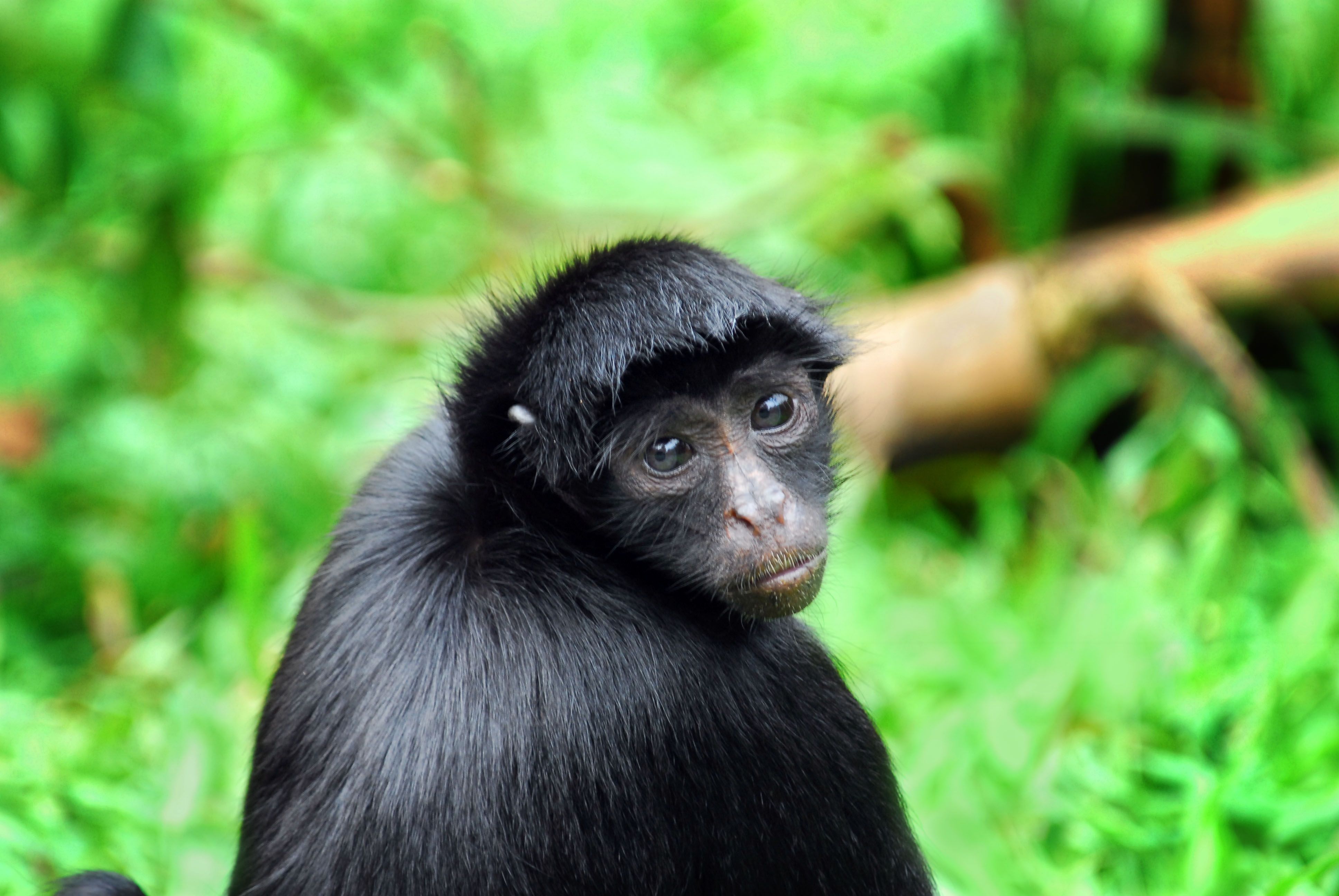
You’re walking through a dense tropical rainforest in Central America, looking up through the thick green canopy, and suddenly, you see it. A blur of dark fur, impossibly long limbs, and a tail that acts like a fifth hand. It’s a spider monkey. Honestly, these creatures are some of the most fascinating primates on the planet, but they’re also some of the most misunderstood. People often lump them in with every other "monkey," but they are a specialized, high-energy marvel of evolution.
They are lanky.
That’s the first thing you notice. They look like a collection of long, spindly sticks held together by fur. This specific physiology is why they got their name; when they hang from the trees by their tails, their limbs dangle down, making them look like giant, hairy spiders suspended in the web of the forest.
What is a spider monkey exactly?
To get technical for a second, a spider monkey belongs to the genus Ateles. They are New World monkeys, which basically means they are native to the tropical forests of Central and South America, stretching from southern Mexico all the way down to Brazil. There are seven recognized species, including the Geoffroy’s spider monkey and the brown spider monkey, which is tragically one of the most endangered primates in the world.
If you want to know what makes them truly unique, look at their hands. Or rather, look at what’s missing. Most primates have opposable thumbs, right? Not these guys. Spider monkeys have either no thumb at all or a tiny, vestigial stump. You’d think that would be a disadvantage, but it’s actually a brilliant adaptation for "brachiation"—that’s the fancy word for swinging through trees. Without a thumb getting in the way, their hands act like perfect hooks, allowing them to grab branches and release them in one fluid motion without snagging.
Then there is the tail. Calling it a "tail" feels like an understatement. It’s a prehensile masterpiece. The underside of the tip has a hairless patch with skin grooves similar to a human fingerprint. This provides incredible grip. A spider monkey can support its entire body weight with just that tail, leaving all four limbs free to reach for fruit or groom a companion. They spend almost their entire lives high up in the emergent layer of the forest, rarely ever touching the ground.
The social chaos of the canopy
Spider monkeys don’t do the "traditional" troop thing that you might see with baboons. They follow a social structure called fission-fusion. Essentially, they live in large groups of up to 35 or 40 individuals, but they almost never stay together. During the day, they break off into small "sub-groups" of three or four to forage.
Why? Because they are fruit fanatics.
They are "frugivores," and about 80% to 90% of their diet consists of ripe fruit. Because fruit grows in patches that can be far apart, a huge group of 40 monkeys would strip a tree bare in minutes and leave everyone hungry. By breaking into smaller teams, they can cover more ground and find enough food to survive. At night, they "fuse" back together to sleep in the safety of high branches. It’s a flexible, intelligent way to manage resources in a competitive environment.
You’ll often hear them before you see them. They are loud. They bark like dogs when they feel threatened, and they make a strange, horse-like whinnying sound to locate each other through the thick leaves. If you’re ever lucky enough to see them interacting, you’ll notice they don't do the typical "pick-and-eat" grooming you see in other monkeys. Instead, they hug. They wrap their arms around each other in a literal embrace to say hello or settle a dispute. It’s surprisingly human.
The harsh reality of their survival
We have to talk about the darker side of the spider monkey’s world. They are in trouble. Because they rely so heavily on large tracts of primary rainforest and specific types of fruit trees, they are the first to suffer when "development" creeps in.
They are the "canary in the coal mine" for the rainforest.
When a forest is fragmented by a road or a farm, spider monkeys can’t just "walk" to the next patch. Remember, they hate the ground. They are awkward down there, vulnerable to predators like jaguars and pumas. If the canopy isn't continuous, they are trapped.
Furthermore, they have a very slow reproductive cycle. A female spider monkey only gives birth to one infant every three to four years. They invest a massive amount of time into their young; a baby will ride on its mother's back for months and stay dependent on her for up to two years. This means their populations can’t "bounce back" quickly. If a group is hunted or loses its habitat, it takes decades to recover, if it recovers at all. Organizations like the Rainforest Trust and various local NGOs in Costa Rica are working to create biological corridors, but it’s a race against time.
Misconceptions and what people get wrong
One of the biggest mistakes people make is thinking spider monkeys make good pets. You see them in movies or on social media and think, "Oh, they're so cute and smart."
Don't do it.
First off, it's usually illegal. Second, they are high-energy, incredibly social, and quite large—weighing up to 20 pounds. In a house, they become destructive, stressed, and aggressive because they aren't meant to be in a living room; they are meant to be 100 feet in the air. A bored spider monkey is a dangerous spider monkey.
Another misconception is that they are "dumb" because they don't use tools as often as chimpanzees. Research by primatologists like Dr. Filippo Aureli has shown that their "social intelligence" is off the charts. Managing a fission-fusion society requires a high level of cognitive mapping and memory. They have to remember who is in their group, where the best fruit trees are, when those trees will be ripe, and how to navigate back to the sleeping site before dark. Their brains are actually quite large relative to their body size.
Identifying a spider monkey in the wild
If you find yourself on a jungle tour, here is how you spot them versus something like a capuchin or a howler monkey:
- The Silhouette: Look for the "bridge." If you see an animal spanning a gap between trees with its tail on one branch and its arms on another, that’s almost certainly a spider monkey.
- The Movement: They don't hop or scuttle. They swing. Their movement is fluid and graceful, like a trapeze artist.
- The Face: They often have white rings around their eyes or white "goatees," depending on the species. Their faces are very expressive, often looking a bit surprised or perpetually curious.
- The Size: They are much larger than the tiny squirrel monkeys you might see, but slimmer and more "leggy" than the heavy-set, loud howler monkeys.
Protecting the acrobats
So, what can you actually do? If you’re traveling to places like Belize, Guatemala, or Peru, be a responsible tourist. Never pay to take a photo with a "pet" monkey on the street; those animals are almost always taken from the wild as infants, which usually involves killing the mother. Support eco-tourism operators that employ local guides who respect the 50-foot rule—keeping a distance so as not to stress the animals.
Buy shade-grown coffee and bird-friendly chocolate. It sounds disconnected, but those farming methods preserve the canopy that spider monkeys live in. Traditional "sun" plantations involve clear-cutting the forest, which is a death sentence for these primates.
Actionable steps for the curious
If you want to dive deeper into the world of these amazing primates, here is how you can actually engage beyond just reading an article:
- Watch Real Field Footage: Skip the "cute pet" videos. Look up the BBC’s Life series or Planet Earth segments specifically on "brachiation." Seeing them move in slow motion gives you a whole new respect for their physics.
- Support Habitat Corridors: Check out the work of the Spider Monkey Conservation project in the Yucatan or Paso Pacifico in Nicaragua. They focus on planting the specific trees these monkeys need to survive.
- Check Your Labels: Use the "Creamy, Not Cruelty" approach to shopping. Avoid products with uncertified palm oil, which is the leading cause of tropical deforestation globally.
- Visit Legitimate Sanctuaries: If you want to see them up close, visit a GFAS-accredited (Global Federation of Animal Sanctuaries) facility. These are places that rescue former pets or lab animals and give them a life that mimics the wild, rather than exploiting them for shows.
Spider monkeys are a vital part of the ecosystem. They are "forest gardeners." Because they eat so much fruit and travel so far, they poop out seeds across vast distances, effectively planting the next generation of the rainforest. Without them, the forest would literally stop growing. Understanding what a spider monkey is isn't just about trivia; it's about understanding how a healthy planet actually functions.