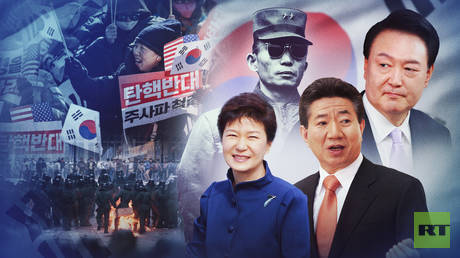
South Korea builds the world’s best chips and exports global pop culture icons, but it can’t seem to keep its presidents out of handcuffs. It’s a recurring nightmare. Since the Republic of Korea was founded in 1948, almost every single person to hold the Blue House—the former presidential residence—has faced a tragic or humiliating end. We’re talking about exile, assassination, suicide, or long prison sentences.
If you think American politics is polarized, you haven't seen anything yet. In Seoul, the transition of power isn't just a change of administration. It's often a criminal investigation waiting to happen. This isn't just bad luck. It’s a systemic flaw rooted in how the country transitioned from a military dictatorship to a vibrant, yet vengeful, democracy.
The Brutal History of the Blue House Curse
The streak started with the very first president, Syngman Rhee. He didn't leave office with a library and a pension. He fled to Hawaii in 1960 after massive student protests against his rigged elections. He died in exile. His successor, Park Chung-hee, presided over the "Miracle on the Han River" but ruled with an iron fist for 18 years. His reward? His own intelligence chief shot him dead at a dinner table in 1979.
Then came the generals. Chun Doo-hwan and Roh Tae-woo eventually traded their suits for prison jumpsuits. In the mid-90s, they were convicted of mutiny and corruption. Chun was even sentenced to death, though he was later pardoned. This set a dangerous precedent. It told every incoming leader that their predecessor was a criminal, and by extension, they might be one too in five years.
The most heartbreaking case remains Roh Moo-hyun. He was a human rights lawyer who wanted to clean up the system. After his term ended, the conservative administration of Lee Myung-bak launched a relentless corruption probe into his family. In 2009, feeling the walls close in and his reputation shattered, Roh jumped to his death from a cliff behind his home. His suicide didn't end the cycle. It just gave the liberal wing a martyr and a reason to seek revenge.
Why the System Is Rigged for Failure
You have to look at the structure of the South Korean presidency to understand why this keeps happening. The president has too much power. It’s often called an "imperial presidency." In the U.S., you have a complex system of checks and balances that, while messy, usually prevents total executive dominance. In South Korea, the president essentially controls the prosecution service.
When a new party takes over, the first thing they do is "clean house." This usually means pointing the prosecutors at the old administration. Because the chaebols—those massive family-owned conglomerates like Samsung and Hyundai—are so deeply intertwined with the government, it’s remarkably easy to find a paper trail of "donations" or "favors."
Every Korean president enters office promising to sever the ties between big business and politics. They all fail. The cost of running a political machine in Korea is high, and the chaebols are the only ones with the cash. It’s a trap. Lee Myung-bak went to prison for it. Park Geun-hye, the daughter of the assassinated Park Chung-hee, was impeached and jailed because of it.
The Culture of Vengeance and Public Bloodlust
There's a specific Korean word, han, which refers to a collective feeling of resentment and unavenged injustice. This permeates the political landscape. The public doesn't just want a change in policy. They want to see the "bad guys" punished.
Korean society is incredibly fast-paced and high-pressure. That same intensity that built a global economic powerhouse also creates a political environment where there is no middle ground. You’re either in power or you’re a target. The media plays a massive role here, too. The "trial by media" in Seoul is often more influential than the actual legal proceedings. By the time a former leader steps into a courtroom, they’ve already been found guilty in the court of public opinion.
Breaking the Cycle Is Not Just About Law
The current president, Yoon Suk Yeol, was a prosecutor himself. He’s the man who put two former presidents behind bars. Now he’s the one in the hot seat. The irony is thick. If the pattern holds, his post-presidency will be defined by how well he can defend himself against the next batch of prosecutors.
To stop this, South Korea needs more than just a new law. It needs a shift in political DNA.
- Decentralize the Prosecution: The office of the prosecutor shouldn't be a political weapon for the Blue House (or the now-relocated presidential office in Yongsan).
- Constitutional Reform: The single five-year term limit was designed to prevent another long-term dictatorship, but it makes the president a "lame duck" the moment they’re elected. It encourages short-term thinking and desperate power grabs.
- Chaebol Reform: Until the massive corporations stop being the ATM for political parties, corruption will be an inevitable byproduct of governance.
If you’re watching South Korean politics from the outside, don't just see it as a series of scandals. See it as a young democracy still struggling with the ghosts of its authoritarian past. The "curse" isn't supernatural. It’s a design flaw in a system that values retribution over reconciliation.
If you want to understand the true pulse of South Korea, stop looking at the K-pop charts and start looking at the court dockets in Seoul. That’s where the real power struggles—and the real tragedies—are hidden. Keep an eye on the current administration’s approval ratings and the movements of the opposition leaders. The next investigation is likely already being drafted in a back room somewhere. Don't be surprised when the handcuffs come out again. It's the one thing you can actually count on in Korean politics.