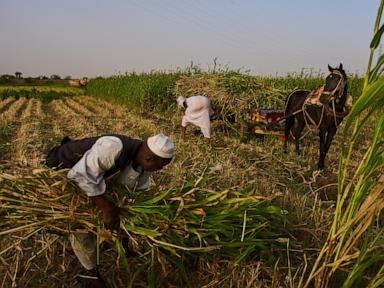
Ahmed kneels in the dirt of Al-Jazirah, but he isn’t planting. He is sifting. Between his calloused fingers, the soil feels like powdered bone. It should be dark, moist, and smelling of the coming harvest—the "breadbasket" of Sudan that once promised to feed a continent. Instead, it is a graveyard of intentions. The rhythmic thrum of the irrigation pumps has been replaced by the erratic, bone-shaking percussion of distant artillery.
He doesn't need a spreadsheet to tell him that the world is breaking. He sees it in the cracked earth.
Sudan is a land defined by the Nile, but it is currently being redesigned by lead. For decades, the nation balanced on a razor's edge of instability, yet the farmers always found a way. They sowed between the coups. They harvested during the droughts. But the current war between the Sudanese Armed Forces (SAF) and the Rapid Support Forces (RSF) has done something the previous decades of turmoil could not: it has severed the connection between the hand and the seed.
The Geography of Hunger
To understand what is happening, you have to look at the map not as a collection of borders, but as a circulatory system. The Al-Jazirah state is the heart. It sits between the Blue and White Niles, a massive irrigation project that should, by all laws of nature, be thriving. But when the RSF swept into the region late last year, the heart began to fail.
War is loud, but famine is a silent, creeping vine. It starts when a farmer cannot buy fuel for his tractor because the banks are rubble. It grows when the fertilizer trucks are hijacked by teenagers with Kalashnikovs. It peaks when the farmer realizes that even if he manages to grow a crop, there is no road left to take it to market.
Consider a hypothetical woman named Zeinab in Omdurman. She isn't thinking about geopolitical shifts or the breakdown of the 1929 Nile Waters Agreement. She is thinking about the price of a single piece of kisra bread. In 2023, she could feed her family for a handful of pounds. Today, she watches the market prices double in a week, then triple. She is witnessing the literal evaporation of her children’s future, one skipped meal at a time.
This isn't just about "food insecurity." That is a sterile term for a visceral reality. This is about the collapse of a 7,000-year-old agrarian soul.
The Mechanics of Destruction
The logistics of a harvest are a delicate dance of timing. If you miss the planting window by two weeks, the yield drops by half. If the rains come and the seeds aren't in the ground, the water just washes the topsoil away, leaving a barren moonscape.
In Sudan, the window didn't just close; it was slammed shut and bolted.
The Integrated Food Security Phase Classification (IPC)—the global gold standard for measuring hunger—recently sounded an alarm that few in the West heard. They pointed to a "catastrophic" risk of famine. Over 18 million people in Sudan are facing acute hunger. Five million are on the brink of starvation. These are not numbers; they are lives suspended in a terrifying limbo.
Why? Because the war moved from the peripheries into the agricultural core.
When the fighting stayed in Darfur or the Nuba Mountains, the central plains could still function. Now, the battle lines run directly through the sorghum fields. Soldiers use grain silos as sniper nests. They burn fields to flush out enemies. They loot the seed banks, eating next year’s survival today because they are hungry, too.
The Invisible Stakes
We often view conflict through the lens of who holds the capital city. We track the movement of tanks. We count the bodies. But the real casualty of the Sudanese conflict is the infrastructure of life itself.
Think about a pump. It is a simple machine. It moves water from the river to the furrow. In Al-Jazirah, these pumps require electricity and maintenance. When the power grid collapsed in the early months of the fighting, the water stopped moving. The canals turned into stagnant ditches. The crops turned into tinder.
When a pump breaks in a war zone, it isn't just a mechanical failure. It is a death sentence for the downstream village.
There is a cruel irony in the timing. Global wheat prices had already spiked due to the conflict in Ukraine. Sudan, which relies heavily on imports to fill the gap left by its struggling domestic production, found itself squeezed from both sides. It couldn't grow its own food, and it couldn't afford to buy anyone else's.
A Harvest of Ghosts
Imagine walking through a market in Port Sudan. This is the last gateway, the only lung left through which the country can breathe. You see sacks of grain arriving from international aid agencies. But the grain stays in the port.
The roads leading inland are gauntlets of checkpoints. Each one demands a "tax." Each one risks a hijacking. By the time a sack of flour reaches a family in the interior, its cost has been inflated by the blood and greed of a dozen different factions.
The aid workers are exhausted. They speak of "unprecedented challenges," but what they mean is that they are being forced to play God. They have to decide which village gets the remaining supplies and which village is left to eat boiled leaves and ground-up seeds.
Trust is the first thing to die in a civil war. Farmers who once shared equipment and seeds now look at their neighbors with suspicion. If I plant, will you steal it? If I harvest, will you tell the soldiers where I hide the bags?
The Weight of the Soil
The tragedy of Sudan is that it was preventable. This wasn't a locust swarm or a natural disaster. It was a choice. It was the result of two men—General Abdel Fattah al-Burhan and Mohamed Hamdan "Hemedti" Dagalo—deciding that their grip on power was worth more than the lives of the 48 million people they claim to lead.
But the earth doesn't care about generals.
The soil only knows what is put into it. For millennia, it was given water and care. Now, it is being fed with the debris of a fractured state. When the rains finally come this year, they won't bring life. they will bring the stench of the unburied and the sight of empty furrows.
Ahmed stands up and wipes the dust from his knees. He has no seeds to plant. He has no fuel for his pump. He looks at the horizon, where the smoke of a distant skirmish stains the sunset a bruised purple.
He knows that hunger is not the absence of food. Hunger is the presence of fear.
It is the realization that the world has moved on, that the cameras are pointed elsewhere, and that the "breadbasket" has become a bowl of dust. He turns his back on his field, not because he wants to, but because the land no longer recognizes his touch. It has become a stranger to him, a vast, silent witness to a hunger that no harvest will ever be able to satisfy.
The wind picks up, carrying the fine grit of the Al-Jazirah across the plains, burying the irrigation ditches one inch at a time.