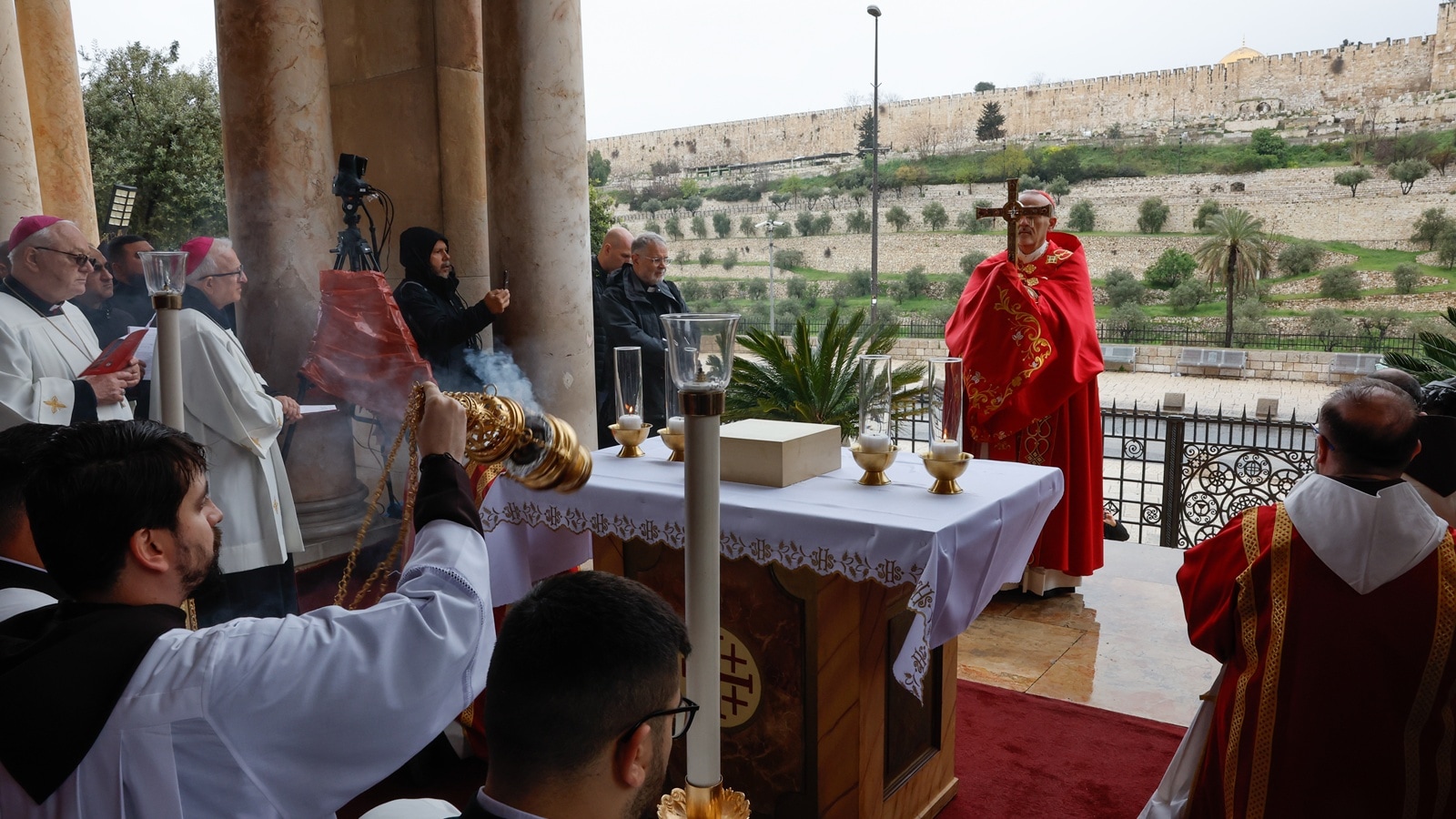
Catholic leaders in Jerusalem found themselves effectively barred from their own religious processions during Palm Sunday, a direct result of a tightening security apparatus that is reshaping the city's status quo. While official narratives often point to crowd control and safety as the primary drivers, the reality on the ground suggests a more systemic shift in how access to the Old City is managed. This is not merely a logistical failure. It is the culmination of years of escalating friction between religious institutions and the administrative power of the state, fueled by a geopolitical climate that no longer prioritizes the delicate balance of the "Status Quo" agreements.
The Breakdown of the Status Quo
The "Status Quo" is not a vague concept in Jerusalem. It is a specific set of nineteenth-century international treaties and firm understandings that dictate how different religious groups share and access holy sites. For decades, these rules kept the peace. However, the events of this Palm Sunday demonstrated that the administrative state now views security protocols as superseding these historical mandates.
When the Latin Patriarchate and other Catholic officials attempted to lead the traditional walk from the Mount of Olives into the Old City, they met a wall of steel and bureaucracy. Security forces established checkpoints that did not just monitor the flow of people but actively choked it. Church officials reported that even those with valid permits were turned away or delayed until the liturgical window had passed.
This is a tactical shift. In previous years, security was a collaborative effort. Today, it is a unilateral imposition. The police presence in the Christian Quarter has transitioned from a protective detail to a restrictive barrier. By prioritizing a "security-first" model, the state has effectively sidelined the religious leaders who are supposedly the custodians of these spaces.
The Weaponization of Crowd Control
Crowd control is the most convenient justification for any restriction of movement. It is difficult to argue against the need for safety in a city as volatile as Jerusalem. Yet, when analyzed through the lens of historical data and comparative events, the restrictions placed on the Catholic community appear disproportionate.
Consider the logistical math. The Old City is a maze of narrow stone corridors. It has a finite capacity. However, that capacity is often stretched significantly during other major events without the same level of total exclusion for leadership. By preventing priests and bishops from reaching the Holy Sepulchre, the authorities are not just managing a crowd; they are decapitating a ceremony.
The impact is felt most acutely by the local Palestinian Christian population. For them, Palm Sunday is both a religious obligation and a cultural touchstone. When the leaders are barred, the community is silenced. The "safety" argument falls apart when you realize that the resulting confusion and bottlenecking at checkpoints often create more dangerous conditions than a free-flowing procession ever would.
The Shadow of Policy Shift
To understand why this is happening now, one must look at the changing demographic and political weight within the governing bodies of the city. There is an increasing influence of factions that view Jerusalem not as a shared international heritage site, but as a singular national asset.
This perspective views non-Jewish religious expressions as a nuisance or a challenge to sovereignty. The Catholic Church, with its deep international ties and immense landholdings in the city, represents a significant pillar of the old world that these new political forces wish to diminish. The bureaucratic hurdles—denying visas for clergy, taxing church properties, and now physically blocking processions—are tools of a slow-motion eviction.
It is a strategy of attrition. If you make it difficult enough to worship, the congregation eventually shrinks. If the clergy cannot perform their duties, their influence wanes. This is the "why" that the standard news reports miss. It isn't a one-off incident. It is a policy.
The International Silence
The Vatican has long practiced a brand of quiet diplomacy in the Middle East. It prefers backroom negotiations and formal protests over public confrontations. But this strategy is reaching its limit. The lack of a forceful, public response to the Palm Sunday restrictions has been interpreted by local authorities as a green light to continue the pressure.
International observers often treat Jerusalem as a frozen conflict, but it is a dynamic one. Every time a checkpoint is moved or a permit is denied without consequence, a new precedent is set. The international community’s hesitation to call out these violations of religious freedom allows the administrative state to normalize the restriction of sacred space.
The Logistics of Exclusion
- The Checkpoint Mesh: Strategic placement of barriers at the New Gate and Jaffa Gate effectively seals the Christian Quarter.
- Permit Attrition: A system where permits are issued so late that planning becomes impossible, or they are revoked at the last minute for "security reasons."
- Physical Deterrence: The use of heavy-duty metal fencing that funnels pilgrims into "holding pens," creating a psychological barrier to entry.
These are the mechanics of modern exclusion. They are sterile, administrative, and highly effective.
The Myth of Neutrality
The state often claims to be a neutral arbiter between competing religious claims. In reality, the state is an active participant. By controlling the keys to the city gates, the police have become the de facto liturgical directors of Jerusalem. They decide who walks where, when they stop, and who is allowed to lead.
This undermines the very essence of religious autonomy. When a secular police officer has more say over a procession than a Bishop, the religious nature of the event is compromised. It becomes a state-sanctioned parade rather than an act of faith.
The Economic Toll
Jerusalem thrives on pilgrimage. The Christian Quarter relies heavily on the influx of visitors during Holy Week. When the city is locked down and leaders are barred, the message sent to the world is that Jerusalem is closed for business.
Local shopkeepers, many of whom have held their stalls for generations, report a sharp decline in foot traffic and revenue. The heavy-handed security presence creates an atmosphere of fear rather than one of reverence. Pilgrims who have saved for years to visit the Holy City find themselves trapped behind barricades, watching their religious leaders being pushed back by riot police. This is not the image the Ministry of Tourism wants to project, yet it is the reality that the Ministry of National Security is creating.
A Precarious Future
The tension in Jerusalem is a zero-sum game in the eyes of the current administration. Every square inch of the Old City is contested. By squeezing the Catholic leadership, the state is testing the boundaries of what the international community will tolerate.
If these actions go unchallenged, we can expect the restrictions to tighten during Easter and beyond. The blueprint has been drawn. It involves the slow, methodical use of administrative law and security protocols to overwrite centuries of religious tradition. The bells of the Holy Sepulchre may still ring, but if the path to the altar is blocked by a line of police, the sound is hollow.
The issue is not a lack of space. It is a lack of will to share it. Jerusalem is being re-engineered into a city of barriers, where the divine is subject to the permit, and the priest is subject to the patrolman. This trajectory leads to a city that is physically intact but spiritually fractured beyond repair. The "Peace of Jerusalem" was always a fragile thing, held together by mutual respect and a healthy fear of upsetting the balance. That fear has vanished, replaced by a cold, bureaucratic certainty.
The Catholic leadership must now decide if they will continue to rely on the old channels of diplomacy or if they will find a new way to assert their right to the city. The stones of the Via Dolorosa have seen many empires come and go, but they have rarely seen the path so deliberately closed to those who hold its history most dear.