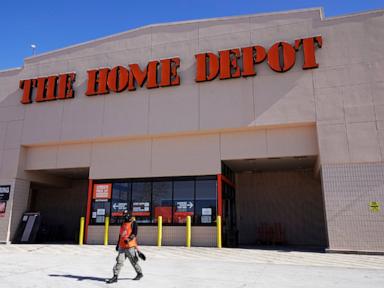
Walk into any suburban home on a Saturday morning, and you will hear a specific kind of music. It is the rhythmic slap of a paintbrush against drywall. The angry whine of a miter saw cutting through pine. The clatter of plastic bins being dragged across a concrete garage floor.
For the last few years, this music was deafening. We locked ourselves inside our houses, looked at our peeling wallpaper, and decided to tear it all down. We built decks. We remodeled kitchens. We bought ride-on lawnmowers just to feel something.
But lately, the neighborhood has gone quiet.
If you want to understand where the global economy is heading, you can look at the Federal Reserve's balance sheets, or you can look at the orange aprons wandering the aisles of your local Home Depot. The giant retailer just dropped its quarterly earnings report. On paper, it looks like a corporate math problem: profit fell, but it managed to beat Wall Street’s grim expectations.
Beneath those numbers lies a much larger story about how we live, how we spend, and the quiet anxiety keeping millions of homeowners awake at 2:00 AM.
The Micro-Decisions of Middle America
Consider a hypothetical homeowner named Sarah. Two years ago, Sarah would have walked into Home Depot with a pre-approved home equity line of credit and a dream of a $45,000 kitchen overhaul. Today, she walks past the custom quartz countertops and goes straight for the plumbing aisle. She is there because her kitchen faucet is leaking, and she is going to fix it herself with a $15 replacement washer and a YouTube tutorial.
This is the shift that defines our current economic moment.
Home Depot’s latest financial results show a distinct trend: total sales dipped to $36.4 billion for the quarter, a slight decline from the previous year. Net income slid to $3.6 billion. Yet, stock analysts cheered. Why? Because the fall wasn't as catastrophic as everyone feared.
The company is surviving on the backs of small, non-negotiable repairs. The big, ambitious projects—the ones that require a second mortgage or a massive credit card balance—have been put on ice. We aren't building a brave new world anymore. We are just trying to keep the roof from leaking.
This shift isn't just about Home Depot's stock price. It is a mirror reflecting a collective psychological fatigue. High interest rates have locked people into their current homes. If you have a 3% mortgage rate, you aren't selling your house to buy a new one. But you also aren't spending $20,000 to renovate a guest bathroom when groceries cost 30% more than they did a few years ago.
Inflation behaves like a slow leak in a basement. You don’t notice it at first. Then, suddenly, you realize everything you’ve stored down there is ruined.
The View from the Aisles
Step back into the store. Smell the sawdust and the fertilizer. There is an incredible, almost desperate vulnerability in a home improvement store during an economic transition.
In the good times, everyone looks like an expert. Customers push flatbeds loaded with pressure-treated lumber and high-end light fixtures, talking loudly with contractors about project timelines. Now, the atmosphere is different. You see people standing in front of the massive wall of fasteners, holding a single stripped screw, trying to find an exact match because they cannot afford to replace the entire bracket.
The professional contractors—the "Pros" who make up a massive chunk of Home Depot’s revenue—are feeling it too. Their backlogs are shrinking. The wealthy clients who wanted a three-car garage extension are suddenly saying, "Let's wait until next spring."
Home Depot’s leadership admitted that high interest rates and broader economic uncertainty are pressuring their business. When the cost of borrowing money skyrockets, the first thing that evaporates is the discretionary project. You don't buy the premium riding mower; you patch up the old push mower and pray it lasts another season.
Yet, the company outperformed expectations because human beings are fundamentally adaptive. We might give up on the dream of a backyard oasis, but we still need to replace a broken water heater. Home Depot has spent decades positioning itself as the infrastructure of American domesticity. When the macroeconomy stumbles, the microeconomy goes to work in the tool rental department.
The Invisible Stakes
There is a historical pattern to this behavior. During the 2008 financial crash, the home improvement sector didn't just vanish; it transformed. People stopped hiring professionals and started doing the work themselves, or they focused entirely on emergency mitigation. The current economic landscape isn't a total collapse—far from it—but it is a period of intense calibration.
We are all looking at the same horizon, trying to guess which way the wind will blow. Will interest rates come down? Will the housing market unlock?
No one knows. Not even the executives sitting in Atlanta steering a multi-billion-dollar retail empire. They are managing the decline, tightening their own belts, and relying on sophisticated supply chains to ensure that even if fewer people are buying, the things they do buy are profitable.
That is the hidden engine of the corporate survival story. Home Depot managed to beat expectations because they anticipated the slowdown. They didn't overstock on luxury patio sets. Instead, they ensured they had enough copper pipe, roofing shingles, and basic maintenance supplies to meet the defensive spending of a nervous public. It is a strategy of resilience rather than growth.
The Final Threshold
The true metric of our economic health isn't found in a percentage beat on a spreadsheet. It is found at the checkout counter.
Watch the cashier scan the items. A gallon of white paint. A roller. A roll of painter's tape. This is the portrait of an economy that is holding its breath. It is a quiet, resilient determination to maintain what we have, to protect our square foot of the world, and to wait out the storm.
We leave the store, the automatic doors sliding shut behind us, the smell of fresh timber lingering in our clothes, carrying a brown paper bag filled with just enough hardware to last the weekend.