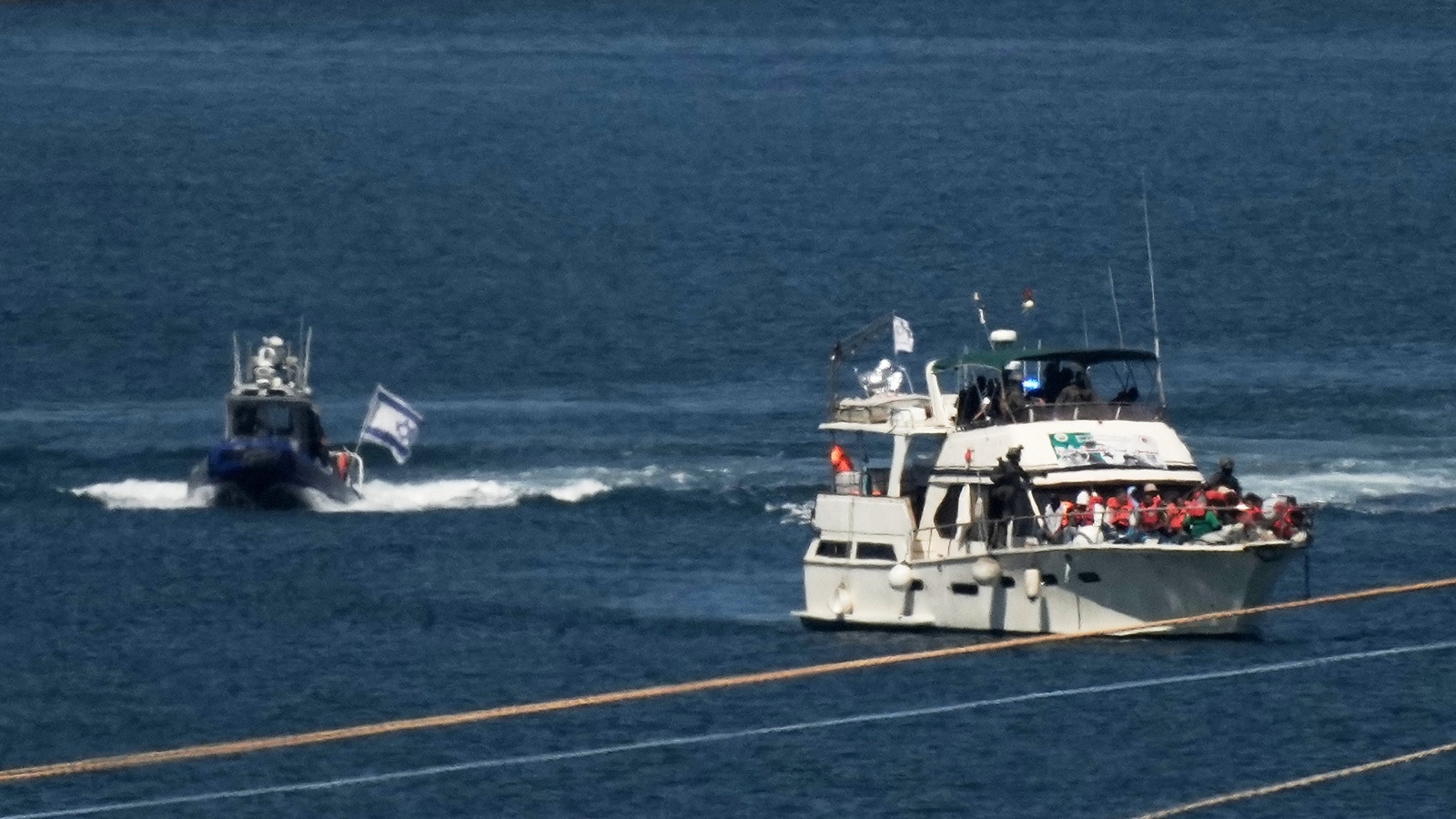
The steel hull of a ship is a cold, indifferent thing until it meets the chop of the Mediterranean. Beneath the waterline, the Atlantic and the Levant collide in a rhythmic thrum that vibrates through the soles of your boots. It is a sound that gets inside your teeth. For the thousands of volunteers currently boarding a fleet of fifty vessels, that vibration is the heartbeat of a desperate gamble.
They aren't soldiers. They are doctors from Madrid, retired teachers from Oslo, and students who sold their cars to buy a plane ticket to the Turkish coast. They are gathered under the banner of the Freedom Flotilla, and their objective is a patch of sand and concrete that has been effectively severed from the map of the living.
This isn't just about cargo. It’s about the physics of a blockade and the chemistry of human endurance.
The Weight of a Grain of Rice
To understand why fifty ships would risk a confrontation with one of the most sophisticated navies on earth, you have to look past the political rhetoric and into the kitchen of a hypothetical family in Gaza City. Let’s call the father Omar.
Omar doesn't care about maritime law or the San Remo Manual. He cares about the fact that the caloric intake of his three children has become a mathematical equation managed by an external power. For nearly two decades, the "buffer zone" and the naval closure have turned the sea—once Gaza's lungs—into a fence. Imagine living in a coastal city where you can smell the salt spray but are forbidden from sailing more than a few miles out to harvest the protein swimming just beyond your reach.
The blockade is a slow-motion strangulation. It isn't always a spectacular explosion; often, it is the silence of a factory that can’t get spare parts, or the gray hue of a child’s skin who hasn't seen a piece of fruit in a month. When the activists talk about "breaking the siege," they are talking about the right to be self-sufficient. They are carrying 5,500 tons of aid, but the most volatile substance on those ships is the precedent they hope to set.
The Anatomy of a Flotilla
Fifty ships. It sounds like an armada from a history book, but the reality is more fragmented and fragile. These are tugboats, old ferries, and repurposed fishing vessels. They are slow. They are vulnerable.
The logistics of such an undertaking are a nightmare of maritime insurance, port clearances, and international pressure. Countries often find their ports suddenly "under maintenance" when the Flotilla arrives, a subtle nod to the diplomatic weight Israel and its allies throw behind the blockade's enforcement.
The activists know the history. They remember 2010. They remember the Mavi Marmara, the shattered glass, the helicopters hovering like predatory insects in the dark, and the ten lives lost in the middle of the night. That memory doesn't act as a deterrent; it acts as a permanent weight in the hull, keeping the mission upright when the political winds howl.
The Invisible Line in the Water
Somewhere in the Mediterranean, there is an invisible line. On one side, you are in international waters, protected by the thin veneer of global convention. On the other, you are a "provocation."
The Israeli government views these ships not as a humanitarian mission, but as a breach of sovereign security. To them, every crate of medical supplies is a potential hiding place for something darker, and every activist is a shield for a political agenda. This is the collision point: one side sees a life-saving hand, the other sees a fist.
But consider the perspective of a nurse on board the lead ship. She is sitting on a crate of high-protein biscuits, checking the seal on a box of antibiotics. For her, the "security" argument falls apart when it prevents a grandmother from getting dialysis. She sees the blockade not as a shield, but as a laboratory for how much a population can bear before it breaks.
The Cost of Looking Away
There is a specific kind of exhaustion that comes with being an activist on the high seas. It is the lack of sleep, the constant monitoring of radar, and the knowledge that at any moment, the horizon could fill with gray patrol boats.
Why do it? Why not just send the aid through the official land crossings?
The answer lies in the bottleneck. Land crossings are filters. They are subject to the whims of bureaucrats and the shifting sands of military "necessity." A sea route is different. A sea route represents an umbilical cord to the rest of the world that doesn't require a permission slip from the person holding the door shut.
If these fifty ships reach the shore, the blockade is functionally dead. Not because the navy couldn't stop fifty more, but because the world will have seen that the fence is made of choices, not inevitabilities.
The Horizon is a Question
As the fleet moves south, the air grows heavier. The volunteers spend their nights in cramped bunks, listening to the water slap against the steel. They talk about their families. They talk about the fear of what happens when the sirens finally go off and the commandos descend.
There is no "safe" outcome here. If the ships are seized, it is another cycle of arrest, deportation, and international outcry. If they are let through, it is a geopolitical earthquake.
In Gaza, the people watch the horizon. They have seen ships before. They have seen them turned back. They have seen them boarded. But they have never seen fifty at once. For a teenager in a refugee camp who has never left a twenty-five-mile strip of land, those specks on the horizon are more than wood and metal. They are proof that the world hasn't completely forgotten how to be outraged.
The sea is a mirror. Right now, it is reflecting a choice we are all making. We can believe that some people are destined to live in a cage for the sake of a theoretical peace, or we can believe that the salt in the bread belongs to everyone.
The ships are moving. The engines are hot. The line in the water is drawing closer with every rotation of the propeller, and the silence of the Mediterranean is about to be broken.
On the deck of the flagship, a young man from Derry adjusts his life jacket. He isn't looking at the GPS. He is looking at the dark smudge of land appearing through the haze, a place where two million people are waiting to see if the world still knows how to sail toward them. He knows that whether they reach the pier or the prison cell, the act of moving toward the forbidden is the only way to prove the fence shouldn't be there at all.
The water remains deep, dark, and indifferent, waiting for the first hull to cross the line.