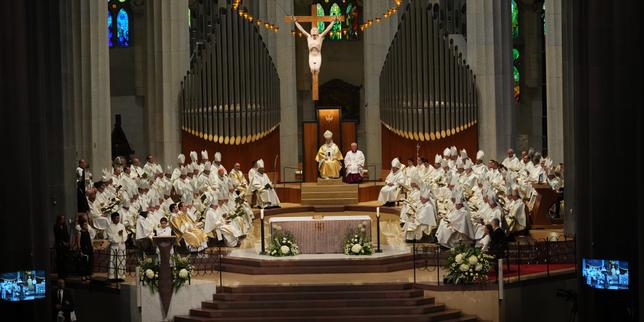
The romanticized narrative surrounding Antoni Gaudí’s masterwork has reached a point of collective delusion. When religious authorities gather in Barcelona to declare the Basilica of the Sagrada Familia a "beacon" or a "lighthouse" for modern evangelization, they are missing the forest for the towering, stone trees. They look at the millions of people flooding through the Nativity and Passion façades and see a revival of faith.
They are wrong.
What they are actually witnessing is the ultimate triumph of hyper-commercialized secular tourism over spiritual devotion. The Sagrada Familia does not convert the modern skeptic; it captivates the modern consumer. To view it as a functional tool for spreading a religious message is to completely misunderstand why people travel, how art functions in the twenty-first century, and what actually drives human connection.
The Crowds Are Looking at the Architecture Not the Altar
Every year, over four million people pay hefty ticket prices to step inside the nave of the Sagrada Familia. Another twenty million gather in the surrounding plazas just to take photos of its organic, melting exterior.
The institutional consensus is simple: Bring them for the spectacle, and they will stay for the spirit. It is a comforting theory for an institution watching church attendance plummet across Western Europe. In Spain, a country historically steeped in Catholicism, government data shows that the percentage of self-identified Catholics who regularly attend Mass has dropped to historic lows. Yet, the Sagrada Familia breaks visitor records year after year.
If this basilica were truly a powerful beacon of evangelization, we would see a localized revival. We would see a cultural shift. We do not.
The hard truth is that the vast majority of visitors are there for the aesthetics, not the theology. They are marveling at Gaudí’s structural genius—the way he rejected traditional Gothic flying buttresses in favor of angled, tree-like columns that branch out to support the vaulting using complex hyperbolic paraboloids. They are tracking the light filtering through Joan Vila-Grau’s stained-glass windows, shifting from cool blues and greens in the morning to fiery reds and oranges in the afternoon.
They are capturing content. They are ticking a box on a travel itinerary.
I have spent years studying how global tourism transforms sacred spaces. When a site becomes an architectural icon of this magnitude, the cultural gravity shifts. The sacred is swallowed by the sublime. The visitor is not experiencing a religious awakening; they are experiencing a secular epiphany triggered by scale, geometry, and light. To confuse architectural awe with spiritual conversion is a profound error.
The Paradox of the Entry Fee
Let us talk about the mechanics of entering this supposed beacon of faith. To experience Gaudí’s vision, a visitor must navigate a highly optimized online booking system, select a precise time slot, and hand over a significant sum of money.
While the basilica administration notes that ticket revenues directly fund the ongoing construction of the towers—including the massive Jesus Christ tower set to make it the tallest church building in the world—this economic reality creates an ideological friction point.
Imagine a scenario where a historical religious movement attempted to spread its core message of radical accessibility and humility by placing that very message behind a twenty-six-euro paywall. It defeats the premise.
True spiritual sanctuaries throughout history achieved their influence by being radical refuges—open, quiet, and removed from the transactional nature of the marketplace. The Sagrada Familia is fundamentally transactional. The crowded naves, the timed entry slots, the security checkpoints, and the ambient hum of thousands of whispered conversations create an environment closer to an art museum or an airport terminal than a house of prayer.
By turning the basilica into a premium ticketed attraction, the institution has successfully funded its construction while inadvertently stripping away its spiritual utility. It has traded the quiet intimacy required for genuine religious reflection for the logistical efficiency required to process mass crowds.
The Myth of the Homogeneous Audience
The prevailing institutional hope is that the beauty of the architecture acts as a universal language, breaking down secular barriers and planting seeds of faith in the minds of non-believers.
This view completely ignores the psychological reality of the modern traveler. People do not enter a space as blank slates. They enter with their own cultural conditioning, biases, and intents.
When a secular tourist from Tokyo, New York, or Berlin walks into the Sagrada Familia, they decode the space through a cultural framework, not a theological one. They see Gaudí as a brilliant, eccentric modernist who drew inspiration from the natural forms of Catalonia—the jagged peaks of Montserrat, the curves of snail shells, the structure of bones. They view the biblical narratives carved into the stone façades as historical or mythological iconography, much like a visitor to Athens views the reliefs on the Parthenon.
To assume that looking at a stone carving of the Nativity automatically sparks a deep meditation on Christian doctrine is incredibly naive. Without a pre-existing framework of belief, the imagery remains purely decorative. The architecture does not create faith; it requires faith to be read the way the church intends. Without it, the basilica is simply a spectacular monument to human ambition and engineering.
The Downside of This Contrarian Reality
Admitting that the Sagrada Familia is primarily a secular tourist asset rather than a spiritual lighthouse comes with a heavy realization. It means acknowledging that one of the greatest architectural achievements of modern history has effectively been divorced from its original, singular purpose.
Gaudí was a deeply devout man who spent the final years of his life living on-site in a modest workshop, devoting his entire existence to creating a "bible in stone." He genuinely believed that the building would draw people back to God. To look at the finished product today and realize it serves primarily as an economic engine for the city of Barcelona and a backdrop for millions of digital vacation albums is tragic for those who value its foundational intent.
But ignoring this reality does not change it. Continuing to market the basilica as a vanguard of modern evangelization prevents the church from addressing the actual, systemic reasons for its declining cultural influence. You cannot build your way out of a crisis of faith with stone and mortar, no matter how beautiful those materials are.
Stop Misunderstanding Why People Marvel at Sacred Spaces
If you want to understand the true impact of the Sagrada Familia, you have to stop asking how it can be used to convert people and start asking why it continues to captivate an increasingly secular world.
The answer is not a latent desire for religion. It is a deep, human hunger for permanence, scale, and uncompromising artistry in an era dominated by cheap, disposable design.
We live in a world of glass-box skyscrapers and prefabricated architecture built for rapid monetization and short lifespans. In contrast, the Sagrada Familia represents a multi-generational commitment to a singular, complex vision. It has survived civil war, the death of its creator, economic crises, and shifting political tides. It is an artifact of absolute dedication.
That is what people are respecting when they look up at the towers. They are honoring the sheer audacity of a project that spans generations. They are reacting to a rare display of artistic conviction that refuses to compromise for the sake of modern convenience.
Instead of trying to force a traditional religious narrative onto a crowd that is largely indifferent to it, recognize the basilica for what it actually is: a magnificent, secular monument to human capability and creative endurance. It is a triumph of art, engineering, and history.
Stop trying to turn a world-class architectural marvel back into a local parish church. The battle for the soul of the Sagrada Familia was decided long ago, and the tourists won.