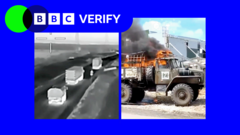
A burning fuel truck sits crumpled on the shoulder of the R-280 highway near Mariupol. There are no artillery craters nearby. No missile fragments. Just a shattered windshield and a scorched engine block. A few miles down the road, another supply truck swerves into a ditch after its driver panics at the sound of a distant buzz.
This isn't random bad luck. It's the physical manifestation of a massive, systematic shift on the battlefield.
Ukraine has officially launched what defense officials call a "logistics lockdown." By deploying automated, middle-range strike drones between 20 and 200 kilometers behind the front lines, Ukrainian forces are aggressively cutting the arteries that keep the Russian military alive. The primary target isn't the infantry in the trenches, but the supply convoys attempting to feed them ammo, fuel, and food.
If you want to understand how autonomous systems are fundamentally breaking classic military doctrine right now, you have to look at the southern supply corridors.
The Death of the Novorossiya Corridor
For months, the Russian military relied on the R-280 highway—dubbed the "Novorossiya" route—to move heavy equipment and vital supplies from mainland Russia through Mariupol and Melitopol, all the way down to occupied Crimea. It's a straight, paved, highly efficient asphalt lifeline.
It has also become a graveyard for Russian logistics.
Data from open-source intelligence groups and reports from Ukraine’s Unmanned Systems Forces, specifically the 412th Nemesis Brigade, show a staggering reality. The Nemesis Brigade recently revealed they've been fielding secret, previously unseen strike "wings" tailored specifically for long-range interdiction. The results were immediate. Dozens of fuel tankers and supply trucks were obliterated along the R-280, forcing Russian occupation authorities to halt or severely limit heavy military traffic on the main highway.
What happens when you block the main road? You force the enemy onto dirt roads, rural pathways, and unpaved fields.
This is where the compounding friction sets in. Heavy supply trucks aren't built for mud tracks. They break down. They get stuck. They move at a crawl. And most importantly, they become incredibly easy targets for circling reconnaissance aircraft that feed coordinates directly to strike teams.
The Math Behind Middle-Strike Dominance
Most news coverage of drone warfare focuses on frontline first-person view (FPV) quadcopters chasing individual soldiers. Those make for dramatic video clips, but they don't alter the operational map. Middle-strike campaigns do.
By scaling up automated fixed-wing drones with ranges between 100 and 300 kilometers, Ukraine has expanded the active kill zone far beyond the reach of standard tube artillery. According to the Institute for the Study of War (ISW), this deliberate expansion aims to deny Russian forces the ability to safely mass personnel or accumulate ammunition reserves anywhere near the combat theater.
Think about the sheer scale of the disruption. Ukraine's Defense Minister, Mykhailo Fedorov, pointed out a direct correlation on military dashboards. The data shows that as the destruction of Russian logistics and warehouses quadrupled over a short period, the frequency of Russian frontline assault operations dropped precipitously.
It's basic math. An artillery piece without shells is just an expensive piece of metal. A tank without fuel is a stationary target.
How Autonomous Guidance Bypasses Electronic Warfare
The biggest question military planners around the world are asking is simple. How are these drones surviving the most heavily jammed electronic warfare environment in human history?
In the earlier phases of the conflict, electronic warfare (EW) was a dominant countermeasure. Russian jamming units could easily sever the radio frequency links between a human pilot and a drone, causing the aircraft to drop harmlessly from the sky or fly off course.
That dynamic is largely dead. The latest generation of Ukrainian middle-strike drones doesn't rely on a constant radio connection to a human operator. They don't use Starlink for terminal guidance, especially after Russian forces attempted to exploit that network before their access was heavily disrupted.
Instead, these systems utilize onboard, automated machine vision and terminal homing algorithms.
Once a drone is launched toward a known logistical corridor, it flies autonomously via inertial navigation, completely immune to standard radio-frequency jamming. As it approaches the target area, the onboard processor takes over. The software recognizes the distinct shape of a moving fuel truck, a cargo vehicle, or a stationary ammunition dump against the background terrain.
The drone locks on and strikes. No pilot required. No signal to jam.
This technological evolution completely outpaces traditional defenses. Russia's response has been to deploy mobile fire groups—essentially pickup trucks with mounted machine guns—along known drone corridors. But even these groups are finding themselves outmatched as Ukrainian units launch rocket-armed FPVs to clear the path or simply saturate the airspace with sheer volume.
The Invisible Attrition of the Rear Guard
When a military faces a logistics lockdown, the damage isn't always measured in immediate frontline casualties. It's measured in cumulative friction.
Because the R-280 highway and alternative southern routes are under constant surveillance and threat of strike, Russian commanders are forced to make incredibly difficult tactical compromises.
- Dispersal: Instead of moving massive, efficient convoys of 20 or 30 trucks, supplies must be broken down into tiny, disjointed groups of two or three vehicles.
- Night Operations: Drivers are forced to operate almost exclusively under the cover of darkness, drastically slowing delivery times and increasing accidents on poorly maintained backroads.
- Distance: Major supply hubs and warehouses must be pushed back even further from the front lines, turning what used to be a two-hour supply run into an agonizing, multi-day logistical gauntlet.
Every kilometer added to a supply chain means more fuel consumed, more wear and tear on an already strained vehicle fleet, and fewer fresh supplies reaching the troops who need them. The cumulative effect shows up directly on the front lines as stalled offensives and weakened defensive lines.
What This Means for Global Military Strategy
The ongoing destruction of supply convoys in southern Ukraine is a massive warning sign for modern militaries. For decades, Western doctrine assumed that air superiority would guarantee safe logistical lines. If you controlled the skies with multi-million-dollar fighter jets, your trucks could roll safely.
Autonomous systems have completely flipped that assumption on its head. Cheap, scalable, and automated wings can achieve a localized version of "air denial" at a fraction of the cost. They turn a transparent battlefield into a deadly trap where movement itself is the primary hazard.
The immediate next steps for defensive forces worldwide aren't found in buying heavier armor or bigger artillery pieces. The priority has to shift toward developing hardened, short-range kinetic interception systems and finding ways to automate logistics from the ground up.
Until armies figure out how to shield their trucks from automated eyes in the sky, those vital supply lines will keep burning.
This video provides an excellent visual breakdown of how these specific long-range strike campaigns are executed and the chaos they cause when catching logistics networks completely exposed: Ukrainian Drones Catch Huge Russian Convoy Defenseless.