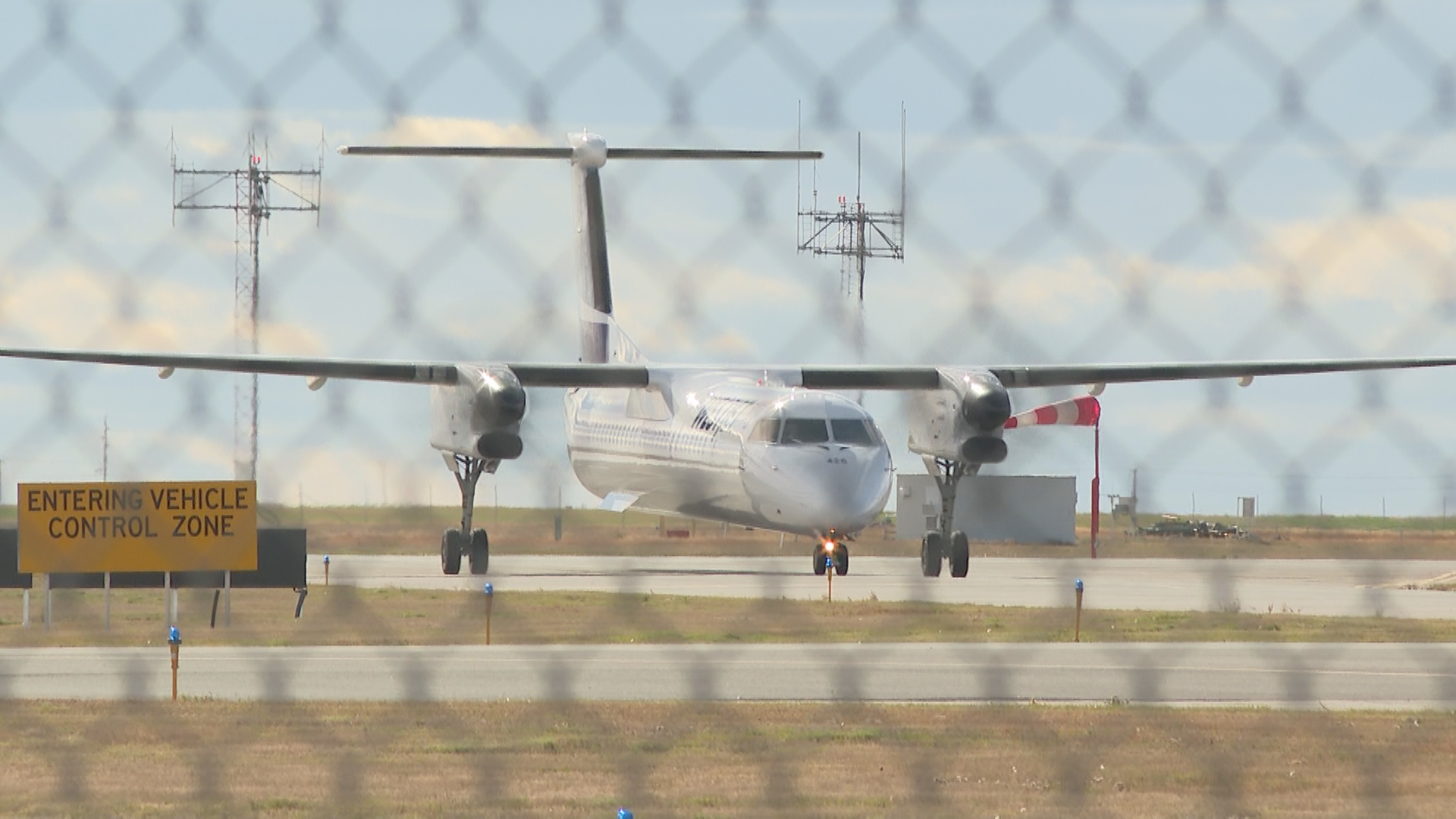
Municipal leaders across the country are mourning a phantom limb. The recent announcement that WestJet is cutting its remaining commercial routes out of Lethbridge and Medicine Hat has triggered the predictable, synchronized wailing from local city halls. Mayors are calling it a "bombshell" and an infrastructure crisis. The media is painting a grim portrait of isolated communities marooned in the vast Canadian prairies, forced into the supposedly agonizing ordeal of driving two hours to a major international hub.
It is a completely manufactured tragedy.
The lazy consensus among regional politicians is that a city cannot claim "next-level" economic status without a commercial airline gate. They view a local airport terminal as a shiny badge of civic adulthood. But let us look at the cold, hard math of regional aviation in 2026. This isn't a crisis. It is a correction. It is an economic liberation disguised as a corporate exit.
Stop trying to resurrect dead regional flight paths. The commercial exit is a massive opportunity to stop flushing taxpayer dollars down an asphalt runway.
The Myth of the Two Percent
Local bureaucrats love to spin numbers to make themselves look indispensable. When WestJet announced its departure from Lethbridge, the immediate defense mechanism from airport management was to state that scheduled passenger flights only accounted for two percent of total air traffic. They pointed to the remaining 98 percent—medevacs, corporate charters, flight training, and agricultural crop-dusting—as proof that the facility is thriving.
Think about the absurdity of that defense.
If commercial passenger traffic only represents two percent of your flight movements, why did the city spend $25 million renovating a passenger terminal? Why are municipal resources being used to run a passenger lounge with a coffee bar and charging stations for a demographic that barely exists?
The math reveals a glaring structural delusion. Regional municipal airports are notoriously inefficient money pits. The City of Lethbridge pours roughly $1.7 million annually into airport operations from ongoing taxation and reserve transfers just to keep the lights on. That money does not cover capital depreciation. It doesn't cover the looming $120 million bill required to service the 1,400 acres of raw land surrounding the facility with water, wastewater, and roads.
I have seen dozens of mid-sized municipalities blow millions of dollars chasing the mirage of commercial flight connectivity. They renovate baggage carousels, extend runways, and hire expensive consultancy firms to draft glossy "market studies." Then they act shocked when an airline operating on razor-thin margins cuts a route that averages a handful of passengers per day.
Air Canada walked away years ago. WestJet tried upgrading to larger planes and reducing frequencies to one flight a day, but the demand simply was not there. The market has spoken, loudly and repeatedly.
The Subsidized Vanity Project
The fundamental misunderstanding among the public and local politicians is how regional air travel actually works. People ask: "Why do I have to keep paying property taxes for an airport I can't fly out of?"
The brutal answer is that you are subsidizing a luxury convenience for a minuscule fraction of the population.
When a regional airport operates a commercial route to a nearby hub like Calgary, it is almost never profitable for the carrier without direct or indirect public handouts. The infrastructure is heavily subsidized by federal and provincial grants—money that still comes out of the taxpayer's pocket, even if it doesn't show up entirely on the local property tax bill. 93 percent of the recent upgrades at YQL came from senior government grants. That is $23 million of public capital locked into a facility whose core commercial anchor just evaporated.
Imagine a scenario where a city spends millions building a state-of-the-art train station, only for the train company to point out that only three people board the train each morning. You wouldn't lobby a second train company to come in and lose more money. You would close the station and repurpose the land.
But local politics is driven by ego, not economics. Having an airport code like YQL or YXH on a boarding pass makes a city feel important. It allows economic development officers to put a checkmark next to "Global Connectivity" in their promotional brochures.
The reality? Businesses do not relocate to a city because it has a single, daily, wildly overpriced turboprop flight to Calgary. They relocate because of land availability, corporate tax structures, labor pools, and robust logistics infrastructure.
The Driving Alternative is Better Business
Let's address the supposed horror of the drive. The core argument against losing commercial flights is that it harms regional connectivity. Travelers from southern Alberta must now drive roughly two hours to Calgary International Airport (YYC).
Good. They should.
Driving two hours down a twin-lane highway is objectively more efficient, cheaper, and more reliable than taking a short-hop regional commercial flight. Let's break down the actual mechanics of a regional flight compared to driving:
| Metric | Regional Flight (YQL to YYC) | Driving (Lethbridge to YYC) |
|---|---|---|
| Pre-Flight / Travel Time | 60 mins arrival + 45 mins flight time | 120 mins driving time |
| Connection Buffer | 60–90 mins for baggage/security transfer | Zero buffer needed; drive straight to terminal |
| Total Travel Time | 2.5 to 3.5 hours | 2 hours |
| Financial Cost | High-tier regional ticket pricing + baggage | Price of fuel or airport parking |
| Reliability | High risk of weather delays or mechanical cancellations | High predictability |
When you fly from a regional airport to a hub, you are trapped by the airline's schedule. If your single daily flight is canceled due to a mechanical issue or a snowstorm in Calgary, your entire multi-thousand-dollar international itinerary is blown to pieces. If you drive, you control your timeline.
By forcing travelers onto the highway, you aren't killing connections—you are streamlining them. The two-hour drive removes a point of failure from the travel chain.
Dismantling the "Attract a New Carrier" Illusion
The immediate response from municipal leaders when a major airline leaves is to announce a new marketing campaign to attract a replacement. They talk about courting ultra-low-cost carriers (ULCCs) or regional boutique airlines to fill the void.
This strategy is dead on arrival.
The aviation industry is facing structural realities that local city councils completely ignore. Operating costs are soaring. Fuel prices are volatile. Pilot shortages continue to plague regional regional links. Major airlines are actively consolidating their fleets, moving away from small turboprops and focusing entirely on high-density, high-margin routes between major hubs.
If WestJet, with its massive domestic network and feed infrastructure, cannot make a southern Alberta route work, a tiny independent carrier has no chance. A smaller airline cannot offer the seamless baggage transfers, frequent flyer alliances, or code-share connectivity that international business travelers require. They will charge exorbitant ticket prices for an isolated point-to-point service that will inevitably fail when the initial municipal marketing incentives run out.
Stop burning public money trying to bribe airlines to fly empty planes to your city.
The Blueprint for a Post-Commercial Airport
The loss of commercial flights is a gift. It forces a city to strip away the vanity and view the airport for what it actually is: an industrial park with a runway.
The path forward requires a complete pivot away from passenger aviation. The 1,400 acres of land surrounding a regional airport are incredibly valuable, but only if you stop trying to build a passenger terminal around them.
First, slash the passenger infrastructure overhead immediately. Fire the consultants drafting passenger recruitment strategies. Close the passenger terminal or lease it out entirely to private flight schools or corporate charter operations. Stop spending money on passenger marketing campaigns.
Second, convert the entire airport strategy into an industrial and logistical land-lease play. The future of regional airports lies in aerospace manufacturing, agricultural technology, drone testing, and heavy freight logistics. Agriculture and resource development are the actual economic drivers of regions like southern Alberta—not business consultants flying back and forth to Calgary for meetings that could have been Zoom calls.
The downside to this approach is obvious: it isn't sexy. No mayor gets to cut a ribbon on a new corporate hangar for an agricultural crop-dusting company with the same media fanfare as welcoming a national commercial airline. It requires admitting that the millions spent on passenger terminal renovations were a mistake driven by outdated civic pride.
But continuing to hunt for another commercial carrier is an exercise in fiscal insanity. The commercial regional flight model is dead, killed by the harsh realities of modern aviation economics.
Accept the loss. Embrace the two-hour drive. Turn the passenger terminal into something useful, and stop asking taxpayers to foot the bill for an empty sky.


