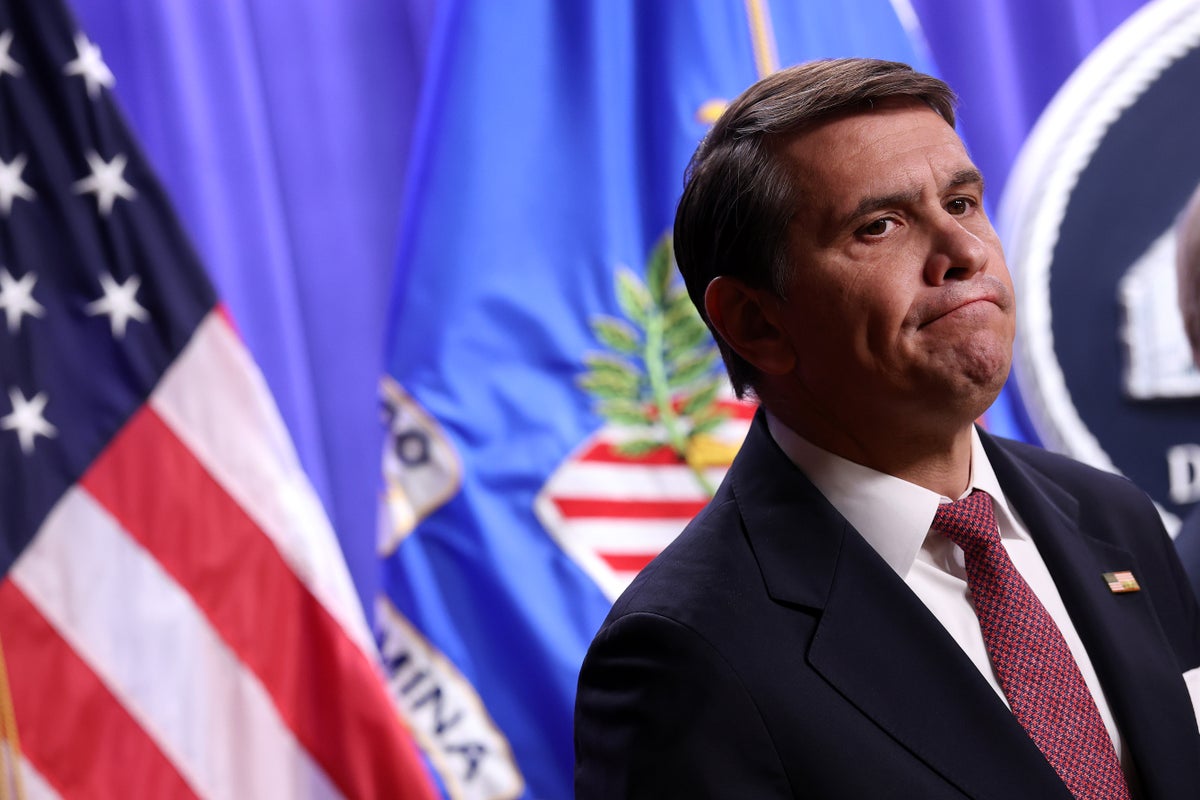
The Department of Justice under President Donald Trump has finally reached the limits of its own rhetoric. Acting Attorney General Todd Blanche admitted that he cannot promise a definitive answer as to whether the 2020 presidential election was stolen. Speaking on Sunday morning, Blanche conceded that despite what he termed a ton of evidence of a rigged election, the American public may never see criminal charges, pointing instead to the possibility of a mere written report.
This admission marks a sharp turn from the aggressive promises made by the administration since taking office. For months, top Justice Department officials insisted that ironclad proof of 2020 election fraud was on the verge of being made public. Instead, the current head of federal law enforcement is signaling a retreat into bureaucratic ambiguity.
The reversal reveals a deeper structural crisis within the Department of Justice. Blanche is discovering what veteran prosecutors have known for decades. There is a vast, unbridgeable chasm between political campaign rhetoric and the strict evidentiary standards required in a federal courtroom.
The Rhetoric Meets the Federal Rules of Evidence
Blanche blamed the lack of immediate charges on the sophistication of the alleged perpetrators. He claimed that those who rigged the 2020 vote are very good at hiding misconduct. This explanation, however, ignores the immense investigative power currently at his disposal, including the full force of the FBI and federal grand juries.
The real obstacle is not a masterclass in concealment. The obstacle is the law. To secure an indictment, a prosecutor cannot rely on statistical anomalies, internet rumors, or affidavits that have already been rejected by dozens of state and federal courts. Federal prosecutors must present concrete, admissible evidence that proves specific individuals knowingly conspired to violate federal law.
The shift from promising arrests to suggesting a report mirrors previous high-profile political investigations. When a special counsel or a Justice Department task force realizes it cannot prove a conspiracy beyond a reasonable doubt, it writes a report. This allows the department to air its findings without having to test them against a defense attorney in front of a jury. By preparing the public for a report rather than a wave of indictments, Blanche is quietly managing expectations.
The Escalating Pressure and Internal Friction
Blanche did not step into the top role at the Justice Department under normal circumstances. He took over as acting attorney general after Trump removed Pam Bondi from the position. Bondi was pushed out in part because she failed to move quickly enough on prosecutions targeting the president's political enemies.
This background explains the intense pressure Blanche faces. He knows firsthand that his tenure depends on demonstrating momentum. To satisfy the White House, he has accelerated other politically charged cases. The department recently secured a new grand jury indictment against former FBI Director James Comey and expanded a multi-year conspiracy probe into other former intelligence officials, overseen by conservative legal figure Joe DiGenova.
Yet, while Blanche has shown a willingness to pursue cases against former officials, the 2020 election probe remains a unique hazard. Promising a definitive legal victory on an issue that has been thoroughly debunked by election officials of both parties creates an impossible standard. The FBI has expanded its efforts, even questioning a senior election official in Wisconsin, but these maneuvers have yet to yield actionable criminal data.
The Fragmented Frontline
The mixed messaging from the administration suggests deep coordination issues between the Justice Department and other law enforcement arms. Just weeks before Blanche's comments, FBI Director Kash Patel claimed on the very same television network that evidence of a rigged election was readily available and that arrests would occur within days.
Those arrests never materialized.
When the head of the FBI promises immediate handcuffs and the acting attorney general walks those promises back to a potential written summary, it points to significant internal friction. Federal law enforcement operates on credibility. When high-ranking officials use media appearances to float imminent prosecutions that do not exist, it erodes the authority of the career prosecutors who have to build these cases.
The current strategy appears to be transitioning away from criminal law and toward political theater. A comprehensive report detailing alleged irregularities can be weaponized politically without ever facing judicial scrutiny. It provides a way to sustain the narrative of a stolen election for the base while avoiding the embarrassment of having a federal judge throw a weak case out of court.
The Cost of Lasting Suspicion
The long-term consequence of this strategy is the systematic erosion of public trust in democratic institutions. By insisting that a mountain of evidence exists while simultaneously stating that it may never be proven in court, the Justice Department ensures that the issue remains permanently unresolved in the minds of millions of voters.
This approach transforms the Justice Department from an agency focused on the objective administration of law into an instrument for historical revisionism. If the department releases a report full of unproven assertions without filing charges, it denies the accused the opportunity to defend themselves in a court of law. It leaves the country trapped in a cyclical debate, ensuring that the 2020 election remains an open wound in American politics.
Blanche’s acknowledgment is a rare moment of realism from an administration built on challenging institutional norms. It shows that even with total control over the federal apparatus, the presidency cannot simply command a conspiracy into existence. The facts remain stubborn, and the law, for now, remains unyielding.
Todd Blanche on Maria Bartiromo's Sunday Morning Futures
This broadcast clip provides direct insight into the confrontational and political nature of the questioning that Justice Department leadership faces regarding these ongoing investigations.