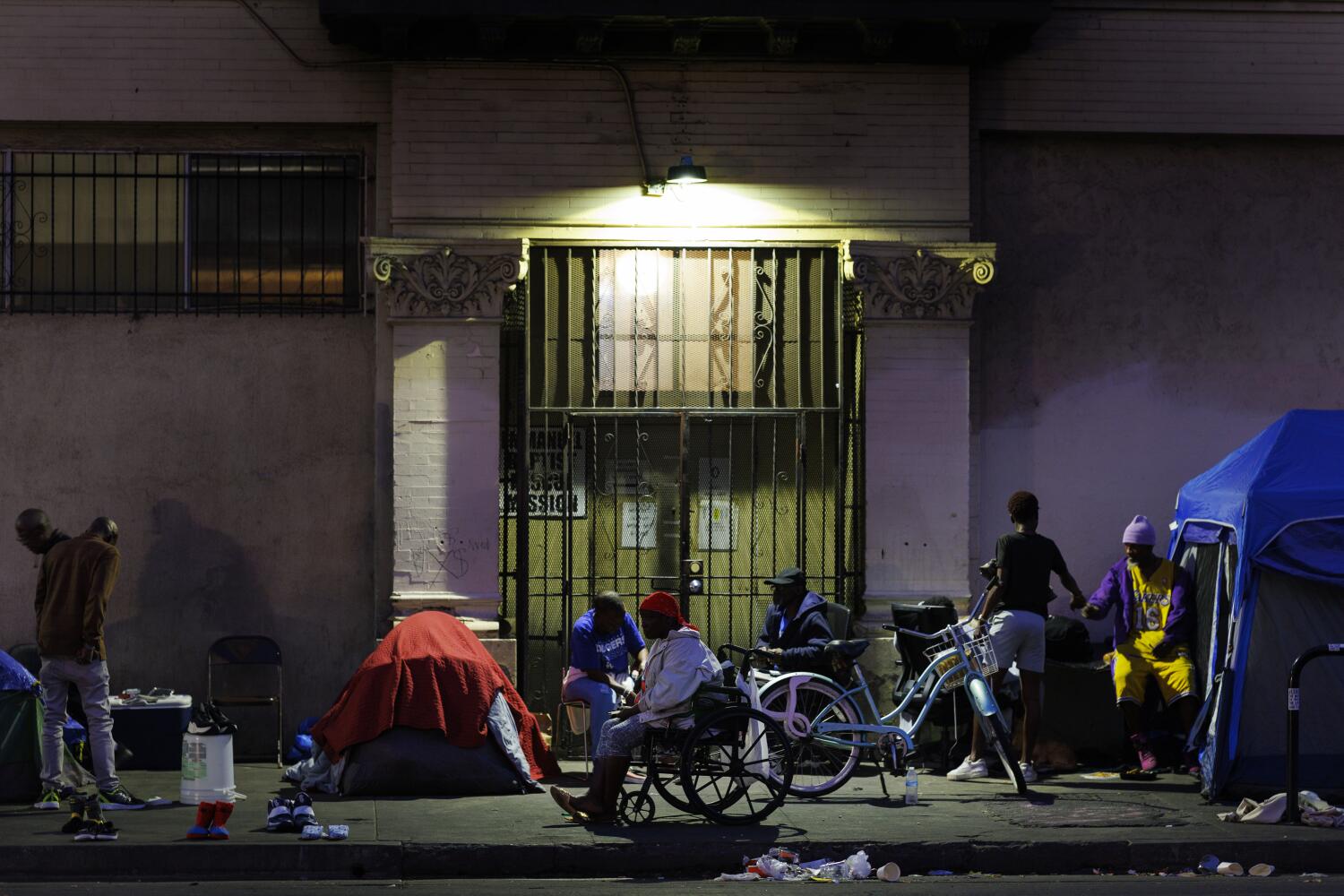
The scent of Los Angeles in August is a cocktail of baking asphalt, exhaust fumes, and, if you walk down San Pedro Street, the unmistakable tang of human desperation. It is a place where survival is calculated in hours, not years. On these sidewalks, a dollar bill isn’t pocket change. It is a lifeline.
It was against this backdrop that a highly specific transaction began quietly repeating itself.
A man steps out of a sedan. He carries a clipboard. To the casual observer, he looks like any other grassroots organizer, the kind of idealistic youth trying to save the whales or register voters before a major election. But he isn't looking for civic engagement. He is looking for hunger.
He finds a man sitting on a milk crate, eyes heavy with exhaustion.
"Hey man," the organizer says, keeping his voice low. "You registered to vote?"
The man on the crate shrugs. Voting is a luxury for people who know where they are sleeping tonight.
"Sign this, fill out the card, and I’ll give you a dollar. And a cigarette."
The deal is struck. It takes less than sixty seconds. The clipboard carrier walks away with a freshly minted voter registration card, and the man on the crate has enough change to buy a cheap bottle of water and a moment of nicotine-induced peace.
To the federal prosecutors who later filed a massive indictment, this transaction was a brazen assault on American democracy. To the people living in tents on Skid Row, it was just another Tuesday. It was just another way to stay alive.
The Machinery of the Margins
When federal authorities handed down charges against a ring of political operatives in Los Angeles, the headlines read like a political thriller. The government alleged a sophisticated conspiracy to defraud the electoral system by paying homeless individuals to register to vote, sign petitions, and complete ballot applications.
The media painted a picture of calculated corruption. But to truly understand what happened, you have to look past the courtroom podiums and look at the math of poverty.
Imagine you are living on the street. Your entire day is consumed by a grueling itinerary of survival. You wait two hours in line for a meal. You walk three miles to find a working bathroom. You guard your meager possessions with your life. Your energy is a finite resource, spent entirely on the bottom tier of Maslow’s hierarchy of needs.
Suddenly, a system designed for the middle class arrives on your doorstep. This system demands your data, your signature, and your identity.
In the abstract, a voter registration form is a sacred document. It is the fundamental building block of a self-governing society. But logic changes when you are starving. When a piece of paper can be traded for a tangible good—a dollar, a pack of smokes, a snack—the abstract value of a vote evaporates. It becomes a commodity.
The operatives who targeted Skid Row understood this perfectly. They weren't just breaking the law; they were exploiting a structural flaw in the human condition.
Consider the mechanics of the operation. The organizers didn't care about political philosophy. They didn't care if the people they signed up believed in the ballot initiatives or the candidates on the roster. They needed volume. They needed names, dates of birth, and signatures to fulfill quotas, often driven by petition-gathering companies that pay per signature.
The incentives were entirely misaligned. The companies wanted profit. The operatives wanted their cut. The unhoused residents wanted to eat.
The only entity that lost in this equation was the integrity of the ballot box itself.
The Illusion of a Voice
There is a profound irony at the heart of this scandal. For decades, voting rights advocates have fought to lower the barriers to entry for marginalized communities. They argued, correctly, that the poor, the homeless, and minorities are systematically shut out of the political process. Homeless individuals often lack the stable address required by registration forms, making them politically invisible.
The Skid Row scheme turned that advocacy on its head. It weaponized the vulnerability of the disenfranchised to create a ghost electorate.
When an operative writes down a fictitious address on a registration form—or uses the address of a local shelter without the resident's knowledge—they aren't empowering that person. They are erasing them. The individual becomes a rubber stamp for someone else’s political agenda.
It is a form of identity theft that leaves the victim physically intact but politically hollowed out.
Let us look at how this plays out in reality. A hypothetical resident we will call Marcus has lived on the streets of Downtown LA for three years. Marcus hasn't voted since 2012. He doesn't read the voter pamphlets because he has nowhere to keep them dry. One afternoon, he signs three different forms for three different people because each offered him a small incentive.
Months later, those forms wind their way through the bureaucratic machinery of the Registrar-Recorder/County Clerk's office. Marcus has no idea what initiatives he has supported or which politicians he has supposedly endorsed. He has been counted, but he has not been heard.
The tragedy is that Marcus’s real problems—the broken mental health system, the lack of affordable housing, the dangerous streets—remain completely unaddressed by the very process he was paid to participate in. His signature was bought for a dollar, but the cost to his actual agency was immeasurable.
The Broken Blueprint
When the federal indictment was unsealed, it sent shockwaves through local political circles. The charges detailed hundreds of instances of alleged fraud. Experts chimed in on cable news, debating whether this was proof of widespread voter fraud or merely an isolated pocket of opportunistic criminality.
But focusing solely on the legality misses the broader, more uncomfortable truth. The Skid Row scandal is a symptom of a deeply transactional political culture.
We live in an era where politics is treated as an industry. Campaigns are multi-billion-dollar enterprises. Petition management firms are hired to gather hundreds of thousands of signatures to get complex initiatives onto the ballot. These firms operate on strict deadlines and tight margins. They sub-contract the work to independent contractors, who in turn hire the foot soldiers who walk the streets with clipboards.
By the time the process reaches the sidewalk, the lofty ideals of democracy have been entirely stripped away. It is a sales job.
If you are paid fifty cents or a dollar per signature by a firm, your incentive is to get as many signatures as humanly possible, by any means necessary. If you find a population of people who are desperate, static, and unlikely to ask questions, you go there. You go to Skid Row.
The law is clear: it is a felony to offer money or prizes to someone in exchange for registering to vote or voting. The feds stepped in because a line was crossed, a boundary breached. Yet the system that created the incentive structure remains completely intact.
We have built a political apparatus that requires massive amounts of raw data to function, and then we express shock when the data-gatherers prey on the poorest among us to meet their targets.
The View from the Sidewalk
To view this crisis purely through a legal or partisan lens is a mistake. It is easy to sit in a comfortable room, reading a court transcript, and condemn everyone involved. It is easy to demand harsher penalties, tighter voter ID laws, or more aggressive policing of registration drives.
But step back onto San Pedro Street.
Watch the sun dip below the skyline of the financial district, casting long shadows over the rows of nylon tents. The skyscrapers house the firms that fund the campaigns. The sidewalks house the people used to validate them.
The real problem isn't just that a few operatives broke the law. The problem is the vast, yawning chasm between those two worlds.
The people who accepted a dollar for a signature weren't trying to subvert democracy. They were trying to get through the afternoon. They were operating in a reality where the long-term benefit of a healthy democratic system cannot compete with the immediate, visceral reality of an empty stomach.
As the legal cases wind their way through the justice system, the operatives will likely face prison time. The petition firms will change their names and rewrite their contracts. The politicians will continue to issue press releases praising the rule of law.
But on the sidewalks of Skid Row, nothing changes.
The tents remain. The hunger remains. And tomorrow, someone else will walk down the street with a clipboard, looking for a cheap way to buy a piece of a man's citizenship.
The man on the crate will look up. He will see the clipboard. He will look at the dollar bill in the operative's hand. He will take the pen, because in that moment, the currency of survival is the only logic that makes any sense at all.