Sam Raimi took a massive gamble in 2013. He stepped into the shadow of a 1939 titan, The Wizard of Oz, and tried to explain how a circus conman from Kansas became the ruler of a neon-colored dreamscape. Honestly, Oz the Great and Powerful is a weird movie. It’s a film that tries to be a prequel to a beloved classic while simultaneously serving as a spiritual successor to Disney's Alice in Wonderland (2010) aesthetic. It made money—nearly $500 million at the global box office—but if you ask a room full of cinephiles about it today, you’ll get a shrug or a heated debate about James Franco’s casting.
What people often forget is that this wasn't just another CGI-heavy reboot. It was an attempt to merge the DNA of L. Frank Baum’s original books with the visual expectations of a modern audience. It’s colorful. It’s loud. Sometimes, it’s genuinely scary. But does it actually work as a backstory for the man behind the curtain?
The Problem with Oscar Diggs
Oscar Diggs is a jerk. At least, he starts that way. James Franco plays him with a persistent, greasy smirk that makes you realize why the character was originally offered to Robert Downey Jr. and Johnny Depp. He’s a small-time magician with big-time delusions of grandeur. He wants to be Harry Houdini or Thomas Edison, but he’s stuck in a traveling circus, tricking locals out of their hard-earned nickels.
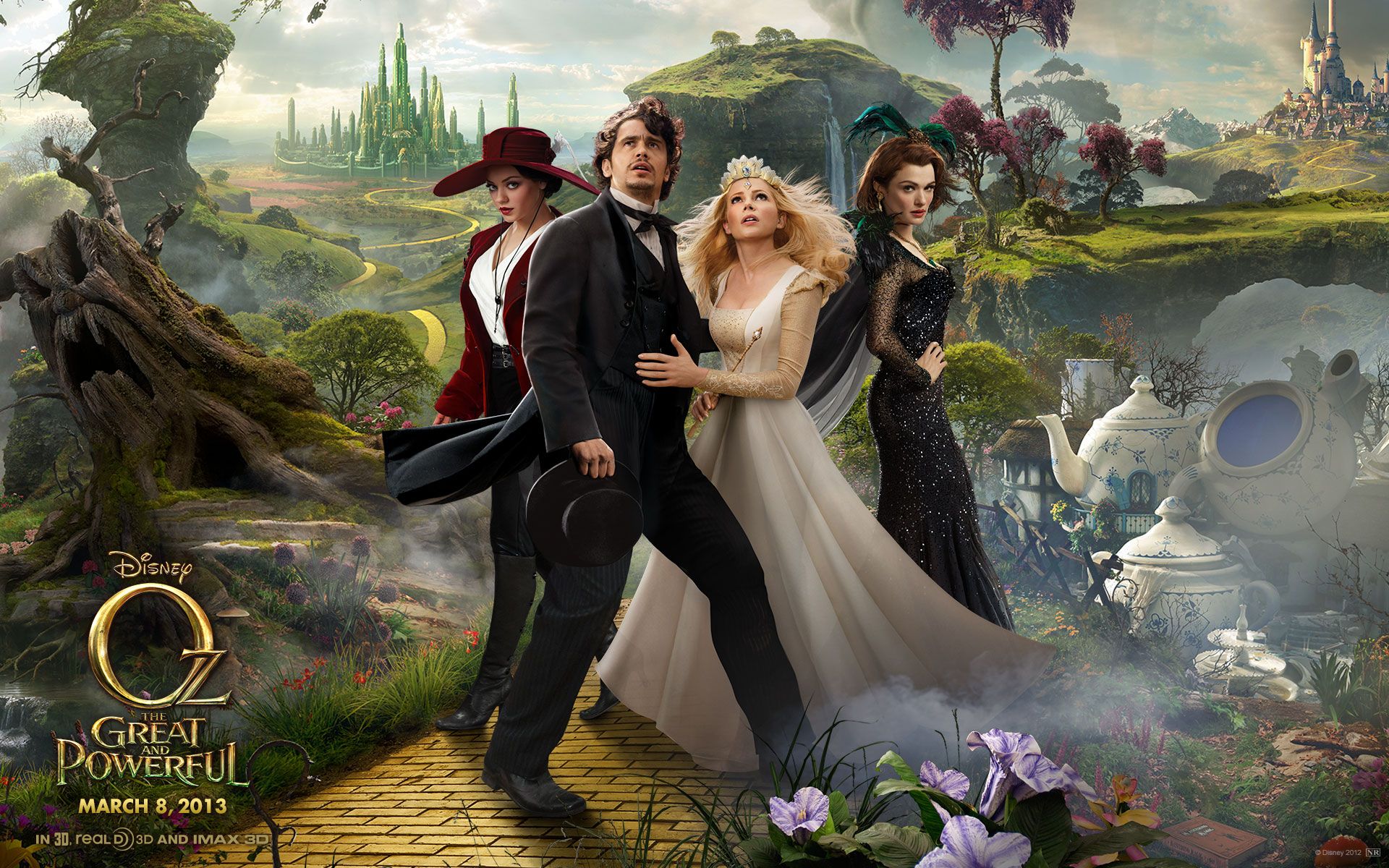
When the inevitable tornado hits, the movie shifts from a sepia-toned 4:3 aspect ratio to a sprawling, widescreen Technicolor explosion. It's a direct homage to the 1939 film, yet it feels different. The land of Oz in this version is hyper-saturated. It’s almost too much. You’ve got the Yellow Brick Road, the Emerald City, and the Dark Forest, but they feel like they were painted by a computer rather than built on a soundstage. Some fans loved this; others felt it lost the "hand-crafted" magic of the original.
The heart of the story, though, isn't the scenery. It’s the three witches: Theodora, Evanora, and Glinda. This is where Oz the Great and Powerful gets complicated. We see the origin of the Wicked Witch of the West, and it’s a tragedy born of heartbreak and a magically tainted apple. Mila Kunis takes on the iconic role, and while her transformation is visually striking, it faced heavy criticism for lacking the sheer, terrifying gravitas that Margaret Hamilton brought to the 1939 role. It’s a different vibe—more "scorned woman with fireballs" and less "ancient personification of evil."
Sam Raimi’s Horror Roots in a PG World
If you look closely, you can see Sam Raimi’s fingerprints all over this thing. Remember, this is the guy who gave us Evil Dead and Spider-Man. There are moments in Oz the Great and Powerful that feel surprisingly dark for a Disney flick. The baboons? They aren't the blue-winged monkeys of our childhood. They are terrifying, snarling beasts that look like they belong in a horror movie.
Raimi uses his signature "shaky cam" and quick zooms to create tension during the action sequences. There’s a specific scene in the graveyard that feels very much like a PG-rated version of an Army of Darkness set piece. This stylistic choice creates a fascinating friction. On one hand, you have the whimsical China Girl—a fragile, porcelain doll that Oscar literally glues back together—and on the other, you have crushing darkness and political betrayal. It's a tonal rollercoaster.
The China Girl, voiced by Joey King, is arguably the best part of the movie. She provides the emotional stakes that Oscar lacks. When he carries her through the woods, you finally see a glimmer of the "Great" man he’s supposed to become. It’s not about magic; it’s about empathy.
Why the Prequel Label is Tricky
Legally, Disney had to walk a tightrope. They owned the rights to the Baum books, which are in the public domain, but they did not own the rights to the specific visual elements of the 1939 MGM film. That’s why the Wicked Witch’s skin is a slightly different shade of green. That’s why the Ruby Slippers are nowhere to be found.
Instead, the film focuses on the "prophecy." The people of Oz are waiting for a Wizard to fall from the sky and save them from the sisters. Oscar realizes he can’t actually perform magic, so he has to use the "magic" of Kansas: technology. He uses projectors, smoke machines, and Edison-style ingenuity to defeat the witches. It’s a clever meta-commentary on filmmaking itself. The Wizard is a director, and the citizens of Oz are his audience.
The Legacy of the Emerald City
Does it hold up? Sort of. Oz the Great and Powerful serves as a fascinating time capsule of the early 2010s "blockbuster" era. It was a time when studios thought every classic story needed a massive, CGI-fueled origin story. While it doesn't replace the 1939 classic—nothing could—it adds a layer of humanity to the Wizard. We see him not as a god, but as a flawed man who eventually chooses to be good rather than just "great."
The film also paved the way for more modern interpretations of Oz, including the massive success of the Wicked stage musical and its subsequent film adaptations. It proved there was still a massive appetite for this world, even if the execution wasn't always perfect.
Key Takeaways for Fans and New Viewers
If you’re planning a rewatch or seeing it for the first time, keep these points in mind:
- Watch the transition: Pay attention to the sound design and screen ratio when Oscar leaves Kansas. It’s a technical masterpiece that honors cinema history.
- Look for the cameos: Bruce Campbell, a Sam Raimi staple, makes a hilarious appearance as a Winkie Guard.
- Appreciate the practical effects: While the backgrounds are CGI, many of the costumes and close-up props were meticulously crafted to bridge the gap between old and new.
- Don't expect a musical: Unlike the 1939 film, this isn't a song-and-dance affair. It’s an adventure-fantasy.
- Analyze the "Magic": The film’s climax is basically a love letter to early cinema technology, specifically the "magic lantern" and smoke-and-mirror illusions.
To truly appreciate the lore, you should consider reading The Wonderful Wizard of Oz by L. Frank Baum. The book version of the Wizard is much more morally ambiguous than any movie version, and seeing where Raimi pulled specific details—like the Quadling Country—makes the viewing experience much richer. You might also want to compare the visual language of this film with Disney's other live-action reimaginings, as it set the template for the decade that followed. Dive into the behind-the-scenes features if you can; the work done on the China Girl’s puppetry and digital blending is still a high-water mark for character animation.