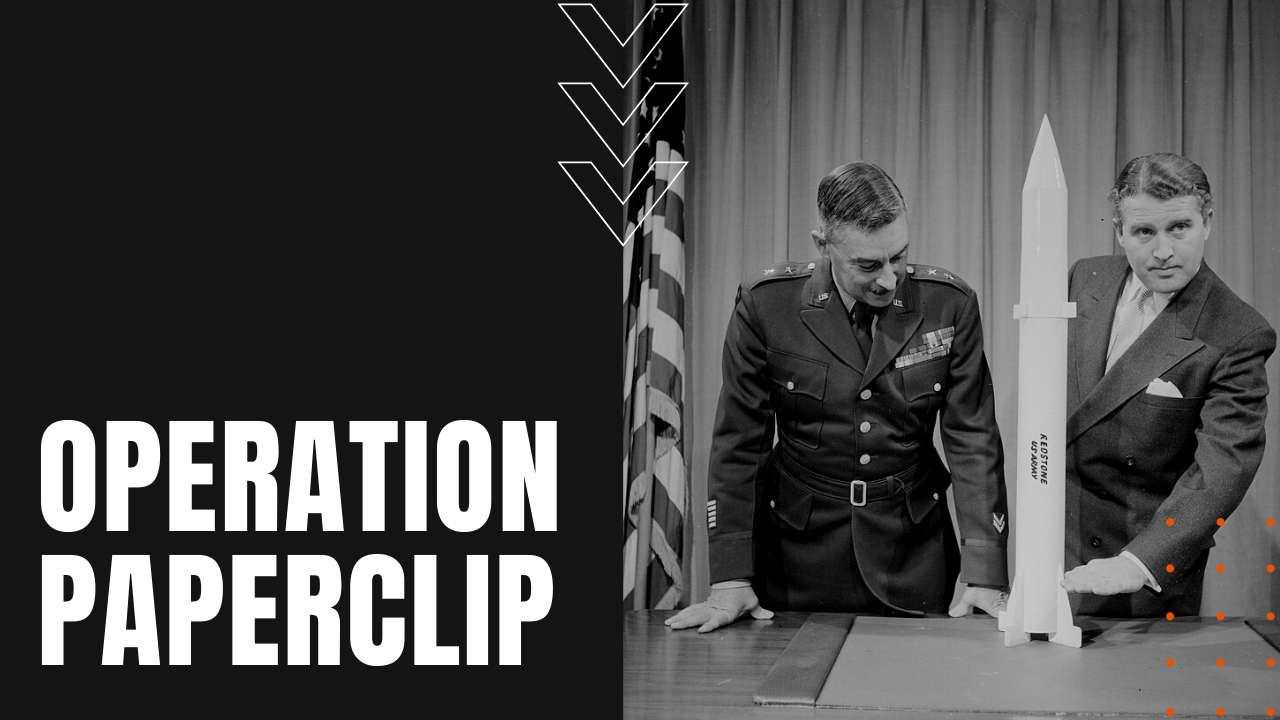
It started with a list. Basically, as World War II was grinding to a halt in 1945, the Allies realized the real prize wasn't just territory; it was brains. German engineers were years ahead of everyone else in rocketry, jet propulsion, and chemical weapons. The Americans knew that if they didn't grab these scientists, the Soviets would. So, they launched a top-secret mission that would eventually be known as Operation Paperclip.
The name is actually kind of mundane for something so controversial. US intelligence officers literally just used paperclips to attach the new, scrubbed biographies to the personnel files of Nazi scientists they wanted to recruit. It was a workaround. President Harry Truman had explicitly forbidden recruiting anyone who was a "menace to the security of the Allied powers" or an active Nazi. But the military and the CIA—then the OSS—decided that the Cold War was more important than the Nuremberg trials. They needed the tech.
Why Operation Paperclip changed everything for NASA
Think about the moon landing. You’ve seen the footage of the Saturn V rocket. Well, that rocket wouldn't exist without Wernher von Braun. He’s the most famous name associated with Operation Paperclip. Before he was an American hero, he was a Major in the SS. He was the man behind the V-2 rocket, a "vengeance weapon" that rained death on London and Antwerp.
Von Braun wasn't just some guy in a lab who happened to live in Germany. He was deeply embedded in the Nazi machine. The V-2s were built in an underground factory called Mittelwerk, where thousands of slave laborers from the Mittelbau-Dora concentration camp were worked to death. Honestly, it's a grim reality that often gets glossed over in the textbooks. When von Braun and his team surrendered to the Americans in the Bavarian Alps, they weren't just looking for safety. They were looking for a paycheck and a lab.
The US gave it to them.
By the late 1950s, von Braun was a household name in America. He worked with Walt Disney to sell the public on the idea of space travel. He became the director of NASA’s Marshall Space Flight Center. It’s wild to think that the same man who designed weapons for Hitler was the architect of the Apollo program. But that was the core trade-off of Operation Paperclip. The U.S. government decided that winning the Space Race was worth the moral cost of ignoring the past.
The scientists you haven't heard of
It wasn't just about rockets. The program brought over 1,600 German scientists, engineers, and technicians.
Take Hubertus Strughold, for example. In the U.S., he was hailed as the "father of space medicine." He did foundational work on how the human body reacts to high altitudes and weightlessness. But back in Germany? His name was linked to horrific "cold experiments" at Dachau, where prisoners were submerged in ice water to see how long they’d survive. Even though he denied direct involvement, the shadow of those war crimes followed his legacy for decades.
Then there was Kurt Debus. He was a loyal Nazi who became the first director of NASA’s Kennedy Space Center. If you go to Cape Canaveral today, his influence is everywhere. The list goes on. Arthur Rudolph, another rocket scientist, was eventually forced to leave the U.S. and renounce his citizenship in the 1980s when his role in managing slave labor at Mittelwerk became too much for the Department of Justice to ignore.
The Soviet side: Operation Osoaviakhim
People often ask if the Americans were the only ones doing this. Not even close. The Soviets were arguably even more aggressive. In a single night in October 1946, Soviet security forces rounded up more than 2,000 German specialists at gunpoint. This was called Operation Osoaviakhim.
The difference was in the treatment. While the Operation Paperclip scientists in America were eventually given high-paying jobs, nice houses in Alabama, and even citizenship, the scientists in the USSR were treated more like intellectual prisoners. They were milked for information and then mostly sent back to East Germany once the Soviets had what they needed. The American approach was "incorporation." The Soviet approach was "extraction."
This created a weird dynamic. By 1950, you had former colleagues who had worked together in Peenemünde now competing against each other from across the Iron Curtain. It was a civil war of German engineering fought for the benefit of the superpowers.
How the government hid the truth
The paperwork was the key. To get these guys past the State Department, military intelligence officers had to get creative. If a scientist had a "heavy" Nazi record, the officers would simply create a new file. They’d leave out the SS memberships. They’d omit the ties to slave labor. They’d clip a new, clean summary to the top of the folder.
Operation Paperclip was basically a massive bureaucratic laundering scheme.
Journalists like Annie Jacobsen, who wrote the definitive book on this, have uncovered how deep the deception went. The Joint Intelligence Objectives Agency (JIOA) was the group in charge. They knew exactly who these men were. They just didn't care. To them, the "Red Menace" of the Soviet Union was a much bigger threat than a few aging rocket scientists with dirty laundry.
If you look at the records now, it's clear the government was worried about public perception. They drip-fed the news to the press. They focused on the "scientific genius" and ignored the politics. It worked. For most of the 1950s and 60s, the American public saw these men as brilliant immigrants helping the US defeat communism.
The legacy of the program today
Is the modern world built on Nazi tech? Kinda.
- The Saturn V Rocket: Directly descended from V-2 tech.
- Jet Engines: German research into axial-flow turbojets influenced early US jet designs.
- Sarid Gas: Nerve agents discovered by German chemists were studied and stockpiled during the Cold War.
- Aerodynamics: The swept-wing design that almost all modern planes use was perfected by German engineers.
It’s an uncomfortable truth. Our reach into the stars and our ability to defend our borders are both tied to a program that bypassed the very justice the US claimed to be fighting for in WWII.
What we can learn from the Paperclip era
The biggest takeaway from Operation Paperclip isn't just a history lesson about rockets. It’s a case study in "ends justify the means" thinking. When a nation feels it is in an existential crisis—like the Cold War—it will often compromise its most basic values to gain a technical or military edge.
Ethically, it was a mess. But practically? It’s hard to imagine the 20th century without it. We probably wouldn't have landed on the moon in 1969. We might have lost the technological lead to the USSR much earlier.
But it came at a price. It meant that victims of the Nazi regime saw their victimizers celebrated as heroes in Huntsville, Alabama. It meant that the truth was buried under decades of classified documents.
Practical ways to research the history yourself
If you want to dig deeper into the reality of Operation Paperclip, you don't have to rely on rumors. Much of the evidence is now public.
- Check the National Archives: The NARA has a massive collection of JIOA records. You can actually look at the digitized files of some of these scientists. It’s surreal to see the "scrubbed" memos in black and white.
- Read the "Ohios": These were the reports written by the scientists themselves immediately after the war. They detail the state of German science in 1945.
- Visit Huntsville: If you go to the U.S. Space & Rocket Center, you can see the results of von Braun’s work. But while you're there, look for the smaller exhibits or local historical deep-dives that mention the Mittelbau-Dora survivors.
- Look into the DOJ’s Office of Special Investigations (OSI): This was the unit created in the 70s to finally track down Nazi war criminals in the US. Their reports on the "Paperclip" men who were eventually deported are eye-opening.
The story of Operation Paperclip is a reminder that history is rarely black and white. It’s a series of gray areas, compromises, and secrets kept in the name of progress. Understanding it doesn't mean you have to dismiss the achievements of the space age, but it does mean you have to acknowledge the dark room those rockets were built in.
Next time you see a picture of the moon, remember it wasn't just math and courage that got us there. It was a complicated, messy, and secretive deal that changed the world forever.