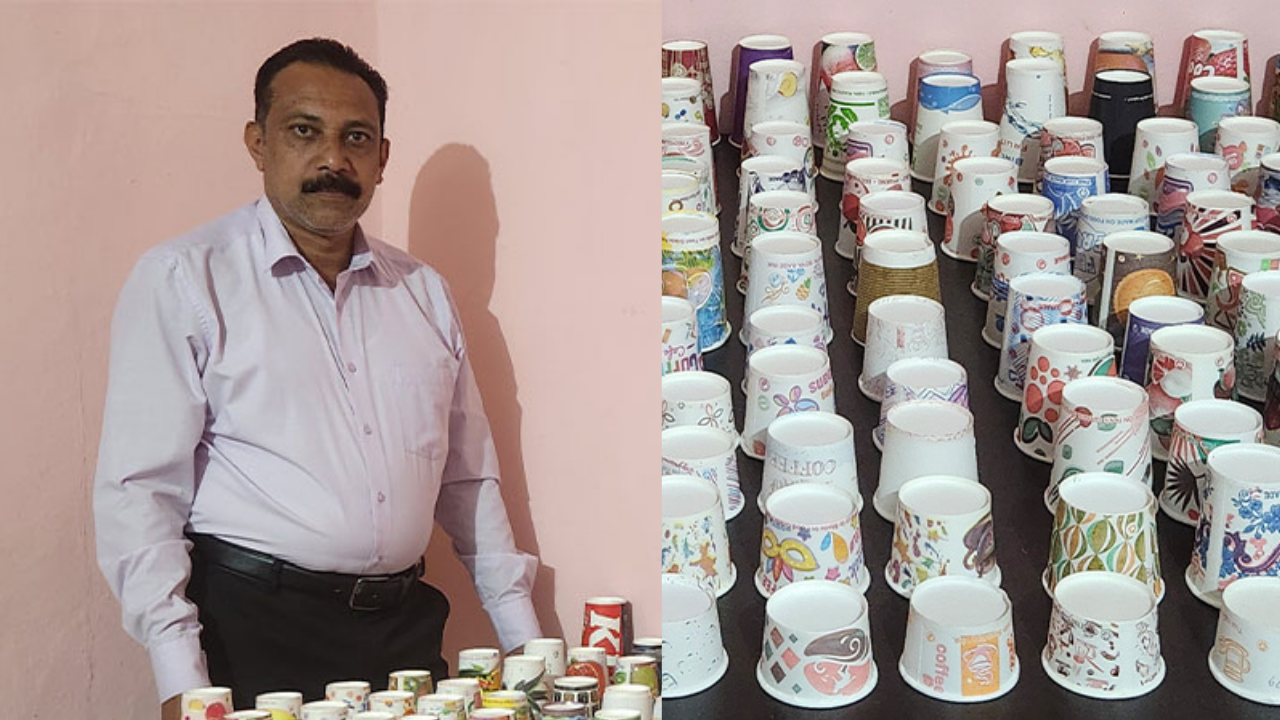
Most people look at a paper cup and see trash. They see a fleeting vessel for a morning caffeine fix, something to be drained in ten minutes and discarded without a second thought. It is the definition of the mundane.
But for Arunkumar Jutti, a paper cup is a passport. It is a physical archive of human interaction, a fragile piece of design, and, ultimately, the blueprint for a world record.
We live in an era obsessed with digital footprints. We track our lives in pixels, likes, and cloud storage. Yet, there is a distinct, grounding ache for the tangible. Jutti understood this deeply. He did not seek immortality through a viral video or a fleeting internet trend. Instead, he turned to the most ephemeral object in modern society. He began to collect.
By the time the officials from Guinness World Records finished counting, Jutti had amassed 858 unique paper cups spanning 31 different countries. It is a number that sounds abstract until you imagine the sheer physical space it occupies. Picture a room swallowed by towers of stacked paper. Each cylinder represents a different city, a different culture, a different hands-on encounter with global daily life.
This is not a story about hoarding. It is a story about the extraordinary lengths a human mind will go to find patterns, meaning, and connection in the everyday objects we ignore.
The Anatomy of an Unlikely Obsession
Every collection begins with a single spark, a moment where the ordinary suddenly shifts into the focus of a telescope. For Jutti, a resident of India, the fascination did not start with a grand grand scheme to enter the history books. It began with an eye for detail.
Consider the paper cup. To the untrained eye, they are identical. To Jutti, they are as distinct as fingerprints. There is the structural integrity of the rim, the specific thickness of the polyethylene lining that prevents the paper from turning to mush, and the graphic design choices that reflect the aesthetic DNA of an entire nation. A cup from a bustling street corner in Mumbai feels, smells, and looks entirely different from one discarded in a sleek, minimalist café in Tokyo or a transit hub in London.
He began saving them. Then, he began asking others to save them.
The logistics of accumulating hundreds of pristine paper cups from 31 countries without them crushing, staining, or molding is a masterclass in obsessive preservation. Imagine the conversations. Jutti instructing friends, family, and acquaintances traveling abroad not to bring back souvenirs, magnets, or postcards, but to carry empty, used coffee cups across international borders. Picture the confusion at airport customs checkpoints as a traveler opens a suitcase to reveal rows of carefully nested paper cylinders.
This is where the narrative shifts from a quirky hobby to a monumental logistical challenge. To qualify for a Guinness World Record, a collection cannot just be a pile of items. Every single piece must be meticulously documented, cataloged, and verified to prove its unique origin and lack of duplication. One mistake, one duplicate cup, and the entire endeavor collapses under the weight of its own rules.
The Global Mosaic
The true magic of Jutti’s achievement lies in the geography of his collection. The 858 cups form a global mosaic, a cross-section of how the world drinks, wakes up, and moves through the day.
Think about the sheer diversity contained within those 31 countries. There are cups that held thick, sweet cardamom chai from roadside stalls in India, standing alongside cups that once contained bitter espressos from European train stations. There are corporate giants represented, sure, but the heart of the collection beats in the obscure, independent logos of small-town businesses thousands of miles apart.
There is a strange vulnerability in looking at a collection like this. It forces a realization about our shared human habits. No matter how fractured the world feels, regardless of political borders, language barriers, or cultural divides, humanity runs on the same basic rituals. We gather. We drink warm liquids. We talk. And we use these humble paper vessels to do it.
Jutti became the curator of these silent witnesses to human connection. The invisible stakes of his journey were rooted in this preservation. In a world that throws everything away, he chose to keep the very thing designed to be forgotten.
The Rigor of the Count
To understand the scale of what happened when the record was officially verified, you have to look at the strict parameters set by the adjudicators. The process is grueling. It requires witness statements, continuous video evidence, and an expert eye to ensure every item meets the stringent criteria of being commercially available and uniquely identifiable.
It is a tense, quiet drama.
The cups are laid out in endless rows, transforming a room into a grid of paper and cardboard. Each cup is inspected. The country of origin is checked. The design is cross-referenced. For hours, the tension hangs thick in the air. For Jutti, this was the culmination of years of quiet gathering, a public reckoning of an internal passion.
When the final count was confirmed at 858, it was not just a victory for Jutti; it was a validation of the idea that anything, no matter how small, can become monumental if you give it enough devotion.
We often look at world records involving massive feats of physical strength or astronomical wealth with a sense of detachment. We admire them, but we cannot relate to them. Jutti’s record is different. It is profoundly human because it is built from the fabric of our everyday lives. It suggests that greatness does not always require changing the world; sometimes, it just requires looking closer at the world we already have.
The stacks of paper cups stand as a monument to patience. They are a tangible reminder that history is not just written in textbooks or carved into stone monuments. Sometimes, it is printed on the side of a disposable cup, waiting for someone with enough vision to catch it before it hits the bin.