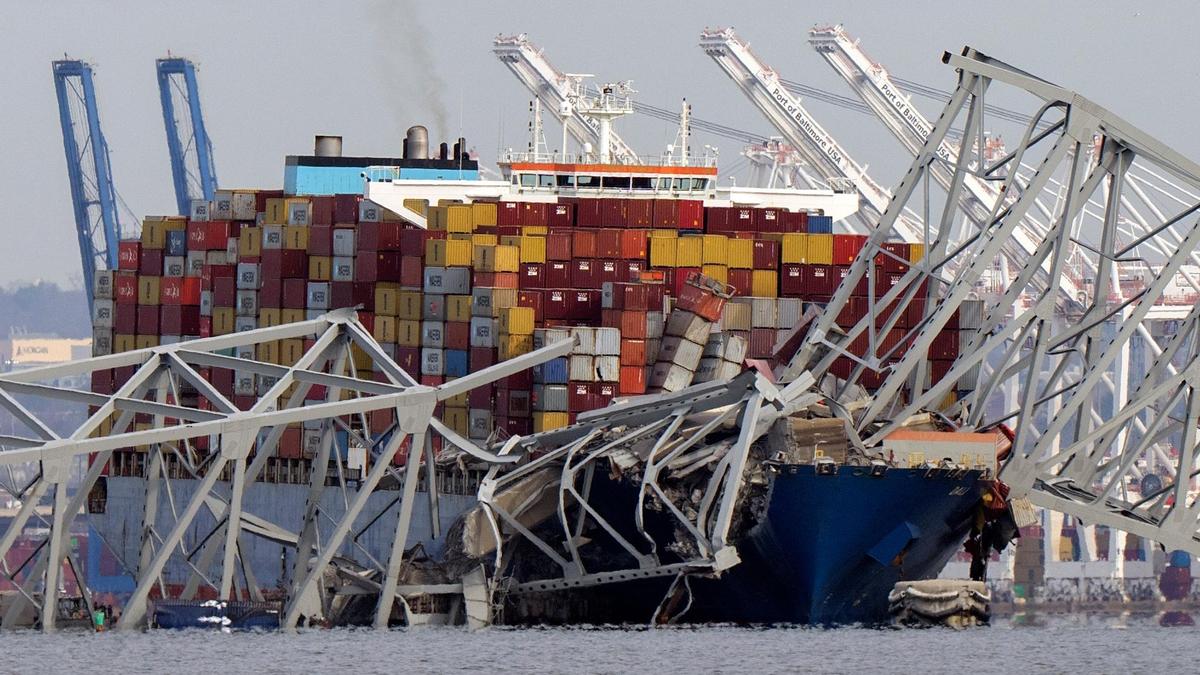
The air over the Patapsco River on March 26, 2024, was crisp, the kind of biting cold that keeps a person sharp. On the bridge of the Dali, a massive container ship nearly a thousand feet long, the rhythm of departure should have been routine. It was a mechanical ballet. Tugboats nudged. Commands were echoed. The massive steel hull, laden with thousands of tons of cargo destined for Sri Lanka, began its slow, deliberate march toward the open sea.
Then, the heart of the ship stopped beating.
To understand the weight of the criminal charges recently filed by the United States government, you have to first understand the silence of a dead ship. When the power fails on a vessel of that magnitude, it isn't just a flicker of lights. It is a total sensory betrayal. The hum of the engine—a vibration felt in the soles of your feet—vanishes. The steering becomes a suggestion rather than a command. In the pitch black of a Baltimore night, 95,000 tons of steel became a drifting island, aimless and unstoppable.
The collision with the Francis Scott Key Bridge wasn't just a maritime accident. It was a structural scream that echoed across the global supply chain. Six men, members of a road crew working in the dark to repair the pavement we all take for granted, vanished into the frigid water.
The Calculus of Negligence
Justice often moves with the same agonizing slowness as a cargo ship, but when it arrives, it carries the same crushing force. The U.S. Department of Justice didn't just see a tragic accident; they saw a paper trail of warnings ignored. The criminal cases now being leveled against Grace Ocean Private Ltd., Synergy Marine Pte Ltd., and a specific Indian national aren't about bad luck. They are about the choices made in the months, days, and minutes leading up to the impact.
Consider the hypothetical life of a marine engineer. Let's call him Rajesh. In the quiet hours of a transoceanic voyage, Rajesh notices a glitch. A breaker trips. A generator coughs. He reports it to his superiors in Singapore or Chennai. He tells them the electrical system is temperamental, that the "heart" of the Dali is skipping beats.
In a world governed by profit margins and tight delivery windows, the response to Rajesh is often a shrug. "Keep it moving," the emails might imply. "We'll fix it at the next port."
The federal indictment suggests this wasn't a hypothetical. It alleges a culture of cost-cutting and mechanical duct-tape. The prosecution's case rests on a chilling premise: the owners and operators knew the Dali was a "dead ship walking" long before it ever touched a pylon of the Key Bridge. They are accused of operating a vessel that was unseaworthy by design and by neglect.
The Invisible Stakes of the Supply Chain
We live in a world of instant gratification. We click a button, and a box arrives. We rarely think about the massive, rusting juggernauts that make this possible. The Dali was a link in that invisible chain. When it struck the bridge, it didn't just break steel; it broke the flow of life for an entire region.
The Port of Baltimore is a lung. It breathes in cars, farm equipment, and coal; it breathes out the commerce that sustains thousands of families. When the bridge fell, the lung collapsed. The "invisible stakes" here aren't just the billions of dollars in lost trade. They are the mortgage payments of the longshoremen who suddenly had no ships to unload. They are the small business owners in Dundalk whose delivery routes were suddenly severed by miles of detour.
The legal system is now attempting to put a price on that chaos. The U.S. is seeking over $100 million in damages. But how do you quantify the terror of the pilots on that bridge, realizing they had no power and no way to stop the inevitable? How do you quantify the grief of families in Mexico, Guatemala, Honduras, and El Salvador, waiting for phone calls from fathers and brothers who would never come home from their shift on the asphalt?
The Mechanics of Accountability
The criminal charges against the Indian national—a high-ranking member of the crew—and the firms in Singapore and Chennai represent a pivot in how the world views corporate responsibility. For too long, the maritime industry has operated in a gray zone of "flags of convenience" and shell companies. If a ship causes a disaster, the owners often try to limit their liability to the value of the vessel itself—a legal maneuver that dates back to the 19th century.
But the 21st century is losing its patience with 19th-century loopholes.
The Department of Justice is signaling that "I didn't know" is no longer a valid defense when the "not knowing" is a result of intentional blindness. The case alleges that the ship’s electrical system had been plagued by issues for months. The crew had supposedly "rigged" the system to keep it running, bypassing safety protocols that would have flagged the ship as unsafe to sail.
Imagine driving a car where the brakes only work 70% of the time, and instead of fixing them, you just learn to pump the pedal harder. Now imagine that car weighs 100,000 tons and is headed toward a crowded highway. That is the level of negligence the U.S. is putting on trial.
The Human Core
Behind the technical jargon of "unseaworthiness" and "voltage irregularities" are human faces. There is the face of the prosecutor, tasked with proving that a corporation thousands of miles away is responsible for the death of a construction worker in Maryland. There is the face of the Indian engineer, caught between his duty to the sea and his orders from a boardroom.
And then there are the workers.
They were high above the water, working under the orange glow of construction lights, probably talking about their kids or the soccer scores. They had no reason to look up. They had no reason to fear the river. The bridge was a permanent fixture of the horizon, as solid as the earth itself.
The tragedy of the Dali is that it was preventable. It wasn't a "rogue wave" or an "act of God." It was a failure of systems—both mechanical and moral.
The legal battle ahead will be long. The firms in Singapore and Chennai have deep pockets and elite legal teams. They will argue that the power failure was an isolated incident, a freak occurrence that no one could have predicted. They will point to the heroism of the pilots who managed to get a Mayday call out, allowing police to stop traffic on the bridge and likely saving dozens of lives.
But the government's stance is unwavering: Heroism in the final seconds does not excuse negligence in the preceding months.
The Weight of the Verdict
We are entering an era where the "human element" is being forced back into the boardroom. The Dali crash is a wake-up call for an industry that has grown accustomed to operating in the shadows of the high seas. It serves as a reminder that every shipping container, every gallon of fuel, and every point of profit is tethered to the safety of the people who interact with these metal giants.
The ripples from the Patapsco River have reached the halls of power in Washington, Singapore, and New Delhi. This isn't just about a bridge. It’s about the standard we set for the machines we build and the companies we allow to run them.
As the sun sets over the broken span of the Key Bridge, the silhouette of the twisted steel serves as a grave marker for an old way of doing business. The lights went dark on the Dali that night, but the legal firestorm that followed is just beginning to cast a very bright, very uncomfortable light on the cost of cutting corners.
The water of the Patapsco is deep, cold, and unforgiving. It doesn't care about quarterly earnings or maritime loopholes. It only knows the weight of what falls into it. Now, the companies responsible are finding out just how heavy that weight can be.