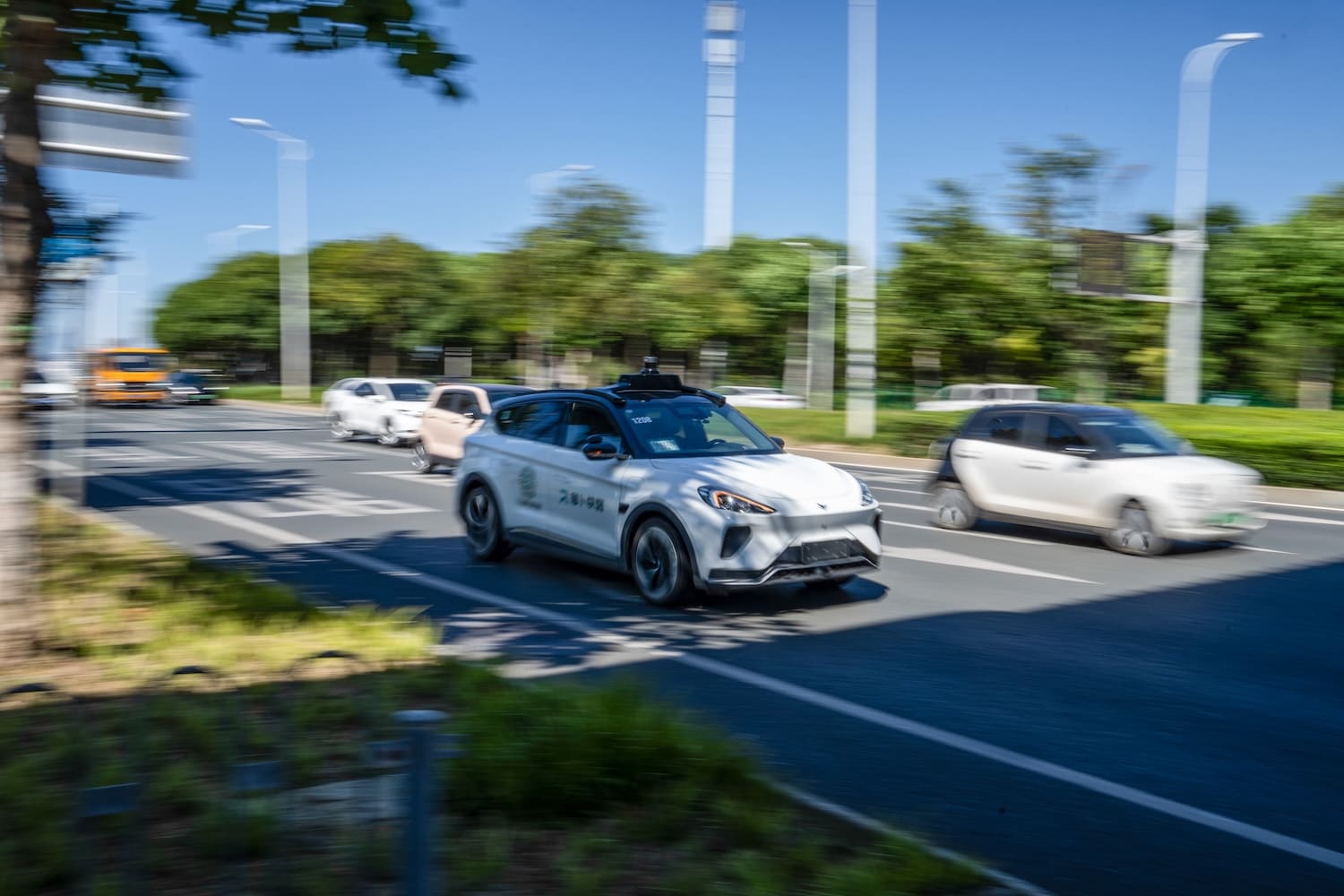
The intersection of Qingchuan Avenue and Riverside Road in Wuhan usually hums with the predictable, rhythmic chaos of a megacity. But on a humid Tuesday evening, the rhythm broke. It wasn’t a crash. There was no screeching of tires or the violent crunch of metal. Instead, there was a silence so profound it felt heavy.
One by one, the white-and-green Apollo Go cars—the pride of Baidu’s autonomous fleet—simply stopped.
They didn't pull to the curb. They didn't signal. They froze exactly where they were, like pieces on a chessboard abandoned mid-game. Within minutes, over a hundred robotaxis had turned into high-tech boulders, obstructing intersections and paralyzing the arteries of the city. Commuters leaned on their horns, the sound bouncing off the silent sensors of vehicles that had no ears to hear them and no drivers to scream back.
This wasn't just a traffic jam. It was a glitch in the vision of the future.
The Invisible Tether
We have been sold a dream of autonomy that looks like total independence. We imagine these cars as sovereign intelligences, navigating the world with the cool detachment of a digital god. But the Wuhan outage pulled back the curtain on a messy reality: these machines are tethered to a digital umbilical cord.
When the mass outage hit Baidu’s cloud servers, those cords snapped.
Imagine a hypothetical passenger named Chen. He is sitting in the back of a robotaxi, checking his phone, enjoying the novelty of a ride that costs less than a cup of coffee thanks to heavy subsidies. Suddenly, the steering wheel—which had been dancing with ghostly precision—twitches and locks. The screen in front of him blurs. The car is no longer a miracle of engineering; it is a two-ton locked box sitting in the middle of a four-lane highway.
Chen looks around and sees three other identical cars stalled in the same intersection. It is a synchronized failure. The "brain" isn't in the car. The brain is miles away in a data center, and that brain just had a stroke.
The local government’s response was swift and chilling for the tech industry. China’s transport regulators moved to halt the issuance of new robotaxi licenses for Baidu. The message was clear: progress is a virtue, but public order is a requirement.
The Mathematics of Friction
To understand why a hundred stalled cars caused a national regulatory freeze, you have to look at the friction between old worlds and new ones. Wuhan has become the global laboratory for autonomous driving. With over 500 robotaxis already roaming its streets, it is the most dense testing ground on Earth.
But this density creates a fragile ecosystem.
When a human driver’s car breaks down, they put on their hazards, steer to the shoulder if possible, and exit the vehicle. They are a sentient agent capable of problem-solving. When a robotaxi suffers a "mass disconnection event," it reverts to its most basic safety protocol: Stop.
In a vacuum, stopping is safe. In a living city, stopping is a weapon.
The Wuhan outage turned these vehicles into physical blockades. Emergency vehicles couldn't pass. People were trapped in the heat. The invisible infrastructure that manages the flow of a city—the unspoken agreement that we all keep moving—was violated by a server error.
Beijing is watching this closely. The central government has a dual mandate: lead the world in AI and ensure social stability. These two goals are currently crashing into each other. If a minor cloud glitch can paralyze a district in Wuhan, what happens when a fleet of 10,000 cars is targeted by a cyberattack? What happens when a software update goes sideways during rush hour in Shanghai?
The Human Cost of Cheap Rides
There is a deeper, more visceral anger simmering beneath the technical reports. It belongs to the taxi drivers.
For months, Wuhan’s traditional cab drivers have watched their livelihoods erode. Baidu’s Apollo Go is staggeringly cheap, sometimes charging as little as 4 yuan (about 55 cents) for a multi-kilometer trip. The human drivers call them "radish cars"—a play on the brand name—and they see them as an invasive species.
When the cars stalled, the videos went viral on Weibo and Douyin not just because of the spectacle, but because of the vindication. For the traditional driver, the outage was proof that the "perfect" replacement was a fraud.
"They don't have a soul," one driver remarked in a social media video, filming a line of stalled Baidu cars. "And when the soul of the network dies, they are just junk."
This isn't just luddite grumbling. It is a legitimate question about the resilience of our systems. We are replacing a decentralized network of human intelligence (drivers) with a centralized network of digital intelligence. Centralization is efficient until it is a single point of failure.
The Regulatory Cold Shower
The decision to halt new licenses is a massive blow to Baidu’s momentum. Before the outage, the company was eyeing a rapid expansion to other Tier-1 cities. They were aiming for a "break-even" point where the lack of a human driver finally made the economics work.
Now, the goalposts have shifted.
Regulators are no longer just looking at crash data or "disengagement" rates (how often a human has to take over). They are looking at systemic reliability. They are demanding to know what happens when the cloud goes dark.
The industry is now forced to grapple with a paradox. To make robotaxis safer, we want them to be able to talk to each other and a central hub. But the more they talk, the more vulnerable they are to a collective collapse.
Engineers are now scrambling to implement "edge autonomy"—giving the car enough onboard processing power to navigate to a safe spot even when the mother ship is silent. But that costs money. It adds weight. It complicates the very simplicity that made the robotaxi business model look so attractive to investors.
The Silence in the Streets
The cars in Wuhan were eventually towed or manually rebooted. The traffic began to flow again. The social media posts were scrubbed or buried under newer trends.
But the air has changed.
The residents of Wuhan—and indeed, observers across the globe—have seen the "ghost" in the machine. We have seen that the future isn't a smooth, inevitable slide into automation. It is a jagged, risky climb.
We are currently in a liminal space. We are too far invested to turn back to a world of purely human-driven transit, but we are too aware of the risks to surrender the keys entirely. The halt on licenses is a necessary pause, a moment for a breathless industry to realize that "moving fast and breaking things" is an unacceptable mantra when the "things" being broken are the streets of a major city.
As night fell over the Yangtze River, the remaining Apollo Go cars continued their silent patrols. They looked the same as they did the day before. But as they glided through the neon-lit intersections, the people on the sidewalks didn't just see a marvel of technology anymore.
They saw a potential statue.
The promise of the autonomous age was that we would finally be free from the errors of human judgment. We forgot that by removing the human, we didn't remove the error. We just moved it to a server rack in a room we can't see, waiting for the next time the signal drops to zero.
The city moves on, but it moves with a new, lingering doubt. Every time a white-and-green car approaches an intersection, there is a split second where the breath catches. Will it turn? Will it go? Or will it simply sit there, a silent monument to a disconnected god?