The asphalt behind the municipal library usually smells of damp oil and exhaust. It is a gray space, a transition zone where people hurry from their cars to the checkout desk, eyes glued to the pavement or the blue glow of a smartphone. But last Tuesday, that mundane stretch of ground hosted something that defied the gravity of our daily routines.
A massive, silver dome sat huddled between the streetlights. It looked like a fallen moon or a secret government experiment. It was a mobile planetarium—a high-tech, inflatable sanctuary designed to bring the cosmos into the heart of a city that had long ago traded the Milky Way for the orange hum of sodium-vapor lamps.
We have forgotten what it means to look up.
Most city dwellers live under a perpetual "skyglow." This isn't a poetic term; it is the scientific reality of light pollution. Our streetlights, billboards, and office windows blast photons upward, scattering them off the atmosphere and creating a thick, hazy veil. For the average person living in a metropolitan area, the visible stars are numbered in the dozens rather than the thousands. We are the first generations of humans to be orphaned from our own galaxy.
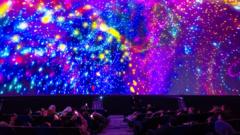
Inside the dome, the air was cool and smelled faintly of nylon. A group of local school kids sat cross-legged on the floor, their sneakers scuffing against the heavy-duty matting. There was a nervous energy in the dark, the kind of hushed anticipation usually reserved for a movie premiere. Then, the digital projector whirred to life.
The ceiling vanished.
Suddenly, we weren't in a parking lot in a mid-sized city. We were suspended in the void. A high-resolution simulation of the night sky, stripped of every streetlamp and porch light, bloomed above us. The kids didn't just look; they gasped. It was a visceral, physical reaction to a sight that their ancestors would have considered a nightly birthright.
The Science of Awe
The mobile planetarium uses a sophisticated digital projection system capable of rendering millions of celestial objects in real-time. It isn't just a static movie. The operator can fly the audience through the rings of Saturn or zoom out until the Milky Way is just a smudge of light among billions of other galaxies.
But the technology is secondary to the psychology. Researchers have spent years studying a phenomenon known as "Awe." When we encounter something vast and beyond our immediate understanding, our brains undergo a shift. Our sense of self shrinks. Our petty anxieties—the missed email, the looming credit card bill, the neighbor's barking dog—recede into the background. We become more prosocial, more generous, and more connected to the people around us.
Consider a hypothetical student named Marcus. Marcus struggles with algebra. He feels like the world is small, cramped, and stacked against him. When Marcus enters that dome and sees the scale of a red supergiant star compared to our tiny, marble-like Earth, something breaks open. The math isn't just numbers on a page anymore; it’s the language that describes the dance of the planets. The stakes of his life haven't changed, but his perspective has. He is no longer just a kid in a parking lot; he is a witness to the universe.
The "pop-up" nature of this experience is its greatest strength. Traditional observatories are often built on distant mountaintops, far from the reach of families without reliable transportation or the luxury of a weekend road trip. By bringing the stars to the city, we democratize wonder. We bridge the gap between the ivory tower of academia and the concrete reality of the sidewalk.
The Invisible Stakes of Darkness
We often talk about light pollution as a nuisance for astronomers, but the cost is far more intimate. Our circadian rhythms—the internal clocks that regulate sleep, mood, and hormone production—are hardwired to the cycle of day and night. When we wash out the darkness, we disrupt our biology.
Ecologically, the damage is even more profound. Migrating birds navigate by the stars. Sea turtle hatchlings use the shimmer of the moon on the waves to find the ocean. Insects are drawn to the false suns of our porch lights, dying by the millions and destabilizing the food chains we rely on. By reclaiming the night sky, even for an hour inside an inflatable dome, we start a conversation about what we are willing to sacrifice for the sake of convenience.
The planetarium program isn't just about identifying Orion’s Belt or pointing out the North Star. It’s a quiet rebellion against the frantic pace of modern life. It forces a stillness. You cannot rush the movement of the planets. You cannot "optimize" a nebula.
The projector shifted, taking us to the edge of a black hole. The visuals were stunning—a warping of light and time that felt like a fever dream. A young girl near the front raised her hand, her silhouette sharp against the glowing event horizon.
"Is it scary?" she whispered.
The educator leading the session paused. "It’s big," he said. "And it’s strange. But we know it’s there because we dared to look. Being brave enough to look at the dark is how we find the light."
The Return to the Pavement
When the session ended and the fans hummed as we filed back out into the night, the transition was jarring. The harsh glare of the library’s security lights felt violent. The stars we had just seen were gone, swallowed again by the amber haze of the city.
But the mood in the parking lot had shifted. People weren't looking at their phones. They were standing by their car doors, heads tilted back, squinting at the spaces between the clouds. They were looking for the things they now knew were hidden just behind the veil.
We often think of progress as an upward trajectory of more light, more speed, and more connection. But sometimes, progress looks like turning the lights off. It looks like an inflatable tent in a mundane location, reminding us that we are part of something ancient and silent.
The stars are still there. They are patient. They are waiting for us to remember how to see them. As the crowd dispersed, a small boy pointed toward a faint, flickering point of light just above the horizon. It might have been a planet, or it might have been an airplane. It didn't really matter. He was looking up, and for a moment, the parking lot was the center of the universe.
The silver dome began to deflate, sighing as it folded back down toward the asphalt, its mission accomplished for the night. The cosmos had visited the city, and the city would never look quite the same again.